InsideTracker bloedonderzoek kopen - 35 bloedwaarden
Een bloedonderzoek met 35 biomarkers voor prestatie en vitaliteit, geïnspireerd op InsideTracker Ultimate — hart, hormonen, stofwisseling, ontsteking, herstel en ijzerstatus.
Voeg toe aan je stack
Geen verwijzing nodig
Toegevoegd aan je stack
Klik op de knop om je mandje te bekijken
Biomarkers inbegrepen
39 markersSHBG (Geslachtshormoonbindend Globuline), TSH (Schildklierstimulerend Hormoon), ALAT (Alanine-aminotransferase), LDL Cholesterol, Gamma-GT, Cortisol, DHEA-S, Oestradiol (E2), Vrij Testosteron, Testosteron Totaal, Foliumzuur, Vitamine B12, Calcium, Ferritine, IJzer, Magnesium, Kalium, Progesteron, Natrium, Transferrine, CRP (C-Reactief Proteïne), Glucose (Nuchter), HbA1c (Geglycosyleerd Hemoglobine), Apo(B) (Apolipoproteïne B), HDL Cholesterol, Cholesterol Totaal, Albumine, ASAT (Aspartaat-aminotransferase), Vitamine D (25-OH), Insuline (Nuchter), Leukocyten Differentiatie, Creatine Kinase (CK), Transferrine Saturatie, Triglyceriden, Klein Bloedbeeld, HOMA-IR, Cholesterol/HDL-ratio, Non-HDL-cholesterol, LDL/HDL-ratio
Het InsideTracker bloedonderzoek is een brede biomarker analyse van 35 bloedwaarden in één meting, van je hormonen en stofwisseling tot je ijzerstatus, lever, mineralen en vitamines. Je koopt hier precies dat panel, afgenomen bij een gecertificeerd Nederlands lab.
Je trainingsdata laat je inspanning en herstel zien, maar deze bloedwaarden analyse kijkt in je lichaam. Zo werk je met objectieve cijfers in plaats van een onderbuikgevoel.
Waarom deze test?
InsideTracker is bekend als platform voor biomarker analyse. Zoek je op InsideTracker Nederland, dan wil je die 35 bloedwaarden meestal laten meten zonder je bloed naar de Verenigde Staten te sturen.
Dit bloedonderzoek is dat InsideTracker alternatief: hetzelfde panel van 35 waarden, afgenomen bij een gecertificeerd Nederlands lab en digitaal terug in je account. Voor sporters brengt de meting je hormonen, je stofwisseling, je ijzerstatus en je herstelwaarden samen in één overzicht.
Zo werk je met data in plaats van aannames, en dat past bij een aanpak waarbij je je lichaam wilt begrijpen en optimaliseren.
Voor wie is deze test?
Dit InsideTracker bloedonderzoek kan passen bij sporters en actieve mensen die een brede basismeting willen. Het kan relevant zijn voor:
- Sporters die hun trainingsdata willen combineren met objectieve bloedwaarden
- Mensen die een InsideTracker alternatief in Nederland zoeken zonder verzending naar het buitenland
- Mensen die inzicht willen in hun ijzerstatus en herstelwaarden
- Mensen die naar meerdere systemen tegelijk willen kijken, van hormonen tot stofwisseling
- Mensen die liever één biomarker analyse doen dan meerdere losse panels
Wat wordt er getest?
Deze biomarker analyse meet 35 bloedwaarden, gegroepeerd per gebied:
- Hormonen: Testosteron, Vrij Testosteron, SHBG, Oestradiol, Progesteron, DHEA-S en Cortisol.
- Stofwisseling: Nuchtere Glucose, Nuchtere Insuline en HbA1c.
- Hart en vaten: Cholesterol Totaal, HDL, LDL, Triglyceriden en ApoB.
- IJzer en mineralen: Ferritine, IJzer, Transferrine, Transferrine Saturatie, Magnesium, Calcium, Natrium en Kalium.
- Lever: ALAT, ASAT, Gamma-GT en Albumine.
- Herstel en ontsteking: CRP en Creatine Kinase (CK).
- Schildklier, vitamines en bloedbeeld: TSH, Vitamine D, Vitamine B12, Foliumzuur en een volledig bloedbeeld met differentiatie.
Wat kan deze test je vertellen?
De uitslag kan je laten zien hoe je waarden in deze gebieden zich verhouden tot de referentiewaarden. Omdat de biomarker analyse veel systemen dekt, kun je zien hoe je hormonen, je ijzerstatus en je herstelwaarden zich tot elkaar verhouden.
Voor sporters kunnen waarden zoals je ferritine, je creatine kinase en je CRP interessant zijn om rond zware training te volgen. Wil je nog breder kijken, dan meet ons Whoop bloedonderzoek 43 bloedwaarden in plaats van 35. Onthoud dat een enkele waarde nog geen diagnose is: je uitslag krijgt pas betekenis in combinatie met je situatie en je voorgeschiedenis.
Hoe wordt het materiaal verkregen?
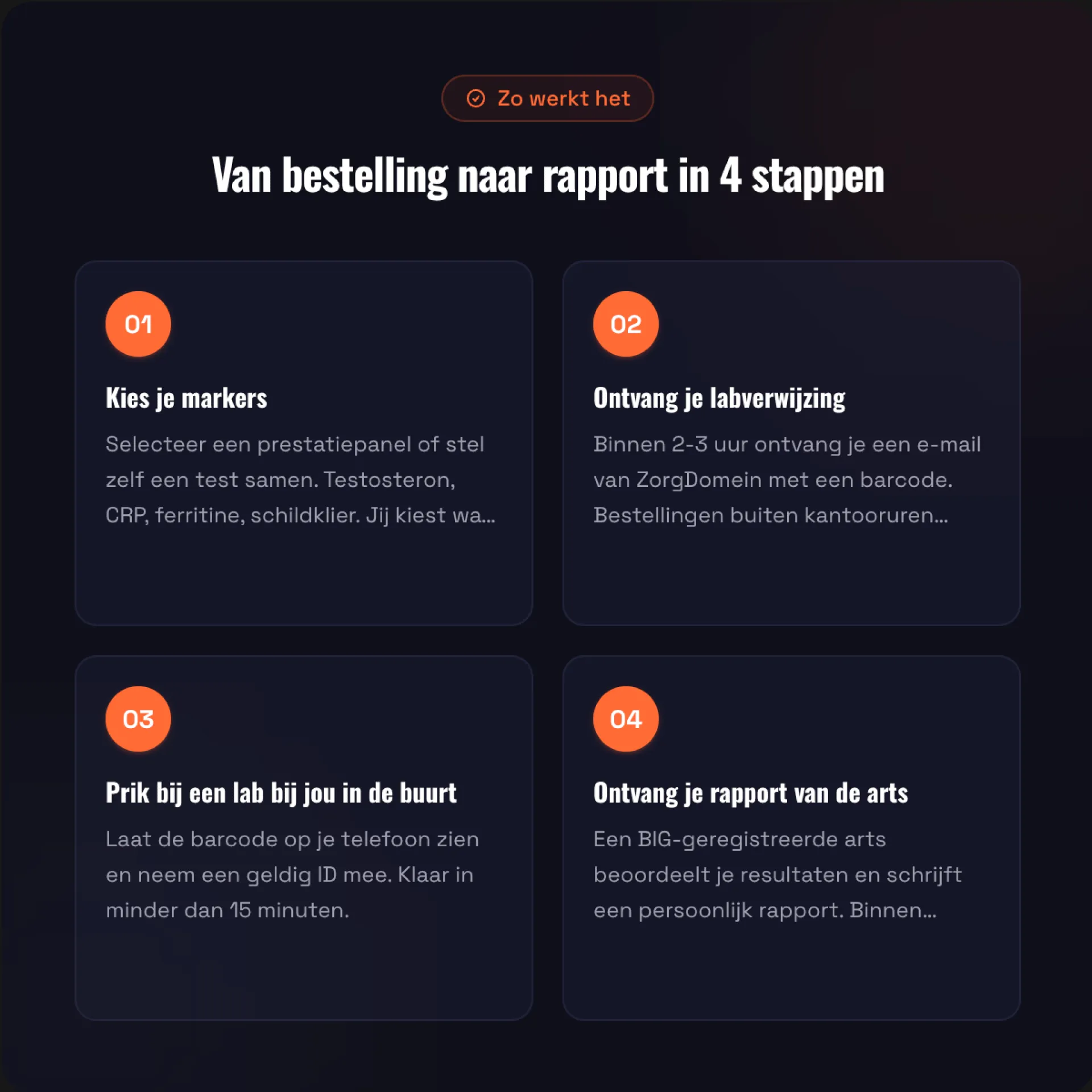
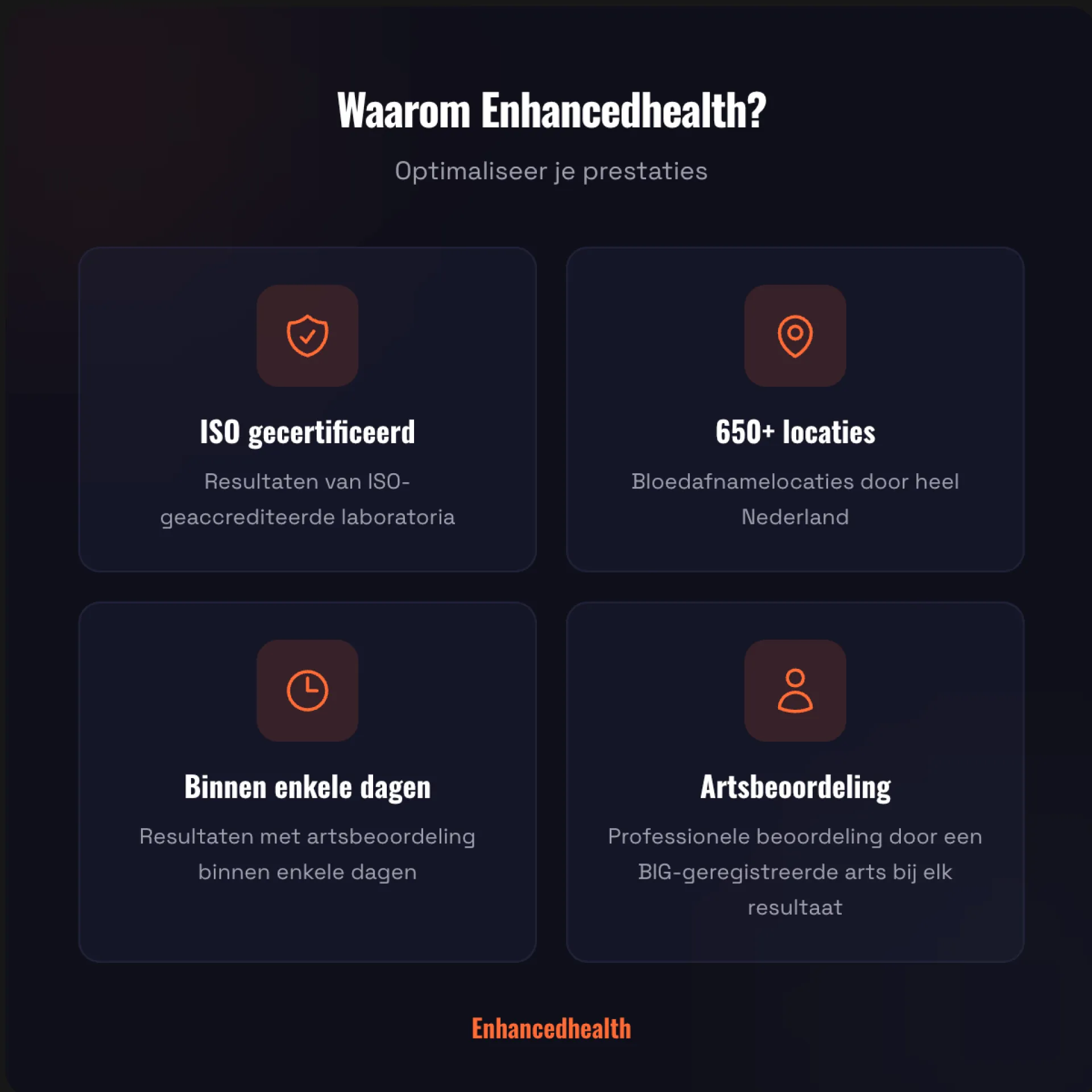
Voor dit InsideTracker bloedonderzoek prikt een medewerker op een gecertificeerde locatie een buisje bloed bij je af. Je stuurt dus geen monster naar het buitenland; de afname gebeurt gewoon in Nederland. Je kunt kiezen uit 650+ priklocaties, dus er is bijna altijd een locatie bij jou in de buurt.
Je hoeft hier weinig voor mee te nemen: de barcode uit je ZorgDomein-mail op je telefoon en een geldig identiteitsbewijs. Zonder BSN ontbreekt die barcode: je print dan via de link in de mail je verwijzingsformulier en neemt dat mee naar de priklocatie. De afname zelf duurt meestal maar een paar minuten.
Wanneer is deze test nuttig?
Een brede biomarker analyse kan op verschillende momenten nuttig zijn. Sommige sporters kiezen ervoor om te meten:
- Als ze een brede basismeting willen voordat ze een nieuw trainingsblok starten
- Als ze hun ijzerstatus en herstelwaarden willen volgen
- Als ze zich moe of futloos voelen en naar meerdere systemen tegelijk willen kijken
- Als ze het effect van een verandering in training of voeding willen volgen
- Als ze liever één uitgebreid panel doen dan meerdere losse tests
Wat betekent de uitslag?
Wat de uitslag betekent, hangt af van je persoonlijke situatie. Elke waarde wordt vergeleken met een referentiebereik, maar een waarde buiten dat bereik betekent niet automatisch dat er iets mis is.
Bij een breed panel kijkt een arts vaak naar hoe de waarden zich tot elkaar verhouden, in plaats van naar één waarde apart. Bespreek afwijkende waarden altijd met je huisarts, zodat je weet wat de uitslag voor jou persoonlijk kan betekenen.
Wat gebeurt er na de uitslag?
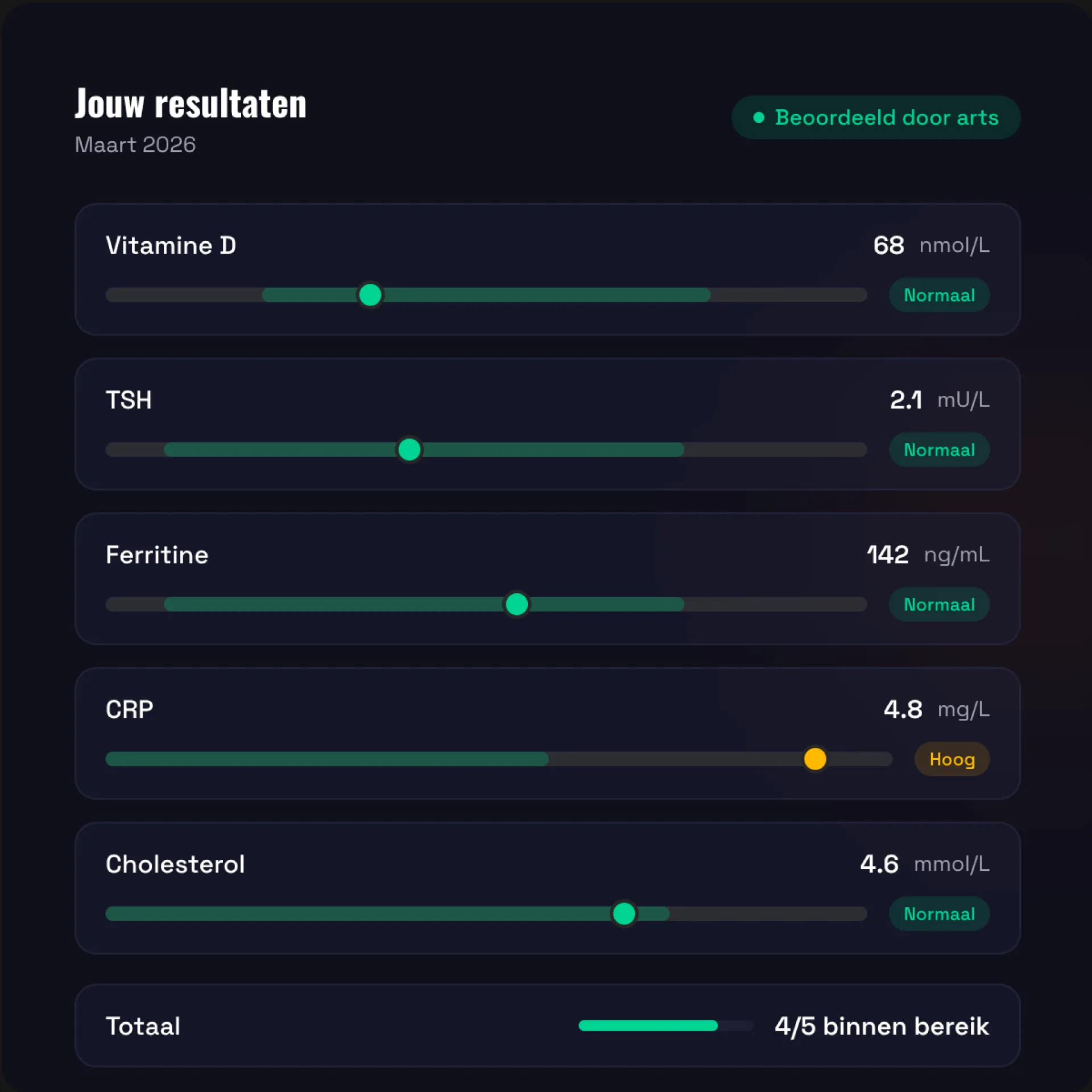
Je ontvangt je uitslag digitaal in je account, meestal binnen enkele werkdagen. Bij je uitslag zie je per waarde of die binnen het referentiebereik valt. Je kunt je resultaten daarna delen met je eigen huisarts.
Elk bloedtestresultaat bevat een professionele beoordeling door een BIG-geregistreerde arts. Bespreek voor behandelbeslissingen je resultaten met je huisarts.
Veelgestelde vragen
Dit bloedonderzoek meet dezelfde 35 bloedwaarden en is bedoeld als InsideTracker alternatief in Nederland. Het verschil zit in de afname: je bloed wordt bij een Nederlands lab geprikt in plaats van opgestuurd.
Nee, je kunt dit bloedonderzoek zelf online aanvragen. Je resultaten kun je daarna met je huisarts bespreken.
Dit panel meet vijfendertig bloedwaarden, verdeeld over hormonen, stofwisseling, ijzerstatus, lever, mineralen, vitamines en je bloedbeeld.
Voor waarden zoals je glucose, insuline en bloedvetten is nuchter prikken aan te raden. Voor je hormoonwaarden is de ochtend vaak een goed moment.
Waarden zoals je ferritine, je creatine kinase en je CRP kunnen interessant zijn om rond zware training te volgen, naast je hormonen.
Je ontvangt je uitslag meestal binnen enkele werkdagen digitaal in je account.
Jouw prestatie metrics
| Nr. | Biomarker | Eenheid | Doorlooptijd |
|---|---|---|---|
| 01 | SHBG (Geslachtshormoonbindend Globuline) | nmol/l | 5 dagen |
| 02 | TSH (Schildklierstimulerend Hormoon) | mu/l | 2 dagen |
| 03 | ALAT (Alanine-aminotransferase) | u/l | 1 dag |
| 04 | LDL Cholesterol | mmol/l | 1 dag |
| 05 | Gamma-GT | u/l | 1 dag |
| 06 | Cortisol | nmol/l | 3 dagen |
| 07 | DHEA-S | umol/l | 5 dagen |
| 08 | Oestradiol (E2) | pmol/l | 2 dagen |
| 09 | Vrij Testosteron | pmol/L | 3 dagen |
| 10 | Testosteron Totaal | nmol/l | 2 dagen |
| 11 | Foliumzuur | nmol/l | 2 dagen |
| 12 | Vitamine B12 | pmol/l | 3 dagen |
| 13 | Calcium | mmol/l | 5 dagen |
| 14 | Ferritine | ug/l | 2 dagen |
| 15 | IJzer | umol/l | 5 dagen |
| 16 | Magnesium | mmol/l | 5 dagen |
| 17 | Kalium | mmol/l | 2 dagen |
| 18 | Progesteron | nmol/l | 1 dag |
| 19 | Natrium | mmol/l | 2 dagen |
| 20 | Transferrine | g/l | 2 dagen |
| 21 | CRP (C-Reactief Proteïne) | mg/l | 2 dagen |
| 22 | Glucose (Nuchter) | mmol/l | 1 dag |
| 23 | HbA1c (Geglycosyleerd Hemoglobine) | mmol/mol | 2 dagen |
| 24 | Apo(B) (Apolipoproteïne B) | g/l | 4 dagen |
| 25 | HDL Cholesterol | mmol/l | 1 dag |
| 26 | Cholesterol Totaal | mmol/l | 1 dag |
| 27 | Albumine | g/l | 2 dagen |
| 28 | ASAT (Aspartaat-aminotransferase) | u/l | 1 dag |
| 29 | Vitamine D (25-OH) | nmol/l | 3 dagen |
| 30 | Insuline (Nuchter) | pmol/L | 5 dagen |
| 31 | Leukocyten Differentiatie | — | 4 dagen |
| 32 | Creatine Kinase (CK) | u/l | 3 dagen |
| 33 | Transferrine Saturatie | % | — |
| 34 | Triglyceriden | mmol/l | 1 dag |
| 35 | Klein Bloedbeeld | — | 2 dagen |
| 36 | HOMA-IR | Index | — |
| 37 | Cholesterol/HDL-ratio | mol/mol | — |
| 38 | Non-HDL-cholesterol | mmol/l | — |
| 39 | LDL/HDL-ratio | ratio | — |
| Je uitslag komt binnen zodra de traagste bepaling klaar is: 5 dagen. Dit is een indicatie; de doorlooptijd verschilt per laboratorium. | |||
Voorbereiding
-
Ben je ziek geweest? Wacht even
NodigHeb je in de afgelopen 2 weken koorts, een infectie of een vaccinatie gehad? Wacht dan met prikken tot je weer helemaal beter bent. Deze waarden reageren op ontsteking en geven anders een vertekend beeld.
-
Stop tijdelijk met biotine
NodigGebruik je een supplement met biotine (vitamine B8, vaak in haar-, huid- en nagelsupplementen)? Stop daar 72 uur vóór de afname mee. Biotine verstoort de meting van deze waarden.
-
Geen zware training vooraf
NodigDoe in de 72 uur vóór de afname geen zware training, lange duurinspanning of iets waarvan je buiten adem raakt. Gewoon wandelen mag.
-
Geen alcohol vooraf
NodigDrink in de 24 uur vóór de afname geen alcohol.
-
Kom nuchter
NodigEet en drink vanaf 22:00 de avond ervoor niets meer, behalve water. Dat is minimaal 8 uur. Koffie, thee, kauwgom en roken laat je die ochtend staan. Plan de afname vóór 10:00.
-
Prik in de ochtend
NodigDeze waarden schommelen over de dag en zijn in de ochtend het hoogst. Laat je bloed afnemen vóór 10:00, het liefst tussen 07:00 en 09:00.
-
Heb je een cyclus? Kies de juiste dag
NodigHeb je een menstruatiecyclus? Tel dan de eerste dag van je menstruatie als dag 1 en laat bloed afnemen op dag 2 tot en met 5. Gebruik je hormonale anticonceptie of heb je geen cyclus, dan telt elke dag.
-
Heb je een cyclus? Kies de juiste dag
NodigHeb je een menstruatiecyclus? Laat dan bloed afnemen 7 dagen vóór je volgende verwachte menstruatie; is die onregelmatig, prik dan wekelijks tot je menstruatie begint. Zonder cyclus telt elke dag.
- Water drinken mag altijd. Drink vooraf gewoon, dat maakt het prikken makkelijker.
- Neem je medicijnen gewoon in, tenzij je eigen arts iets anders heeft gezegd.
Dit panel uitbreiden
Zelfde afname, geen tweede afspraak.
Meer prestatie panels
InsideTracker Cognition
Een bloedonderzoek met 7 biomarkers, geïnspireerd op de InsideTracker Cognition categorie — bloedsuikerregulatie, insuline, cortisol, B12 en foliumzuur achter je cognitiescore.
InsideTracker Metabolism
Een bloedonderzoek met 11 biomarkers, geïnspireerd op de InsideTracker Metabolism categorie — bloedsuiker, insuline, HOMA-IR, het volledige lipidenprofiel, ALAT en TSH achter je stofwisselingsscore.
InsideTracker Hormone Balance
Een bloedonderzoek met 12 biomarkers, geïnspireerd op de InsideTracker Hormone Balance categorie — oestradiol, progesteron, testosteron, SHBG, DHEA-S, cortisol, TSH en de mineralen achter je hormoonscore.