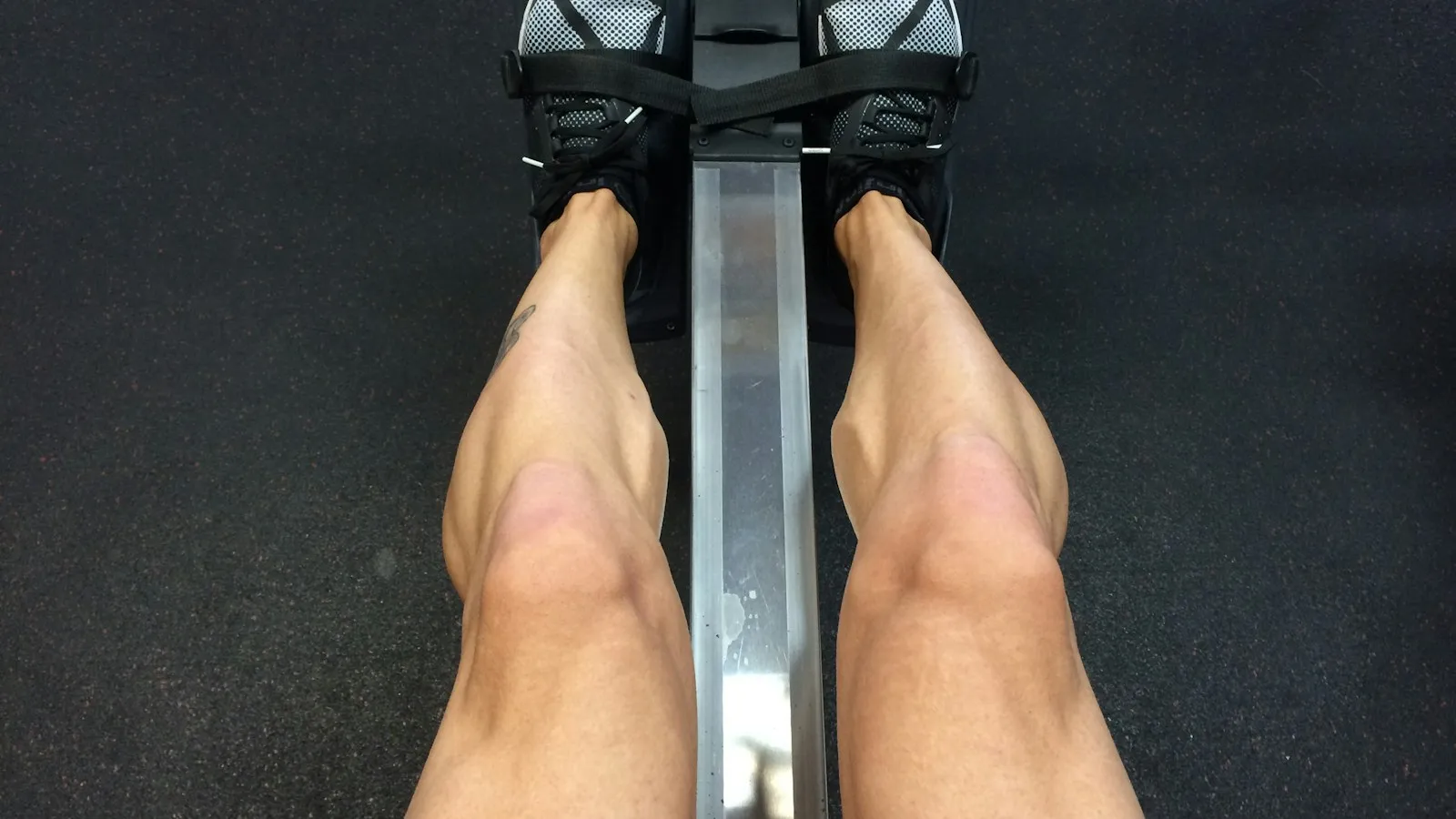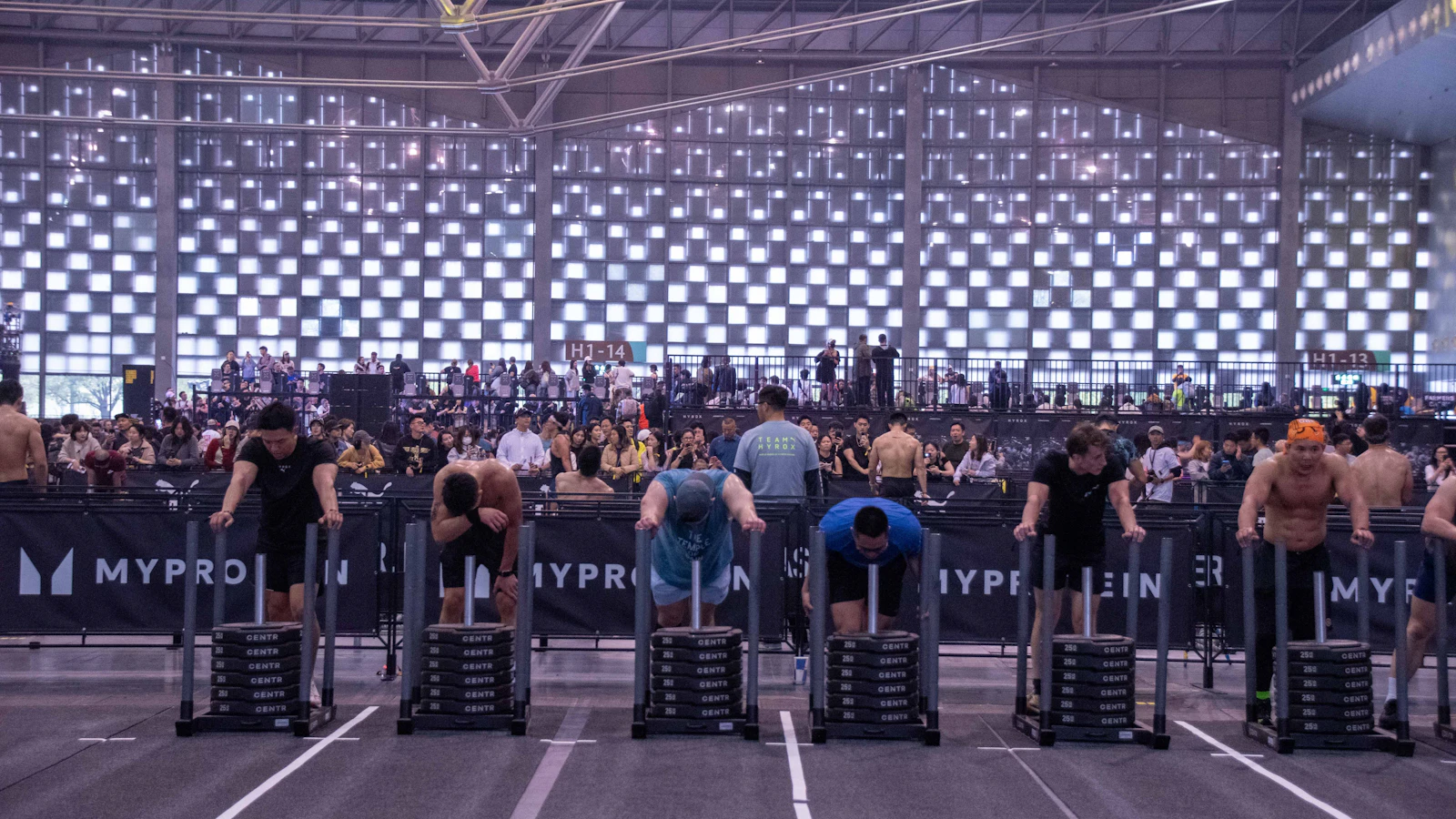
A good Hyrox training plan is roughly sixty percent running and forty percent station work. You spread it over three to four sessions a week for twelve weeks. That is not an opinion. The first scientific measurement of a Hyrox counted 51 running minutes out of 86 (PMID 40230601).
Yet almost every plan online looks the other way round: lots of sled work, few kilometres.
Below is the block in the order that works, with the numbers attached. It also has one section no other Dutch page carries. Namely: what twelve weeks of Hyrox does to your blood.
What does Hyrox training involve?
Hyrox training prepares you for eight 1 km runs, alternated with eight stations. Four of them are ergometer and sled work: SkiErg, sled push, sled pull and burpee broad jumps. The other four: rowing, farmers carry, sandbag lunges and wall balls.
A Hyrox race therefore asks for strength and endurance in one effort. That combination is what weighs heaviest during a Hyrox.
So you train three things. Running on tired legs, the stations themselves, and the transition between the two.
That third one is the forgotten half.
In a simulated race with eleven recreational athletes, the eight runs took 51 minutes together (PMID 40230601). The eight stations took 33 minutes. Almost eighty percent of the time they sat at a heart rate the researchers called very hard. A Hyrox is therefore mostly a long endurance effort with strength work inside it.
What the race is exactly and who it suits sits in what is Hyrox. The eight stations in order, with distances, sit in Hyrox stations.
How long do you need to train for Hyrox?
Count on twelve weeks if you run five kilometres today and train twice a week. If you already run ten kilometres in one go and lift, eight weeks is realistic. Fewer than six weeks is not advisable for anyone. You learn the stations but never build the running volume.
Twelve weeks is not an arbitrary number.
A scoping review bundled 39 studies on functional training for hybrid competitions (PMID 41133555). Programmes of eight to twelve weeks typically delivered eight to fifteen percent gains in VO2max. In the major lifts that was ten to twenty percent.
Those are group averages for people who went from little to structured training. If you are already trained, your gain will be smaller.
How often per week should you train for Hyrox?
Three to four sessions a week is enough for a first race. Two runs, one station session and one combined session. More days mostly produce fatigue in beginners, not extra speed. If you have trained for years, you can go to five.
The order within the week matters.
Strength and endurance in one programme get in each other's way a little. A meta-analysis of 21 studies looked at exactly that (PMID 22002517). The effect of strength training on muscle growth shrank as endurance training became more frequent and longer.
The effect on strength itself largely held up. For Hyrox that is good news. You do not need to get bigger, you need to stay strong enough to run.
So never put your heaviest station session and your longest run on the same day. The best order when you do combine them sits in cardio before or after strength training.
The 12-week Hyrox training schedule
The plan counts back from the date of your Hyrox event. It runs in four blocks: base, build, race-specific and taper. In each block the running volume grows first, and only then the weight on the stations. That way you build the part that costs the most time.
| Weeks | Block | Running per week | Stations | Goal of the block |
|---|---|---|---|---|
| 1 to 4 | Base | 15 to 20 km, easy | 2 sessions, technique at light weight | build volume, learn all eight stations |
| 5 to 8 | Build | 20 to 28 km, with 1 interval session | 2 sessions, race weight on 4 of the 8 stations | running on tired legs, strength at pace |
| 9 to 11 | Specific | 25 to 30 km, with 1 simulation a week | 2 sessions, race weight everywhere | transitions, pacing, half and full simulation |
| 12 | Taper | 10 to 15 km, pace stays | 1 session, short and sharp | rested at the start line |
The kilometres are guide values for someone who starts the base weeks from five kilometres per run. If you already run more, scale up and keep the ratio the same.
This is what a week from the build block looks like, on four days.
| Day | Session | Content |
|---|---|---|
| Monday | Stations, strength | sled push and pull at race weight, farmers carry, lunges; 45 to 60 minutes |
| Wednesday | Running, intervals | 6 x 1 km at 10 km pace, 2 minutes jogging between |
| Friday | Combination | 4 rounds of 1 km run plus 1 station, in race order |
| Sunday | Long run | 10 to 14 km in zone 2, conversational pace |
Saturday is off, Tuesday and Thursday are off or a walk. More rest than this feels to many people like doing too little. It is exactly enough.
How to run that Sunday zone 2 at the right heart rate: zone 2 training.
Which exercises do you train for Hyrox?
You train all eight stations, but not equally often. The two sled stations and the wall balls deserve the most attention. They load your legs the hardest, and the wall balls come last. In the simulation, heart rate, lactate and perceived exertion all peaked at the wall balls (PMID 40230601).
Strikingly, the stations with the heaviest weights were finished fastest. The sled push took 128 seconds, the sled pull 155 (PMID 40230601). Time leaks away at the long stations: the rower, the SkiErg and the lunges.
Every exercise, plus the substitute when your gym has no sled, sits in Hyrox exercises. The official weights per division sit in Hyrox weights.
Why running decides your Hyrox time
Because it is half the race, and because it is the part that fades. Take 24 Pro men at Hyrox Madrid (PMID 42697540). Their running speed fell from 16.1 km/h on kilometre one to 13.6 km/h on kilometre eight. That is sixteen percent slower, in athletes with an average VO2max of 51.6 ml/kg/min.
The same study found the runs were done at 84 percent of the second ventilatory threshold. Translated: just under the pace you can hold for an hour. Eight times over, with stations in between.
In the recreational simulation, a faster finish correlated with three things (PMID 40230601). A higher VO2max, more endurance training volume and a lower body fat percentage. Maximum strength was not on that list.
The practical lesson: raise your running ceiling first, and make your stations more efficient afterwards. How to lift that ceiling in eight weeks sits in increasing your VO2max. Where your number sits for your age is in what is a good VO2max.
Which finish time belongs to which level sits in Hyrox times.
Strength training does help your running, by a detour. A meta-analysis of 93 highly trained runners looked at strength training (PMID 26694507). Two to three sessions a week had a large effect on running economy.
The loads sat at 40 to 70 percent of maximum. Heavy enough to count, light enough to run the next day.
The last two weeks: how to taper for Hyrox
Cut your training volume by forty to sixty percent in the final two weeks. Keep your pace and your number of sessions the same. That form of tapering produced the largest performance gain in a meta-analysis of 27 studies (PMID 17762369). Fewer kilometres, the same speed, the same days.
Most first races go wrong here, not in week four.
People get restless from resting and throw in one more simulation at race weight in week twelve. Do not. Your last full simulation is in week ten. After that you train sharp and short.
When a mid-block rest week belongs in a longer programme sits in deload week.
What twelve weeks of Hyrox does to your blood values
A Hyrox block stacks running volume on strength work, and you see that in your blood. Four values move most often in such a block. Ferritin and haemoglobin from the kilometres, creatine kinase from the stations.
And vitamin D if your block falls in winter. None of those values is a diagnosis. They tell you where your ceiling sits.
| Blood value | What the block does to it | What you may notice in training | When measuring may be useful |
|---|---|---|---|
| Ferritin | endurance training raises iron loss, especially in women | intervals fade, you recover more slowly | before week 1, as a baseline |
| Haemoglobin | sets how much oxygen every litre of blood carries | the same pace feels heavier at the same heart rate | together with ferritin |
| Creatine kinase (CK) | rises sharply after eccentric work such as lunges and wall balls | muscle soreness that lasts for days | not within 48 hours of a heavy station session |
| Vitamin D | drops in the Netherlands between October and March | little, and that is the problem | in a winter block |
The iron side has the most evidence. Seventeen studies looked at endurance athletes with low iron but no anaemia (PMID 25361786). Iron treatment had a moderate effect on VO2max there (Hedges g 0.61).
That is a group effect in people with a deficiency. Not a promise for everyone who takes a pill. It does say a low store can hold down your running ceiling while you do everything right.
CK is the value you can misread. It stays clearly raised for at least a day after a heavy session (PMID 17569697). A draw on the Monday after your simulation therefore measures your training, not your health. What a high CK does and does not mean in athletes sits in high CK explained.
Sleep is the fourth variable, and you do not measure it in blood. Eight hybrid athletes aged 23 to 32 slept an average of 6.6 hours a night (PMID 41762273). After a strength session they took 29 minutes to fall asleep.
After an endurance session it was 10 minutes. So do not schedule your heavy station session in the evening.
If you want the iron and recovery side in one go, that sits in 360 health. The iron store alone can be checked with the ferritin test. How not to distort such a result sits in fasting blood tests for athletes. The wider list for runners is in blood values for endurance athletes.
Common mistakes in a Hyrox preparation
The most common mistake is starting too fast, and that begins in training. Run every combination session at race pace and you train exactly the pace you cannot hold. The Pro men in Madrid lost sixteen percent of their speed over eight kilometres (PMID 42697540). You will lose more.
The second mistake is skipping the Roxzone, the stretch between the running track and the station. In Madrid, running speed there was 10.5 km/h, the lowest of the whole race (PMID 42697540). Train only running and stations, never the transition, and you easily lose a few minutes there.
The third mistake is doing every station session at race weight. Your CK shoots up, you sleep worse, and your run two days later is worthless. Race weight belongs in the build and specific blocks, not in week two.
And then the gut. Thirty to fifty percent of athletes have gastrointestinal complaints during exercise (PMID 24791919). Test your race breakfast in your simulations, not on race day.
What do you do now?
Pick your race date, count twelve weeks back and put the four blocks in your calendar. This week, run easy for an hour once. Do all eight stations once at light weight, and write down how that felt. That is your week 1.
One thing on top of that: take a baseline of the iron side before week 1. Not because you must. But a low ferritin is the one cause of stagnation that training does not fix.
The Dutch Health Council (Gezondheidsraad) sets 150 minutes of moderate activity a week in its exercise guidelines. Plus two sessions of muscle and bone strengthening. This plan sits well above that. If you doubt your body can take it, talk to your GP first.
Every blood test result includes a professional assessment from a BIG-registered doctor. For treatment decisions, discuss your results with your GP.
References
- Brandt T, et al. Acute physiological responses and performance determinants in Hyrox. Frontiers in Physiology, 2025. PMID 40230601.
- Gutiérrez-Hellín J, et al. Relative running intensity and pacing during an official HYROX PRO MEN competition. International Journal of Sports Physiology and Performance, 2026. PMID 42697540.
- Villarroel López P, Juárez Santos-García D. High intensity functional training in hybrid competitions: a scoping review. Journal of Functional Morphology and Kinesiology, 2025. PMID 41133555.
- Wilson JM, et al. Concurrent training: a meta-analysis examining interference of aerobic and resistance exercises. Journal of Strength and Conditioning Research, 2012;26(8):2293-307. PMID 22002517.
- Balsalobre-Fernández C, Santos-Concejero J, Grivas GV. Effects of strength training on running economy in highly trained runners: a systematic review with meta-analysis of controlled trials. Journal of Strength and Conditioning Research, 2016;30(8):2361-8. PMID 26694507.
- Bosquet L, Montpetit J, Arvisais D, Mujika I. Effects of tapering on performance: a meta-analysis. Medicine and Science in Sports and Exercise, 2007;39(8):1358-65. PMID 17762369.
- Burden RJ, Morton K, Richards T, Whyte GP, Pedlar CR. Is iron treatment beneficial in iron-deficient but non-anaemic endurance athletes? A systematic review and meta-analysis. British Journal of Sports Medicine, 2015;49(21):1389-97. PMID 25361786.
- Brancaccio P, Maffulli N, Limongelli FM. Creatine kinase monitoring in sport medicine. British Medical Bulletin, 2007;81-82:209-30. PMID 17569697.
- Buoite Stella A, et al. Strengthening recovery, enduring sleep: an ecologically valid assessment of sleep quantity and quality in hybrid athletes. European Journal of Applied Physiology, 2026. PMID 41762273.
- de Oliveira EP, Burini RC, Jeukendrup A. Gastrointestinal complaints during exercise: prevalence, etiology, and nutritional recommendations. Sports Medicine, 2014;44 Suppl 1:S79-85. PMID 24791919.
- HYROX. The Fitness Race: race format and weights per division. hyrox.com/the-fitness-race.
- Gezondheidsraad. Beweegrichtlijnen 2017.
Autor
Enhanced Health
Dr. Naimi, lekarz wpisany do holenderskiego rejestru BIG, nadzoruje standardy medyczne naszych treści i ocen. Przeczytaj naszą politykę medyczną
Powiązane badania
Powiązane artykuły

Hyrox times: what is a good finish time per level and per station?

Hyrox weights by division: one table for Open, Pro, Doubles and Relay