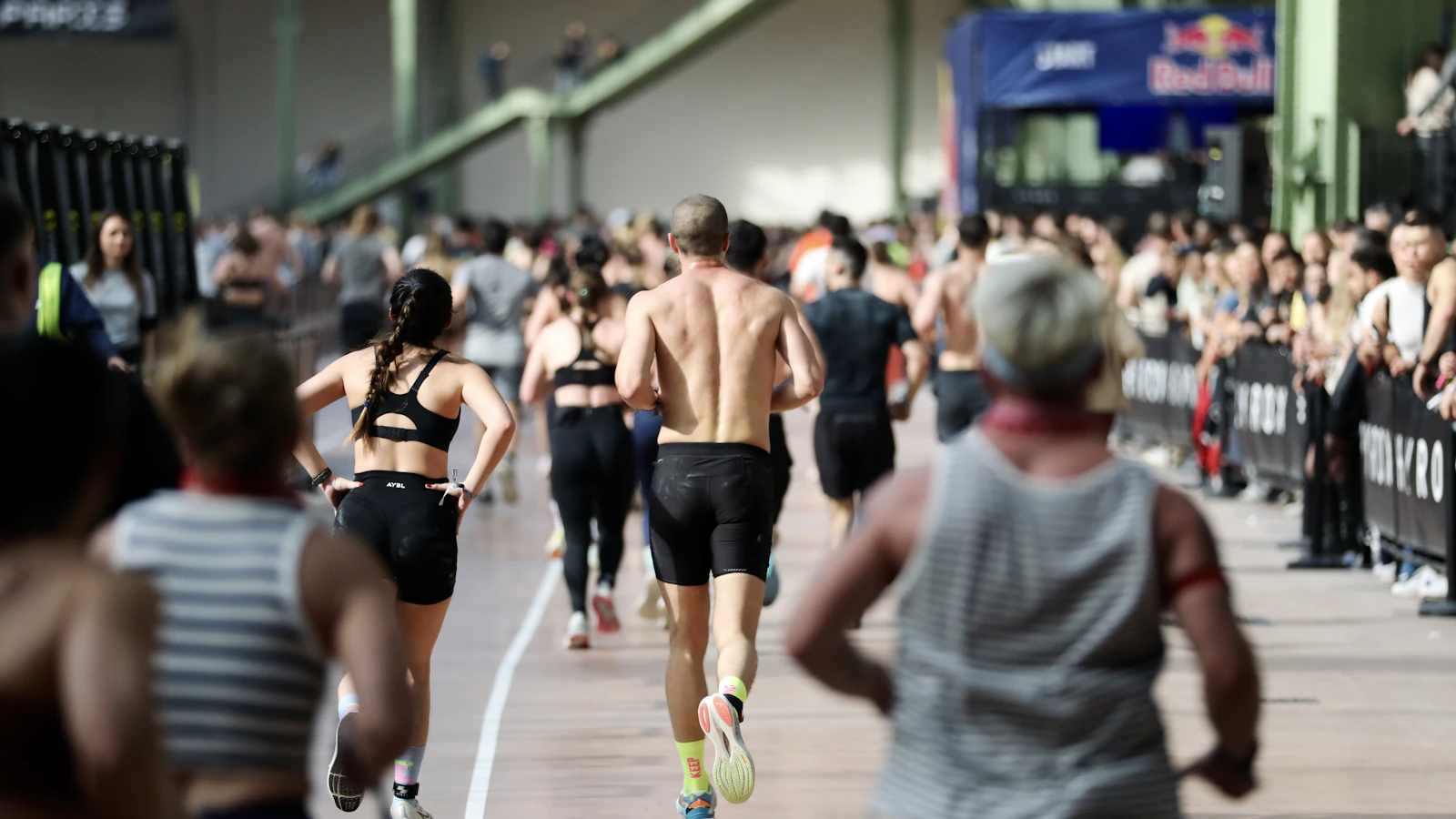
A good Hyrox time depends on your division and your experience. Recreational athletes with 18 months of experience run around 86 minutes in Open, Pro men around 70. The Elite median sits at 57 minutes for men and 63 for women.
For a first race, anything under two hours is a fine time. Those numbers come from measurements, not from a forum.
What they do not tell you is where the time sits.
In the first measured Hyrox, 59 percent of the time went on the eight runs (PMID 40230601). So if you want to get faster, first find out how your own time is divided. Below are the tables per level and per station. And the question nobody asks: what does your blood say about a slow split?
What is a good Hyrox time?
These are the measured times per level. The first row comes from a simulated race in eleven recreational athletes. The second from 24 Pro men at Hyrox Madrid. The last two from every Pro and Elite result of the first seven seasons.
| Level | Measured time | Source |
|---|---|---|
| Recreational, Open, over a year of experience | 86.5 minutes (median; interquartile range 14.5) | PMID 40230601 |
| Pro men, competition | 69:58 (mean; spread 5:05) | PMID 42697540 |
| Elite men, median season 2024/25 | 57:17 | PMID 42524284 |
| Elite women, median season 2024/25 | 1:03:22 | PMID 42524284 |
A first race takes most people longer than those 86 minutes. The measured group had already trained Hyrox for 18 months. Between an hour and a half and two hours is normal for a debut. Under 75 minutes in Open means you have trained seriously.
Read the table as direction, not as an exam grade. Three of the four rows are small or specific groups.
How long does a Hyrox take?
For you: add your eight-kilometre time on tired legs to half an hour of station work. In the measurement the eight runs took 51 minutes together, the eight stations 33 (PMID 40230601). Do you run ten kilometres in 55 minutes?
Then you will not get under 50 minutes for the race's eight kilometres. The pace per kilometre drops.
Say you run ten kilometres in 52 minutes and your eight stations cost 35 minutes together. Then 1:35 is a realistic first race, and 1:20 is not. How much the pace drops has been measured.
In Madrid, the Pro men ran kilometre one at 16.1 km/h and kilometre eight at 13.6. In the Roxzone between track and station it sat at 10.5 km/h (PMID 42697540). So sixteen percent of pace lost is normal at the top. In a first race it is more.
How is your Hyrox time divided per station?
Roughly sixty percent running and forty percent stations. Within those stations most time goes to the long, light ones. These are the station times from the first measurement in recreational athletes.
| Section | Measured time (median) | What stands out |
|---|---|---|
| Eight runs together | 51.2 minutes | 59 percent of the race |
| Eight stations together | 32.8 minutes | 41 percent of the race |
| Sled push (50 m) | 128 seconds | the fastest station, despite the heaviest weight |
| Sled pull (50 m) | 155 seconds | second fastest |
| Wall balls (100 reps) | not reported separately | highest heart rate, lactate and perceived exertion of the whole race |
Source for all rows: PMID 40230601. The study did not report every station separately, and frankly that is the gap in the data.
That gap has since been closed. A benchmark study on 186,411 official results up to the 2023/2024 season publishes percentiles (PMID 42189569). Per station and per category, from the tenth to the ninetieth. Lay your own splits next to it and you see at a glance where you lose time.
What each station involves and the order they come in sits in Hyrox stations.
What is the fastest Hyrox ever?
In the 2024/25 season the Elite median sat at 57:17 for men and 1:03:22 for women. The records sit well below that (PMID 42524284). The exact record changes almost every season. It lives in the official ranking, not in this piece.
More interesting than the record is the trend.
Between season four and seven, the Pro medians got eight to ten minutes faster (PMID 42524284). In the top 100 that was thirteen minutes for men and seventeen for women. The field is learning the race faster than the race is changing.
Where can I see my Hyrox times?
In the organiser's official results module, by name or bib number. With your splits per run and per station. Keep those splits. They are the only honest training advice you get after a race.
Compare them with yourself first and only then with the table.
What decides whether you get faster, and what your blood says about it
In the measurement, a faster finish correlated with three things (PMID 40230601). A higher VO2max, more endurance training volume and a lower body fat percentage. Maximum strength mattered little.
The plan built on that sits in Hyrox training. Where your VO2max sits for your age is in what is a good VO2max.
There is one cause of a slow split that no plan fixes.
Your running ceiling depends among other things on how much oxygen your blood carries. Seventeen studies looked at endurance athletes with low iron but no anaemia (PMID 25361786). Iron treatment had a moderate effect on VO2max there (Hedges g 0.61).
That is a group effect in people with a deficiency, not a promise. A low ferritin can hold down your pace at kilometre six while your training is right.
The Dutch Heart Foundation (Hartstichting) puts it plainly: how you feel and progress outweighs one number. Does your pace at the same heart rate keep dropping for months? Then the iron side is a logical place to look.
Ferritin, haemoglobin and your recovery markers sit together in 360 health. The iron store alone can be checked with the ferritin test. A result is not a diagnosis.
Look up your last splits tonight, or run a four-station simulation this week. Write down your time per section. That is the only table that is really about you.
Every blood test result includes a professional assessment from a BIG-registered doctor. For treatment decisions, discuss your results with your GP.
References
- Brandt T, et al. Acute physiological responses and performance determinants in Hyrox. Frontiers in Physiology, 2025. PMID 40230601.
- Gutiérrez-Hellín J, et al. Relative running intensity and pacing during an official HYROX PRO MEN competition. International Journal of Sports Physiology and Performance, 2026. PMID 42697540.
- Rappelt L, et al. Longitudinal performance development in PRO and ELITE HYROX competitions across the first seven competitive seasons. Frontiers in Physiology, 2026. PMID 42524284.
- Fernández-Navarrete I, et al. Where am I struggling? Detailed benchmarks for every workout and category in Hyrox competition. Journal of Sports Medicine and Physical Fitness, 2026. PMID 42189569.
- Burden RJ, Morton K, Richards T, Whyte GP, Pedlar CR. Is iron treatment beneficial in iron-deficient but non-anaemic endurance athletes? A systematic review and meta-analysis. British Journal of Sports Medicine, 2015;49(21):1389-97. PMID 25361786.
- Hartstichting. Sporten en je hartslag.
Autor
Enhanced Health
Dr. Naimi, lekarz wpisany do holenderskiego rejestru BIG, nadzoruje standardy medyczne naszych treści i ocen. Przeczytaj naszą politykę medyczną
Powiązane badania
Powiązane artykuły
Hyrox weights by division: one table for Open, Pro, Doubles and Relay
Hyrox stations: the 8 workouts in order, with distances