Comprehensive blood test with 19 biomarkers
Broad health panel: hormones, thyroid, vitamins, lipids, liver, kidney, and blood count.
Add to your order
No referral needed
Added to your order
Click the button to view your cart
Biomarkers Included
23 markersHbA1c (Glycated Hemoglobin), TSH (Thyroid Stimulating Hormone), Triglycerides, Urea (BUN), Creatinine, eGFR (Estimated Glomerular Filtration Rate), Free T4 (Thyroxine), LDL Cholesterol, Liver Function Test (LFT), SHBG (Sex Hormone Binding Globulin), Vitamin B12, Vitamin D (25-OH), Total Testosterone, Free T3 (Triiodothyronine), Ferritin, HDL Cholesterol, Albumin, Total Cholesterol, Basic Blood Count, Free Testosterone, Cholesterol/HDL Ratio, Non-HDL Cholesterol, LDL/HDL Ratio
This comprehensive blood test measures nineteen biomarkers in one draw. You arrange it yourself, without a GP referral. It covers your hormones, your thyroid and your metabolism. Your liver, kidney, vitamins and blood count are included too.
You order it online and pick a certified draw location near you. Your results arrive within a few working days, assessed by a doctor.
Why a comprehensive blood test?
Your blood says something about many systems at once. A comprehensive panel brings those systems together in one overview. That reveals patterns a single biomarker would not show.
Many people want to know where their body stands. That applies even when you have no complaints. Shifts in your values are often slow and unnoticed.
For anyone who trains, that matters even more. Your training, your food and your recovery all play a part. You then work with numbers instead of guesswork.
Who is this test for?
This blood test may suit people who:
- want a wide view of their general health
- train and want to follow recovery at marker level
- are considering a preventive blood test as a yearly check
- feel tired or flat and want a broad starting point
- prefer one panel over several separate tests
- want a baseline to compare against later
Do you have specific complaints? Discuss with a doctor which values are useful for you.
What does this blood test check for?
This panel measures nineteen biomarkers, grouped by area:
- Hormones: Total Testosterone and SHBG.
- Thyroid: TSH, Free T3 and Free T4.
- Cholesterol: total cholesterol, LDL, HDL and triglycerides.
- Liver, kidney: Albumin, Liver function test, Urea, Creatinine and eGFR.
- Metabolism: HbA1c, your longer-term blood sugar.
- Vitamins and iron: Vitamin D, Vitamin B12 and Ferritin.
- Blood count: Small Blood Count, for your red blood cells and platelets.
Most standard blood tests fall into a handful of panels. This one carries four of them. Those are a lipid panel, a thyroid panel, a metabolic panel and a blood count.
That metabolic panel covers your liver, your kidney and your blood sugar. On top of those it adds testosterone and SHBG, plus vitamin D, B12 and ferritin.
This panel carries a Small Blood Count. Do you want a complete blood count with differential? You order that as a separate test.
What can a blood test tell you?
Your cholesterol values say more together than apart. LDL is often called bad cholesterol, HDL good cholesterol. What counts is the ratio between the two.
Your blood lipids relate to your risk of cardiovascular disease. You never judge that risk on one value alone. Smoking, blood pressure and exercise all play a part.
Your thyroid markers say something about energy and metabolism. An overactive thyroid causes different complaints than a slow one. Your vitamin and iron values may point to a shortage.
A high value says little on its own. It only gains meaning alongside your other values.
How much does a blood test cost in the Netherlands?
This panel costs €346. You pay yourself and need no referral.
If your GP requests the blood work, that works differently. The GP orders the determinations directly. Such testing usually falls under your Dutch insurance excess.
Some people deliberately choose their own route, because they prefer not to wait. Others would rather discuss results with their GP first. Both work, and you can combine them.
Looking for a smaller package? Have a look at our lipid panel.
How is your blood drawn?
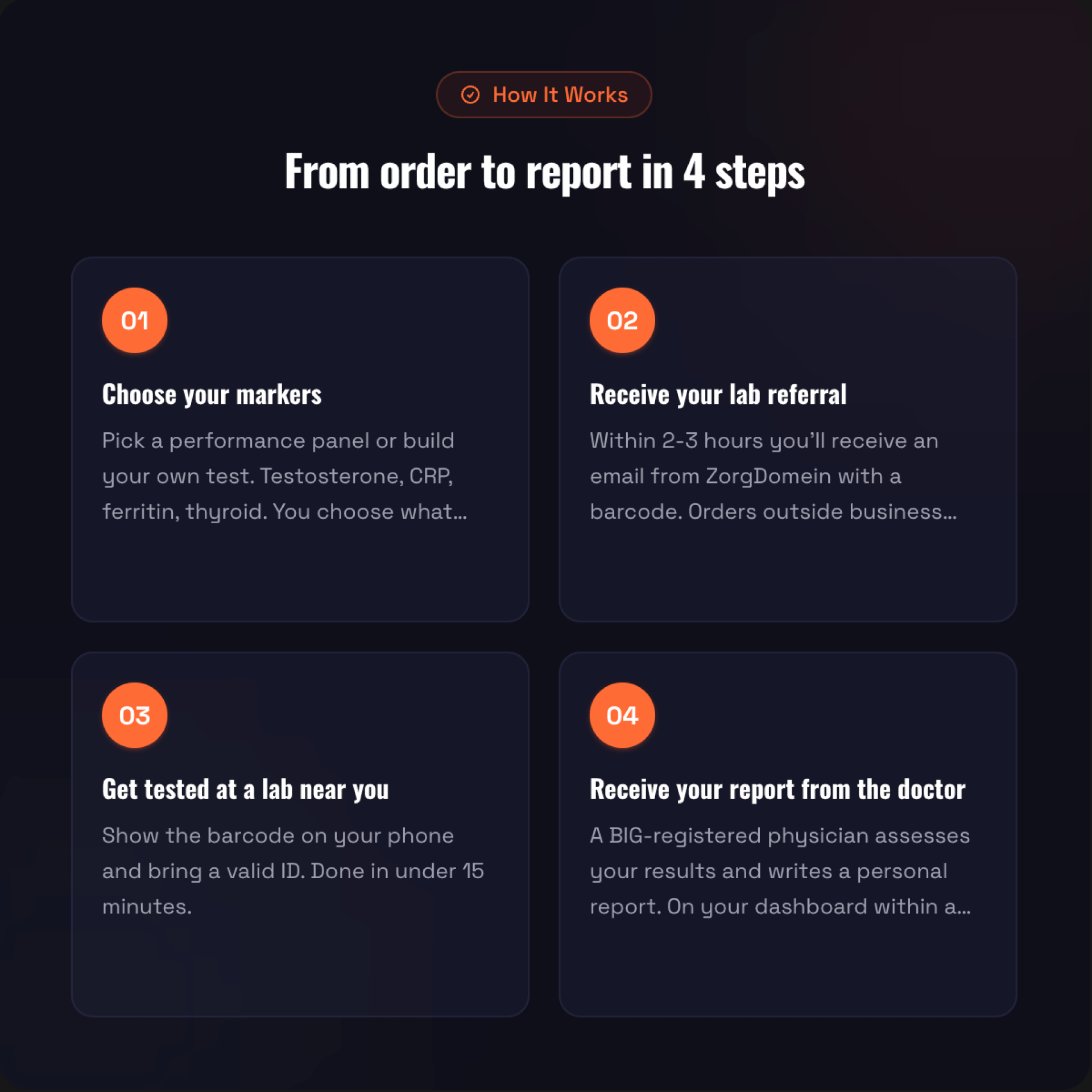
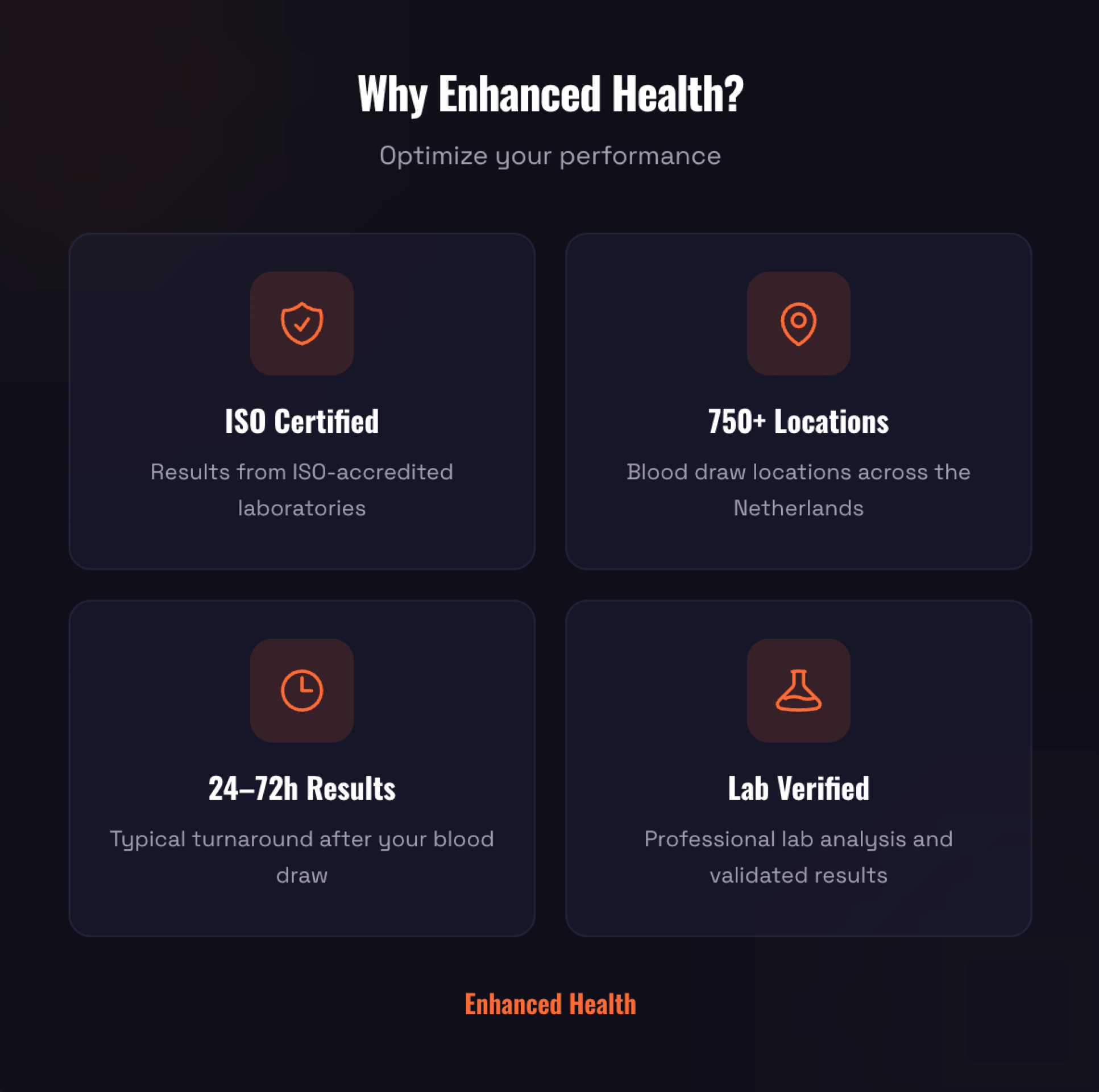
A phlebotomist draws one tube of blood at a certified location. You choose from 650+ draw locations across the Netherlands. The draw itself usually takes a few minutes.
Show the barcode from your ZorgDomein email and bring valid photo ID. Without a BSN there is no barcode: you then print your referral form through the link in the email and bring it to the draw location. You may be left with a small bruise at the puncture site. It normally fades within a few days.
When is this test useful?
A blood test like this can be useful at several moments:
- when you want a wide baseline of your blood values
- when you feel tired and want to look at several systems
- when you want to follow the effect of training or food
- when you want to track your values once a year
Want to go deeper? Our Whoop panel measures forty-three markers.
What do the results mean?
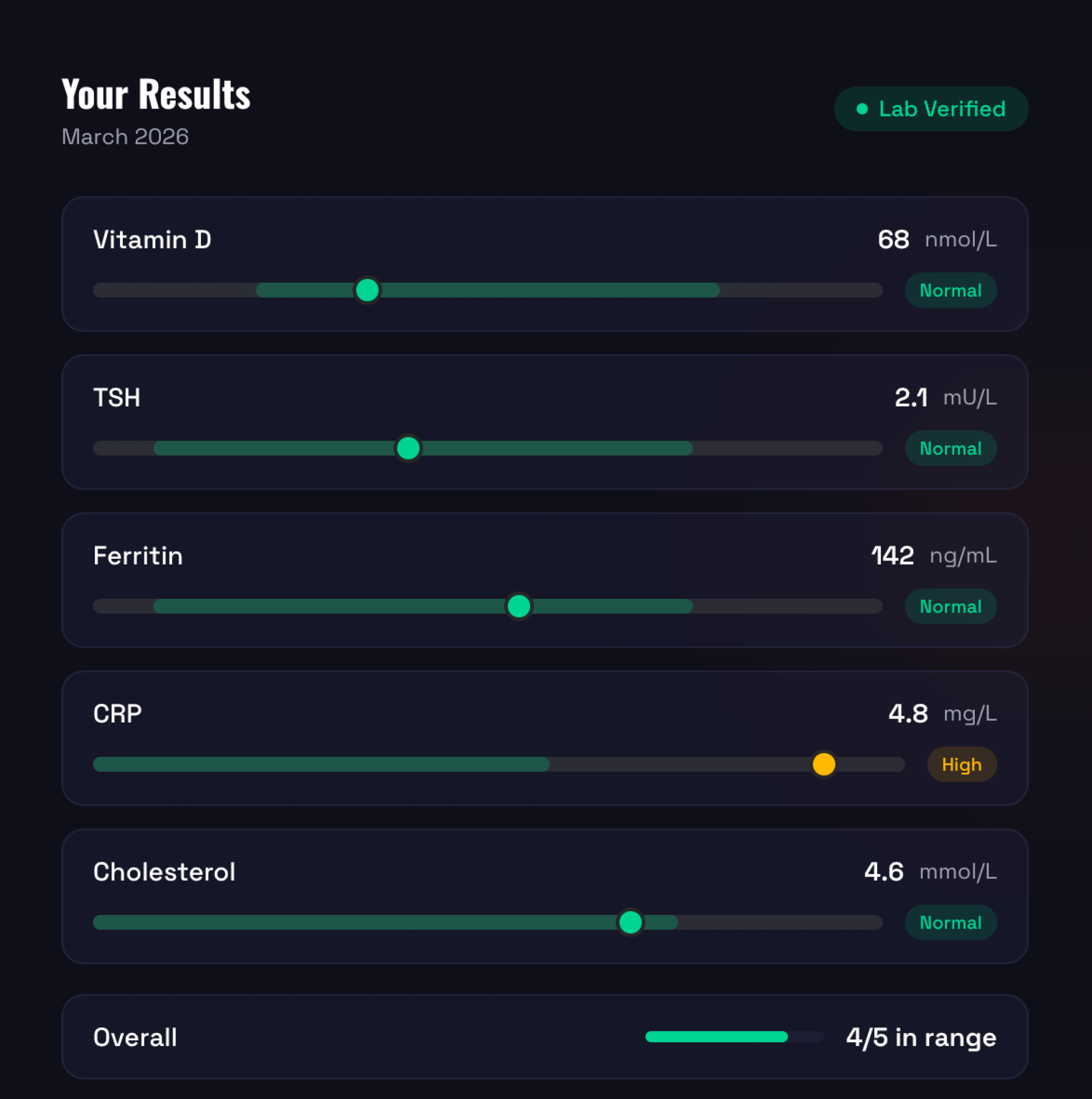
Each value is compared against a reference range. A value outside that range does not automatically mean something is wrong.
With a wide panel a doctor looks at how the values relate. Always discuss abnormal values with your GP. That way you know what the result means for you.
What happens after the results?
Your results appear in your account, usually within a few working days. Per value you see whether it falls inside the reference range. You can then share your results with your own GP.
Every blood test result carries an assessment by a BIG-registered doctor. Discuss your results with your GP before any treatment decisions.
Frequently asked questions
That depends on the panel. This one measures nineteen biomarkers. They cover your hormones, thyroid, cholesterol and liver. Also your kidney, blood sugar, vitamins and blood count.
Lists differ, but five panels come up most often. Those are a blood count, a metabolic panel and a lipid panel. A thyroid panel and a liver panel complete the set. This test covers all five, and adds testosterone, SHBG, vitamin D, B12 and ferritin.
That depends on the route. If your GP requests it, the work usually runs through your insurer and counts against your excess. Ordering this panel here costs €346 directly, and your excess stays untouched. We cannot guarantee reimbursement.
Not for this one. You order it yourself online and can discuss your results with your GP afterwards.
This panel carries a Small Blood Count, covering your red blood cells, white blood cells and platelets. For a complete blood count with differential, order that as a separate test.
For your blood lipids and blood sugar, fasting can be helpful. For your hormone values the morning is often a better moment.
What's Included
| No. | Biomarker | Unit | Turnaround |
|---|---|---|---|
| 01 | HbA1c (Glycated Hemoglobin) | mmol/mol | 2 days |
| 02 | TSH (Thyroid Stimulating Hormone) | mu/l | 2 days |
| 03 | Triglycerides | mmol/l | 1 day |
| 04 | Urea (BUN) | mmol/l | 5 days |
| 05 | Creatinine | umol/l | 1 day |
| 06 | eGFR (Estimated Glomerular Filtration Rate) | ml/min/1,73m² | 1 day |
| 07 | Free T4 (Thyroxine) | pmol/l | 4 days |
| 08 | LDL Cholesterol | mmol/l | 1 day |
| 09 | Liver Function Test (LFT) | — | 4 days |
| 10 | SHBG (Sex Hormone Binding Globulin) | nmol/l | 5 days |
| 11 | Vitamin B12 | pmol/l | 3 days |
| 12 | Vitamin D (25-OH) | nmol/l | 3 days |
| 13 | Total Testosterone | nmol/l | 2 days |
| 14 | Free T3 (Triiodothyronine) | pmol/l | 4 days |
| 15 | Ferritin | ug/l | 2 days |
| 16 | HDL Cholesterol | mmol/l | 1 day |
| 17 | Albumin | g/l | 2 days |
| 18 | Total Cholesterol | mmol/l | 1 day |
| 19 | Basic Blood Count | — | 2 days |
| 20 | Free Testosterone | pmol/L | 3 days |
| 21 | Cholesterol/HDL Ratio | mol/mol | — |
| 22 | Non-HDL Cholesterol | mmol/l | — |
| 23 | LDL/HDL Ratio | ratio | — |
| Your result arrives once the slowest test is finished: 5 days. This is indicative; turnaround varies per laboratory. | |||
Preparation
-
Been ill? Wait a little
RequiredHad a fever, an infection or a vaccination in the past 2 weeks? Wait with the draw until you are fully recovered. These values react to inflammation and would give a distorted picture.
-
Pause biotin
RequiredDo you take a supplement with biotin (vitamin B8, common in hair, skin and nail supplements)? Stop it 72 hours before the draw. Biotin interferes with the measurement of these values.
-
Better no hard training beforehand
RecommendedHard exercise in the 48 hours before can raise this value temporarily. Plan the draw on a rest day if you can.
-
No alcohol beforehand
RequiredDrink no alcohol in the 24 hours before the draw.
-
Preferably fasting
RecommendedComing fasting gives a slightly cleaner value, but it is not required. If it suits you, eat nothing from 22:00 the evening before and drink only water.
-
Have the draw in the morning
RequiredThese values vary over the day and peak in the morning. Have your blood drawn before 10:00, ideally between 07:00 and 09:00.
-
On levothyroxine? Worth knowing
Good to knowTell the staff at the draw when you took your tablet; for most values the timing makes no difference.
- Water is always fine. Drink as usual beforehand, it makes the draw easier.
- Take your usual medication, unless your own doctor told you otherwise.
Extend this panel
Same draw, no second appointment.
More Test Panels
TRT Monitoring
Independent monitoring panel for men on TRT: testosterone (total and free), SHBG, albumin, hemoglobin, hematocrit and PSA.
General Hormones
Testosterone panel for men: total testosterone, SHBG, albumin and calculated free testosterone.
Lipids
LDL-C, HDL-C and triglycerides in one blood draw.