Lipid panel: LDL-C, HDL-C and triglycerides in view
LDL-C, HDL-C and triglycerides in one blood draw.
Add to your order
No referral needed
Added to your order
Click the button to view your cart
Biomarkers Included
4 markersTriglycerides, LDL Cholesterol, HDL Cholesterol, LDL/HDL Ratio
A lipid panel is a blood test that looks at your blood fats. This panel determines your LDL-C, your HDL-C and your triglycerides in mmol/L.
Your blood fats move with your food, your training and your body composition. These figures let you work from data rather than a hunch.
Why have a lipid panel measured?
Your blood fats say something about how your body handles fat. A lipid panel brings your LDL-C, your HDL-C and your triglycerides together in one overview.
That is useful for athletes and active people. Your lifestyle, your food and your training all feed into your cholesterol values. Measuring regularly shows you how your values develop.
Who is this test for?
A cholesterol blood test may suit people who want to follow their blood lipids. Think of:
- Athletes and active people who want insight into their HDL, LDL and triglycerides
- People who have adjusted their diet and want to follow the effect
- People with a family history of elevated cholesterol who want to stay informed
- People looking for a triglycerides test or LDL cholesterol test. They prefer to measure the whole profile at once.
- People who want to add a broader blood test later, such as our 360 health check
What does this lipid panel measure?
This panel measures three blood values around your blood fats:
- HDL-C is often called the good cholesterol. The NVKC uses 1.04 and 1.55 mmol/L as thresholds, the same for men and women.
- LDL-C is the value a doctor steers treatment on. The NVKC calls below 3.0 mmol/L favourable.
- Triglycerides say something about your fat metabolism.
In many laboratories LDL-C is calculated from your other values rather than measured directly. That calculation becomes unreliable when your triglycerides are high.
Your total cholesterol and your non-HDL cholesterol are not part of this panel.
What can this test tell you?
The results show you how your blood lipids compare to the reference ranges. A high LDL or high triglycerides may be associated with cardiovascular risk. Your HDL is often looked at alongside them.
For active people this shows how your lifestyle relates to your lipid values. Keep in mind that a single value is not a diagnosis. Your lipid panel gains meaning alongside your situation and your history.
Home cholesterol test or professional blood draw?
Online you often see a home cholesterol test or self-test with a finger-prick. Such a home test can seem convenient. A finger-prick often gives a more limited picture than a venous draw.
With us you do not use a home kit but a professional blood draw. A staff member draws a small tube of blood at a certified location. The lab then measures your lipid panel.
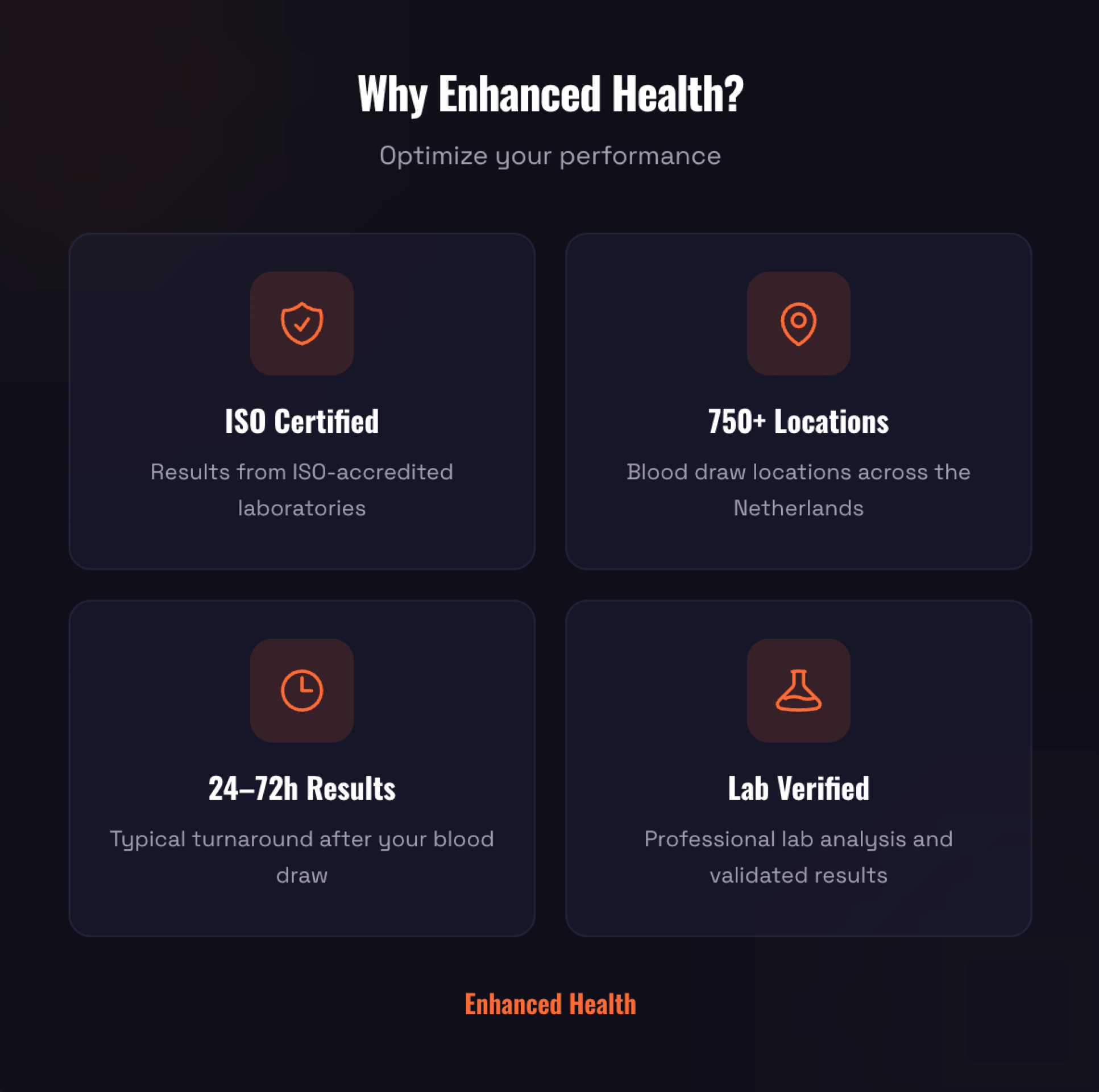
You can choose from 650+ collection sites in the Netherlands. There is almost always a location near you.
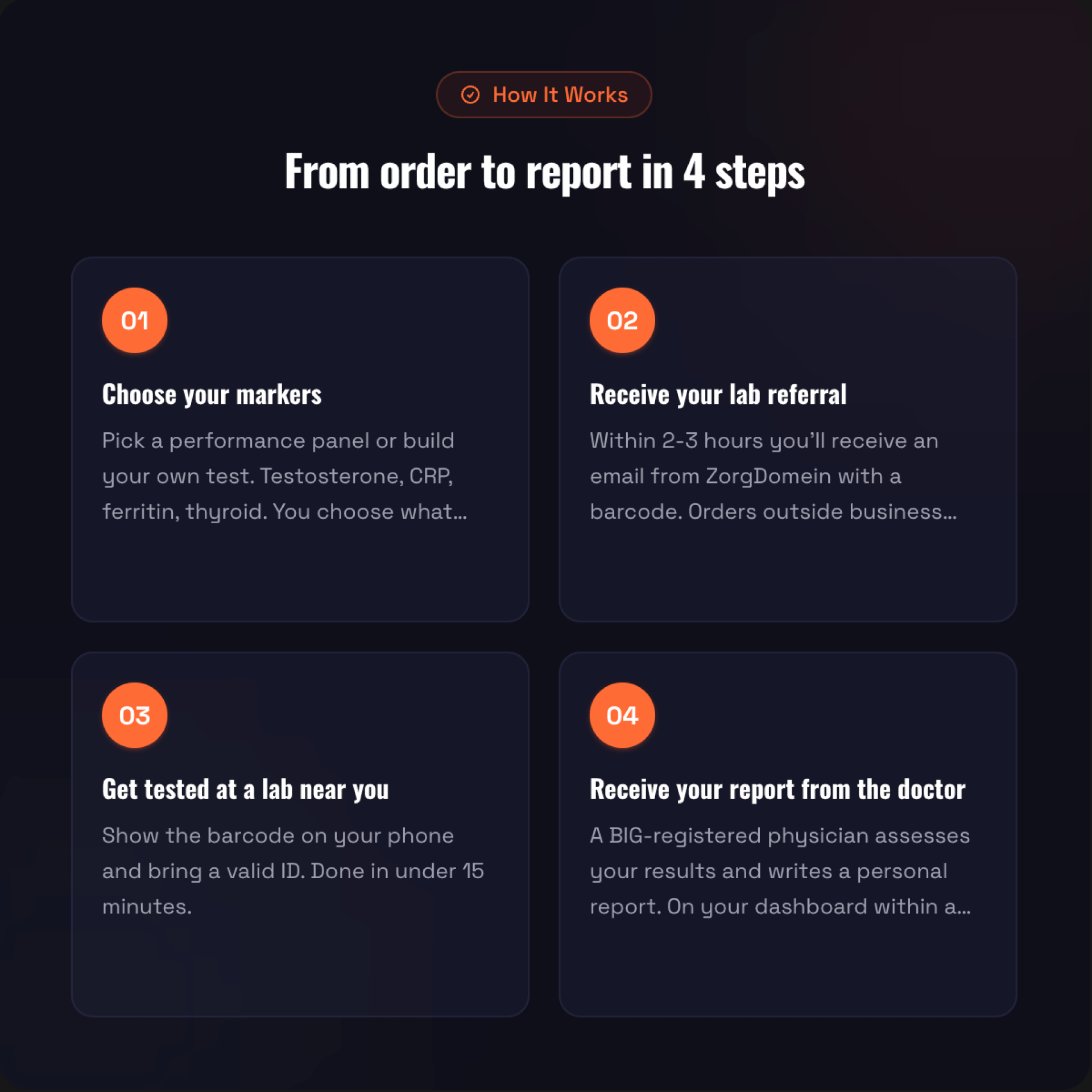
You show the barcode from your ZorgDomein email and bring a valid ID. Without a BSN there is no barcode: you then print your referral form through the link in the email and bring it to the draw location. The draw itself usually takes only a few minutes.
When is this test useful?
Want to buy a cholesterol blood test? People often do so at moments like these:
- When they have changed their diet and want to follow the effect on their blood lipids
- When they want insight into their cardiovascular markers
- When their lipid values were deviating before and they want to keep following them
- When they want to keep an eye on their blood lipids periodically
- When they want to start with a basic panel before expanding
What do the results mean?
Your result shows how your blood fats relate to each other. A doctor looks at your LDL-C, your HDL-C and your triglycerides together. One value on its own says little.
Each value is compared against a reference range in mmol/L. The normal range differs per laboratory. A value outside that range does not automatically mean something is wrong.
A high cholesterol level or a low HDL is not a diagnosis on its own. Whether lowering LDL makes sense depends on your overall risk. Discuss that with your doctor.
What happens after the results?
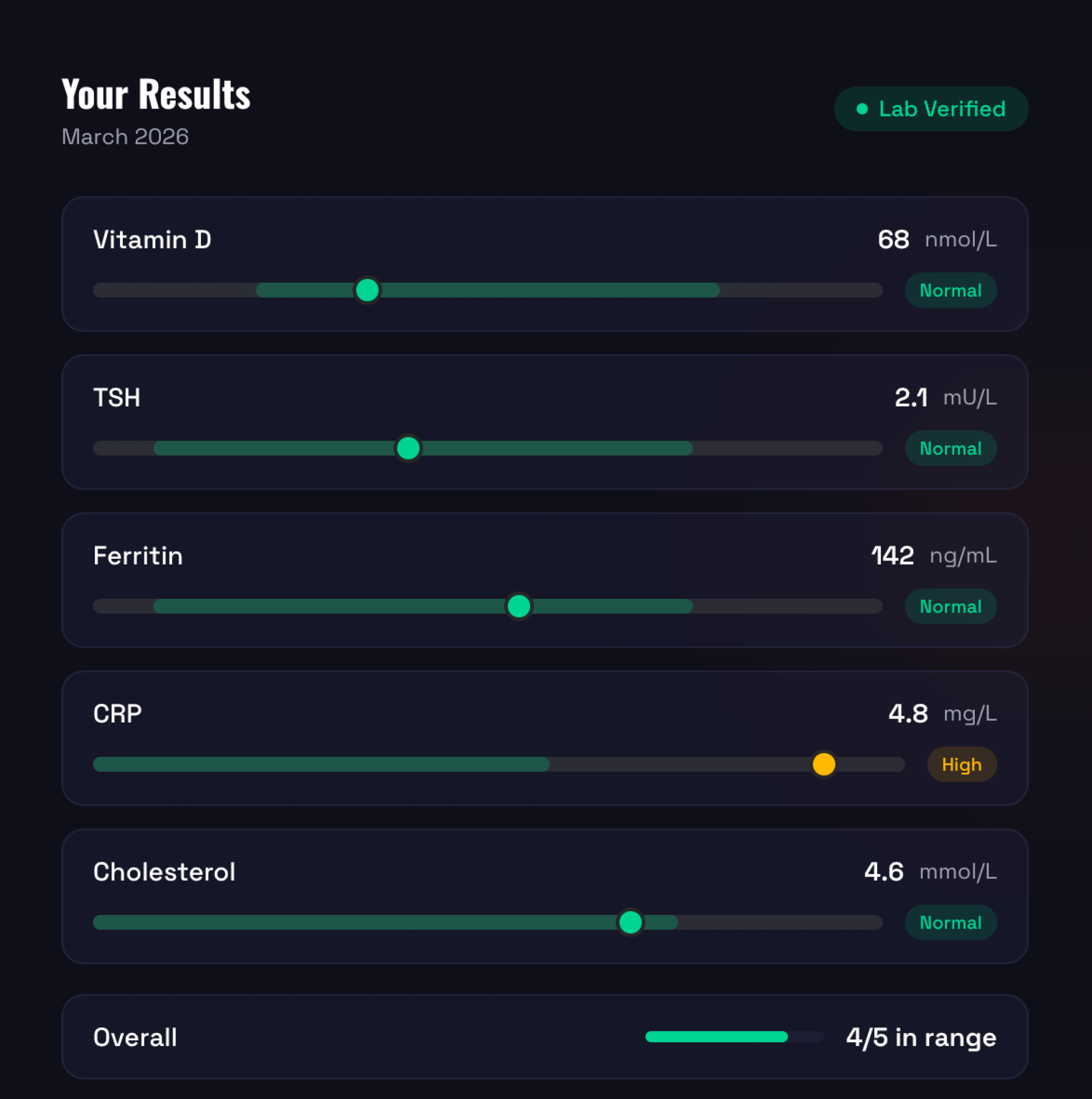
You receive your results digitally in your account, usually within a few working days. For each value you can see whether it falls within the reference range. That lets you follow your lipid panel over time.
Want to buy a cholesterol blood test now? Check out quickly and then plan your blood draw at a location near you.
Every blood test result includes a professional assessment from a BIG-registered doctor. For treatment decisions, discuss your results with your GP.
Frequently Asked Questions
A lipid panel is a blood test for your blood lipids. This panel measures your HDL cholesterol, your LDL cholesterol and your triglycerides. That lets you read them alongside your training and your nutrition.
No single value is dangerous on its own. For non-fasting blood the Dutch NHG guideline uses 5.0 mmol/l as the cut-off for total cholesterol. That is the 80th percentile, so roughly a fifth of the Dutch population sits above it. Only above 8.0 mmol/l would a doctor consider an inherited lipid disorder, and that is no emergency.
There is no single normal LDL value, because it depends on your overall cardiovascular risk. As a general target the Dutch NVKC uses an LDL below 3.0 mmol/l. It puts HDL above 1.55 mmol/l. For non-fasting triglycerides the cut-off is 2.0 mmol/l.
No, fasting is not required. We grade your values against the NHG non-fasting cut-offs. You can therefore give blood at any time of day. Fasting does give a slightly cleaner reading, so it is a bonus if it suits you.
No. This panel measures your HDL cholesterol, your LDL cholesterol and your triglycerides. Your total cholesterol and non-HDL cholesterol are not included.
A home cholesterol test with a finger-prick often gives a more limited picture. With us your blood is drawn venously at a certified location. That captures your values more accurately. They are also more comparable over time.
What's Included
| No. | Biomarker | Unit | Turnaround |
|---|---|---|---|
| 01 | Triglycerides | mmol/l | 1 day |
| 02 | LDL Cholesterol | mmol/l | 1 day |
| 03 | HDL Cholesterol | mmol/l | 1 day |
| 04 | LDL/HDL Ratio | ratio | — |
| Your result arrives once the slowest test is finished: 1 days. This is indicative; turnaround varies per laboratory. | |||
Preparation
-
No alcohol beforehand
RequiredDrink no alcohol in the 24 hours before the draw.
-
Preferably fasting
RecommendedComing fasting gives a slightly cleaner value, but it is not required. If it suits you, eat nothing from 22:00 the evening before and drink only water.
- Water is always fine. Drink as usual beforehand, it makes the draw easier.
- Take your usual medication, unless your own doctor told you otherwise.
Extend this panel
Same draw, no second appointment.
More Test Panels
Kidney Health
Creatinine, eGFR, and BUN: key kidney function markers.
Complete Blood Count
Full blood count: red cells, white cells, and platelets.
TSH Test
Measure your TSH to check how your thyroid drives your metabolism and energy. No referral needed.