
Complete blood count (CBC) blood test without a referral
Full blood count: red cells, white cells, and platelets.
Add to your order
No referral needed
Added to your order
Click the button to view your cart
Biomarkers Included
1 markersComplete Blood Count (CBC)
A complete blood count is a blood test that counts and assesses your blood cells. It looks at your red blood cells, your white blood cells and your platelets. Most laboratories abbreviate it to CBC.
You see how many cells of each type you have in one overview. You also see how large they are. That makes it one of the most requested blood tests.
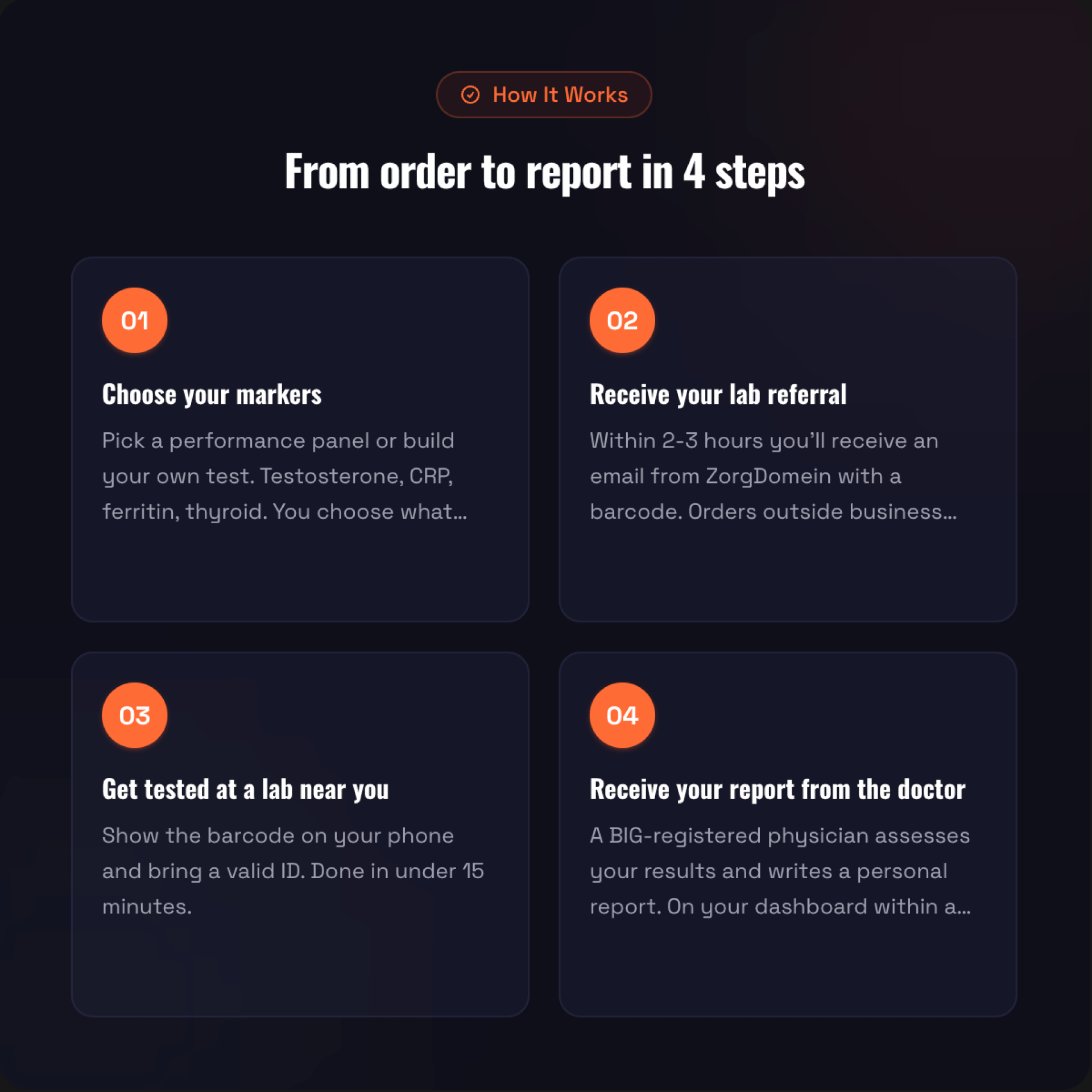
You order it online and then choose a draw location. You do not need a referral. A BIG-registered doctor reviews your result.
What is included in a complete blood count?
A CBC blood test looks at three groups of cells. Each group has its own job.
- Red blood cells (erythrocytes) carry oxygen through your body.
- White blood cells (leukocytes) belong to your immune defence.
- Platelets (thrombocytes) play a role in clotting.
The number of red blood cells says something about your oxygen transport. The lab also measures the amount of haemoglobin in your blood. Haemoglobin is the protein that binds oxygen.
Your white blood cells come in different types. In a differential the lab splits them into neutrophils, lymphocytes, monocytes, eosinophils and basophils.
Which values appear on your result?
Your result lists values such as these:
- Haemoglobin (Hb) binds oxygen in your red blood cells.
- Haematocrit is the share of your blood made up of cells.
- Leukocytes are your white blood cells.
- Thrombocytes are your platelets.
- MCV, MCH and MCHC describe the size and filling of your red blood cells.
- RDW shows the spread in cell size.
This set is also called a full blood count. Add a differential and laboratory staff call it a CBC with diff.
What are normal values for a complete blood count?
A CBC has no normal value of its own. It is not a single measurement, but a panel of measurements. Every value in that panel has its own reference range.
Those ranges differ per laboratory. They also differ by sex and by age. A number from one list therefore does not always fit a result from another lab.
So read the reference range printed on your own result. Each individual value has its own page explaining what it means.
How is the sample taken?
A member of staff draws one tube of blood from a vein in your arm. This happens at a certified draw location. There are 650+ locations across the Netherlands.
The tube contains a substance that prevents clotting. That keeps your cells intact so the analyser can count them.
Show the barcode from your ZorgDomein email and bring valid photo ID. Without a BSN there is no barcode: you then print your referral form through the link in the email and bring it to the draw location. The draw itself usually takes a few minutes.
Who is this blood test for?
This test suits people who want to track their blood values. For example:
- Athletes tracking their haemoglobin and red blood cells
- People whose tiredness lasts longer than usual
- People following their recovery after a heavy training block
- People whose earlier values deviated
- People with a chronic condition keeping an eye on their values
- People wanting a baseline before a new lifestyle
Do your symptoms persist? Then discuss them with your GP first.
Want more than your blood cells measured? Then look at the broader 360 Health panel.
What do your results mean?
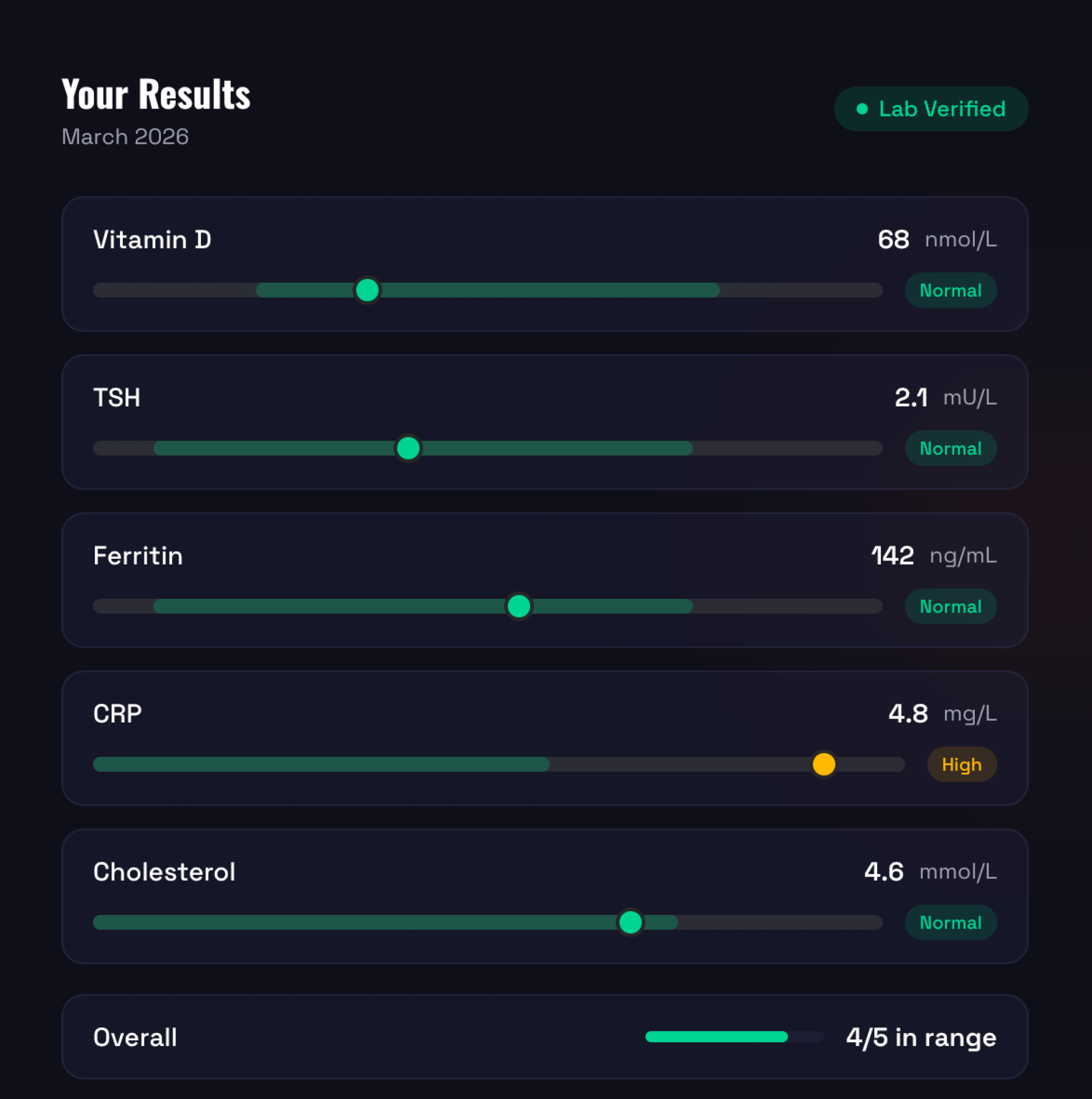
Your result places each value beside the reference range of the lab. A value outside that range does not automatically mean something is wrong.
A doctor often looks at the whole picture. Your red cells, your white cells and your platelets together say more than one value alone.
One result is not a diagnosis. Always discuss deviating values with your GP.
Preparation: do you need to fast?
You usually do not need to fast for a CBC test. Drink enough water on the day of your draw. That often makes the draw easier.
Did you train hard shortly beforehand? Then take that into account. Heavy exertion can temporarily affect some values.
Unsure about your own situation? Then check with your GP.
What does a complete blood count cost?
The price of this test is shown at the top of this page. You pay online and then schedule your draw yourself.
Your result is usually in your account within five working days. Every result carries an assessment by a BIG-registered doctor.
You then share your result with your GP yourself. They can weigh what the values mean in your situation.
Frequently asked questions
It counts your red blood cells, your white blood cells and your platelets. It also measures your haemoglobin and haematocrit, plus indices such as MCV and RDW. A differential adds the types of white blood cells.
The price is shown at the top of this page. You pay online and then schedule your draw yourself. You do not need a referral from your GP.
A frequently asked question is whether you need to fast. For this test you usually do not. Do drink enough water on the day of your draw.
A small blood count measures a limited set of values. The full version measures the whole set, including indices such as MCV and MCHC. A differential splits your white blood cells further.
Yes. Your haemoglobin appears as Hb on your result. That is the protein binding oxygen in your red blood cells.
What's Included
| No. | Biomarker | Unit | Turnaround |
|---|---|---|---|
| 01 | Complete Blood Count (CBC) | — | 5 days |
| Your result arrives once the slowest test is finished: 5 days. This is indicative; turnaround varies per laboratory. | |||
Preparation
Nothing special is needed for these tests.
- Water is always fine. Drink as usual beforehand, it makes the draw easier.
- Take your usual medication, unless your own doctor told you otherwise.
Extend this panel
Same draw, no second appointment.
More Test Panels
Lipids
LDL-C, HDL-C and triglycerides in one blood draw.
Kidney Health
Creatinine, eGFR, and BUN: key kidney function markers.
TSH Test
Measure your TSH to check how your thyroid drives your metabolism and energy. No referral needed.