TRT monitoring: blood testing during testosterone therapy
Independent monitoring panel for men on TRT: testosterone (total and free), SHBG, albumin, hemoglobin, hematocrit and PSA.
Add to your order
No referral needed
Added to your order
Click the button to view your cart
Biomarkers Included
7 markersPSA (Prostate-Specific Antigen), SHBG (Sex Hormone Binding Globulin), Total Testosterone, Albumin, Hemoglobin, Hematocrit, Free Testosterone
TRT stands for testosterone replacement therapy: treatment with testosterone for a diagnosed deficiency. This blood test tracks the values that change during that therapy.
The panel measures your testosterone, SHBG, albumin, hemoglobin, hematocrit and PSA. Those are the checks guidelines recommend for men on testosterone therapy.
We are not a TRT clinic and we prescribe nothing. You use this TRT blood test alongside your own doctor or clinic, in the Netherlands or abroad. A BIG-registered doctor assesses your results.
What is TRT?
TRT, short for testosterone replacement therapy, brings a testosterone deficiency back to a normal level. It is also called testosterone therapy.
Testosterone is a prescription medicine. You get it as an injection, gel or patch, always through a doctor. The aim is a healthy range, not the highest possible value.
That makes it different from a steroid cycle. In a cycle the doses sit far above what your body makes itself.
When is TRT needed?
Guidelines only speak of a deficiency with symptoms and a repeatedly low testosterone value. That value is measured in the morning, on at least two separate days.
Symptoms that fit a deficiency include lower sex drive, fewer morning erections and low energy. One low result is not enough, because testosterone varies over the day.
No diagnosis yet? Then the hormone blood test is a more logical starting point than this panel. Discuss your results with your GP afterwards.
Can you get TRT in the Netherlands?
Yes, but only on a doctor's prescription. Your GP can test you and, if needed, refer you to a urologist or internist. There are also private TRT clinics in the Netherlands.
Whichever route you take, TRT treatment needs regular blood checks. That is what this test is for.
What does TRT do to your blood values?
The therapy changes more than your testosterone. The best-known change is a rising hematocrit. Your body makes more red blood cells and your blood gets thicker.
Your own testosterone production also drops, and with it usually your sperm production. Your PSA can rise slightly. In some men estradiol rises too.
Risks and side effects of TRT
You discuss the pros and cons with your doctor. Guidelines list a hematocrit that runs too high, acne, fluid retention and tender breasts, among others. Sperm production also falls, which matters if you still want children.
Many of those effects show up in your blood first. That is why guidelines ask for regular checks during treatment.
Which TRT blood values are tested?
This panel measures the seven values that matter most during therapy:
- Total testosterone: all the testosterone in your blood.
- Free testosterone: the part your body can use directly. It is calculated from testosterone, SHBG and albumin.
- SHBG: the protein that binds testosterone.
- Albumin: a blood protein that also counts toward your free testosterone.
- Hemoglobin: the oxygen-carrying protein in your red blood cells.
- Hematocrit: the share of red blood cells in your blood. Testosterone therapy can raise it.
- PSA: a prostate value that is followed periodically during treatment.
Why doesn't this panel include liver values, cholesterol or estradiol?
Guidelines do not recommend them for routine checks with injections or gel. Liver enzymes matter mainly with oral androgens. Cholesterol belongs to your general heart and vascular care.
Estradiol is usually measured only with symptoms, such as tender breasts. That way you do not pay for tests you do not need. If your doctor wants extra values, you add them separately.
When should you have a TRT blood test?
Guidelines name a check three to six months after starting or after a dose change. After that, a yearly check is usual. Your doctor sets your schedule.
Timing matters too. With injections you measure midway between two injections. With gel you measure two to eight hours after applying it.
Who is this TRT monitoring for?
This TRT monitoring suits men who want to follow their therapy with their own numbers:
- Men treated at a clinic in the Netherlands or abroad
- Men who have used testosterone therapy for a while and want to measure periodically
- Men who want to keep following their hematocrit
- Men who want an extra measurement between two clinic checks
This test does not replace your doctor's care. It adds an independent measurement to it.
How does the blood draw work?
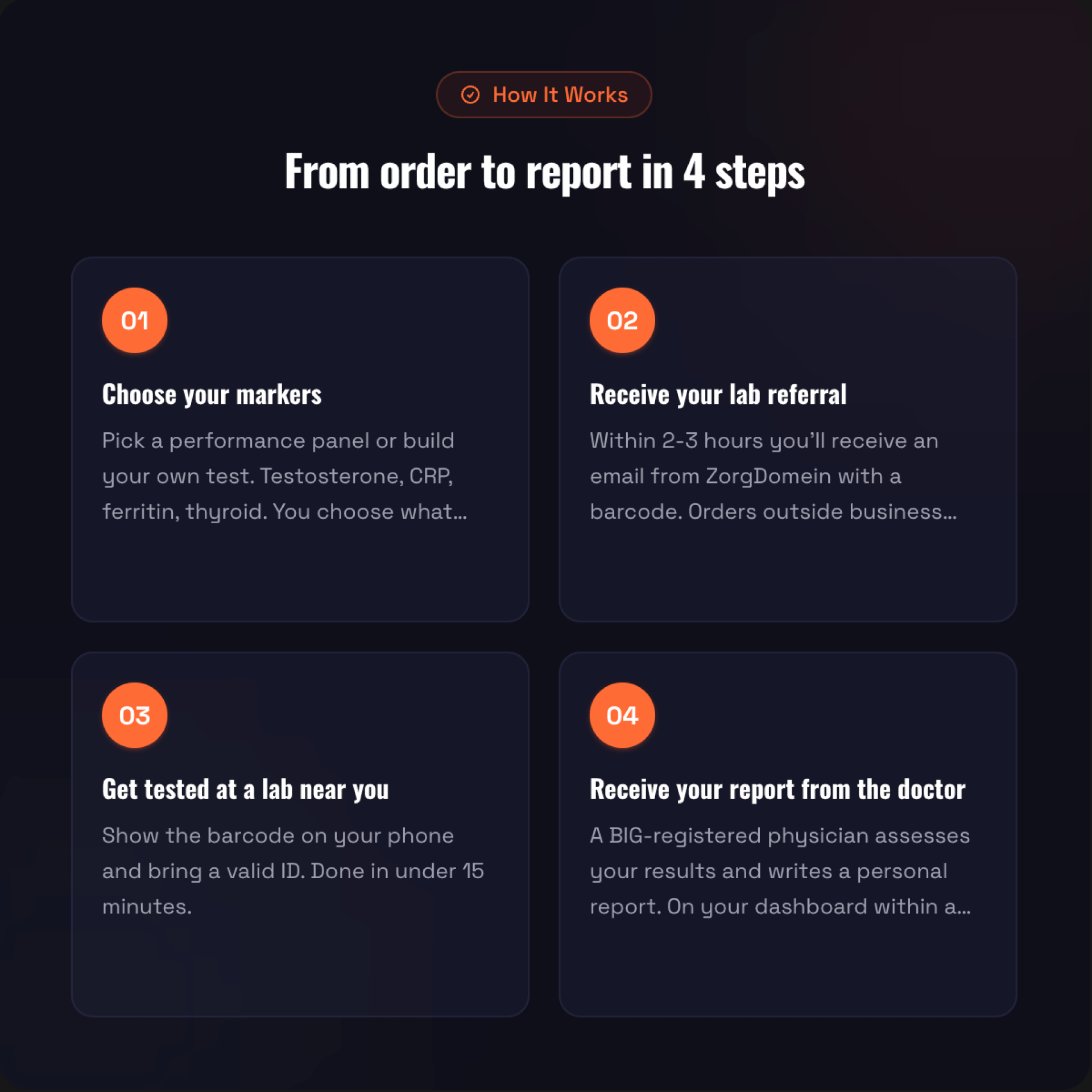
You order online, without a GP referral. After you order, we arrange your referral through ZorgDomein. Allow one business day. Orders placed in the evening or at the weekend start on the next business day.
The ZorgDomein email carries a barcode. Without a BSN there is no barcode: you then print your referral form through the link in the email and bring it to the draw location. You show it at one of the 650+ collection points, with a valid ID. Your order confirmation is not a referral.
What do the results mean?
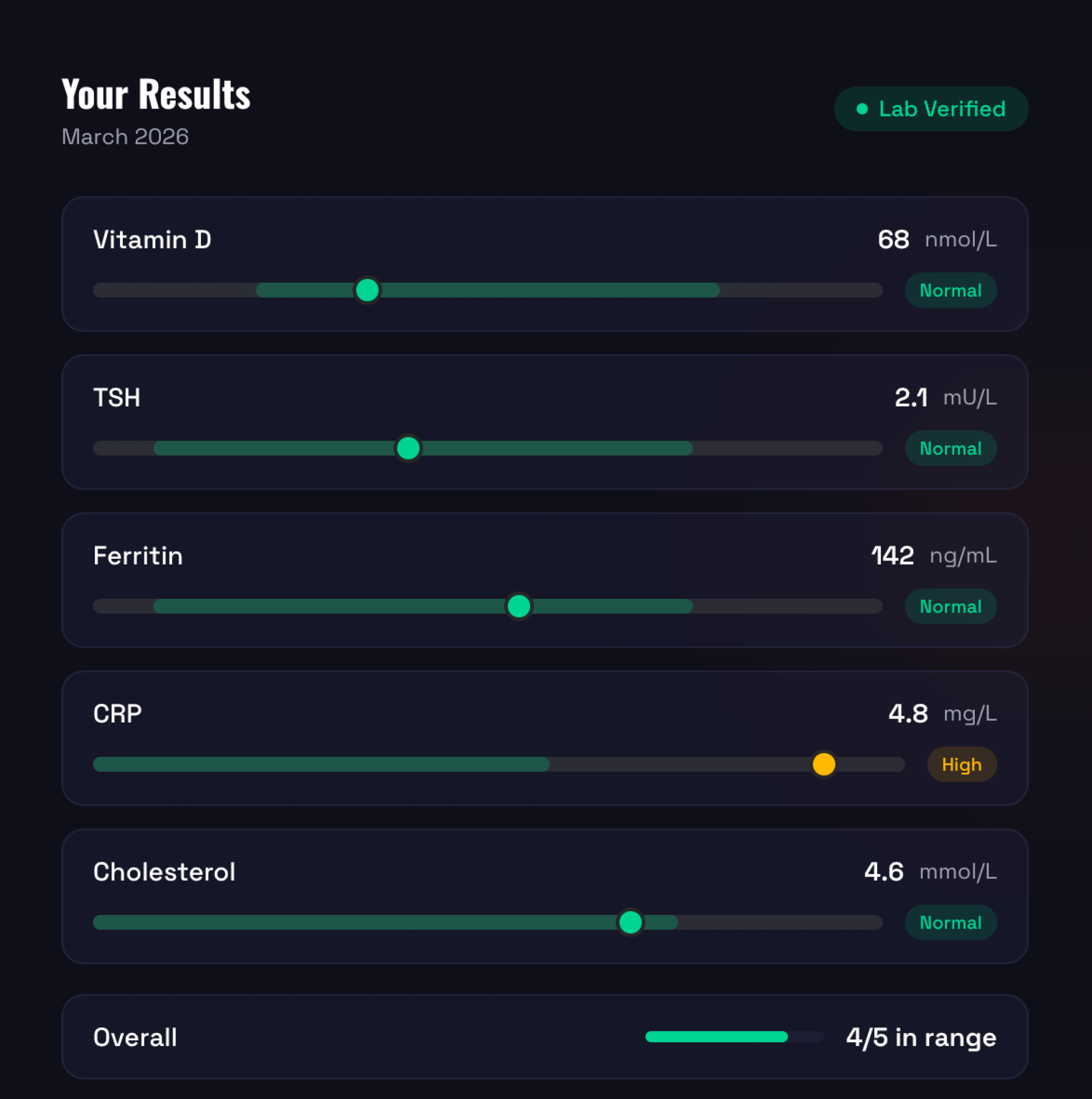
You see for each value whether it falls within the reference range. A value outside that range does not automatically mean something is wrong.
A doctor looks at the whole picture: your testosterone together with your hematocrit. You follow your PSA for your prostate, especially from forty onward. Measure more often and you see your own trend.
Your results are usually in your account within a few business days. A BIG-registered doctor assesses every result. Discuss abnormal values and treatment decisions with your treating doctor.
Want to measure more broadly? Take a look at the extended blood test with 44 values.
Frequently Asked Questions
TRT stands for testosterone replacement therapy. It is treatment with testosterone for men with a diagnosed deficiency. You only get it through a doctor.
Yes, on a doctor's prescription. That can be through your GP and a specialist, or through a private clinic. We do not offer treatment ourselves; this test is monitoring alongside your doctor.
Guidelines ask for symptoms that fit a deficiency and a repeatedly low morning testosterone value. Your doctor makes that diagnosis.
It brings your testosterone back to a normal level. Your hematocrit often rises and your own production and sperm production fall. You follow that in your blood.
Known downsides include a high hematocrit, lower sperm production, acne, fluid retention and tender breasts. Always discuss the pros and cons with your doctor.
Yes, this is an independent measurement separate from your provider. Many men use it as an extra check between visits. Share your results with your treating doctor.
Guidelines name three to six months after starting or after a dose change, and yearly after that. Your doctor sets your schedule.
Reference values differ per lab. Guidelines name a hematocrit above 0.54 as a reason to review treatment. Your doctor judges what fits you.
No. Timing matters more. With injections you measure midway between two injections, with gel two to eight hours after applying it.
What's Included
| No. | Biomarker | Unit | Turnaround |
|---|---|---|---|
| 01 | PSA (Prostate-Specific Antigen) | ug/l | 2 days |
| 02 | SHBG (Sex Hormone Binding Globulin) | nmol/l | 5 days |
| 03 | Total Testosterone | nmol/l | 2 days |
| 04 | Albumin | g/l | 2 days |
| 05 | Hemoglobin | mmol/l | 1 day |
| 06 | Hematocrit | l/l | 1 day |
| 07 | Free Testosterone | pmol/L | 3 days |
| Your result arrives once the slowest test is finished: 5 days. This is indicative; turnaround varies per laboratory. | |||
Preparation
-
Pause biotin
RequiredDo you take a supplement with biotin (vitamin B8, common in hair, skin and nail supplements)? Stop it 72 hours before the draw. Biotin interferes with the measurement of these values.
-
No hard training beforehand
RequiredNo heavy training, long endurance sessions or anything that leaves you out of breath in the 48 hours before the draw. Normal walking is fine.
-
No ejaculation and no cycling beforehand
RequiredNo ejaculation, no sex and no cycling in the 48 hours before the draw. Have the blood taken before any prostate exam, at least 6 weeks after a biopsy and 4 weeks after a urinary infection.
-
Have the draw in the morning
RequiredThese values vary over the day and peak in the morning. Have your blood drawn before 10:00, ideally between 07:00 and 09:00.
- Water is always fine. Drink as usual beforehand, it makes the draw easier.
- Take your usual medication, unless your own doctor told you otherwise.
Extend this panel
Same draw, no second appointment.
More Test Panels
General Hormones
Testosterone panel for men: total testosterone, SHBG, albumin and calculated free testosterone.
360 Health
Broad health panel: hormones, thyroid, vitamins, lipids, liver, kidney, and blood count.
Free Testosterone Test
Measure your free testosterone, the bioavailable fraction that influences your performance and recovery. No referral needed.