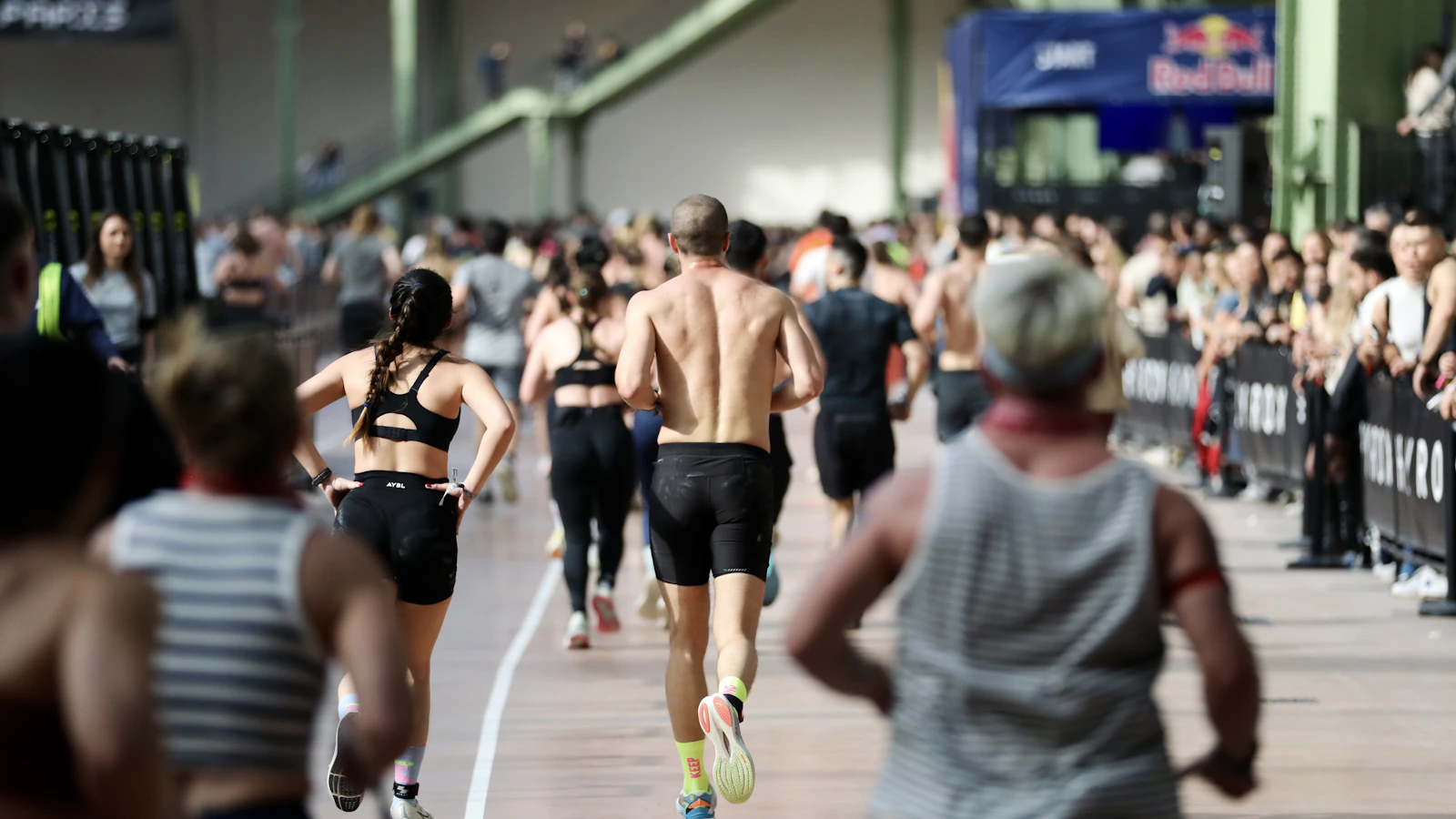
Feeling dizzy after a workout usually comes from your blood pressure dropping the moment you stop. Your leg muscles no longer pump blood upward while your blood vessels are still wide open.
Standing still and upright for fifteen minutes after exercise gives many people near-fainting symptoms. Researchers estimate that at 50 to 80% of healthy people (Halliwill 2014, PMID 24197081).
Most dizziness after exercise is harmless: sit or lie down and it often passes. I watch two things: when it starts and what comes with it.
Dizzy during a workout is a different story from dizzy afterwards. And dizzy with chest pain is a reason to call.
Why do you get dizzy after a workout?
Dizziness after a workout usually has one of four causes. Your blood pressure drops when you stop abruptly, or you are hot and have sweated a lot. Sometimes your iron or your haemoglobin is low, and very rarely your heart is involved.
| Cause | When it starts | What comes with it |
|---|---|---|
| Blood pressure drops after stopping | Right after your last set or after the finish, when you stand still | Light-headed, black spots, blurred vision, pale and sweaty |
| Heat and heavy sweating | On warm days or in a warm gym | The same complaints. Heat opens your blood vessels further |
| Iron deficiency or anaemia | During training too, and on ordinary days | Out of breath sooner, tired, palpitations |
| Your heart (rare) | During the effort itself | Chest pain, palpitations or fainting |
Dehydration often gets the blame. Three doctors reviewed the evidence and point to a different main cause. That is blood pooling in your legs as soon as you stand still (Asplund 2011, PMID 21948122).
What happens to your blood pressure when you stop exercising?
Your blood pressure falls after exercise because the vessels in the muscles you used stay wide open. While you move, your leg muscles squeeze blood back to your heart. Stand still and that pump stops, so blood sinks to your legs.
Your brain then gets less blood for a moment. You feel that as a light head or nausea.
It is called post-exercise hypotension, low blood pressure after effort (Halliwill 2013, PMID 22872658).
For a long time doctors thought dehydration and overheating were the main cause. According to Asplund's review it is mostly that fall in blood pressure after standing still. Doctors do first rule out the dangerous causes, such as cardiac arrest or heat stroke.
After that the treatment is simple: drink and lie down with your legs up.
Two runners after the same 10 kilometres
Imagine two runners cross the finish of a 10 km together. One stands in the queue for the medal, the other walks for five minutes.
After a minute the first sees black spots and has to sit down. The second notices nothing, although their training, their drinking and their pace were the same.
The difference is in their calves: whoever keeps walking keeps the muscle pump working. Movements like that often help to prevent a large drop in blood pressure (Halliwill 2014).
That is why dizziness after running is the best-known example: you stop suddenly, often hot and sweaty.
Why is your vision blurry after a workout?
Blurry vision after a workout usually comes from the same low blood pressure. Thuisarts is the Dutch GPs' public site. For low blood pressure it lists black spots, blurred vision and briefly seeing nothing. You usually don't have those complaints lying down.
So sit or lie down and wait until your sight is back. Then stand up slowly, and according to Thuisarts extra slowly when you are very warm.
Do you see double, struggle to speak or lose strength in an arm or leg? Then call your GP or the out-of-hours GP service straight away.
Dizzy during a workout: when is it your blood?
Dizziness during a workout fits less well with blood pressure that only drops after you stop. If you also tire sooner and run out of breath earlier, anaemia may play a part. Thuisarts lists dizziness and not getting enough air during exercise as complaints of anaemia.
Anaemia means you have too few red blood cells. Those cells hold haemoglobin, which carries oxygen to your cells. Anaemia is most often caused by too little iron.
Iron deficiency is common in athletes. In one review 15 to 35% of female athletes were deficient. In men it was 5 to 11% (Sim 2019, PMID 31055680).
Those percentages come from groups that were studied, mostly endurance athletes. They say nothing about you; only a measurement does.
Your haemoglobin shows whether there is anaemia. Your ferritin shows how full your iron stores are.
The complete blood count measures your haemoglobin and counts your red blood cells. The ferritin test measures ferritin only.
I wouldn't take iron without a measurement; why not is in iron bisglycinate.
When do you call your GP about dizziness after exercise?
Call your GP or the out-of-hours GP service straight away if you fainted during exercise. According to Thuisarts the same goes if you had chest pain or palpitations just before.
Make an appointment on a working day if you fainted without feeling it coming. Do the same if relatives under 40 have heart problems or died suddenly of a heart problem.
Are you very dizzy again and again, and do standing up slowly and drinking enough not help? According to Thuisarts that is also a reason for an appointment.
What a skipped beat means in athletes is in heart palpitations during exercise.
My advice as a training partner
For dizziness I'd start with the cheapest test: five minutes of walking after your next hard session. If it stays away, you know what it was. Stand up extra slowly after a sauna or a hot bath.
Do you also get dizzy during training, or have you been short of breath sooner for weeks? Then I wouldn't stop at cooling down, and I'd discuss it with my GP.
How your heart rate and your blood pressure differ is in heart rate versus blood pressure.
If a blood value is off, discuss it with your GP. Every blood test result includes a professional assessment from a BIG-registered doctor. For treatment decisions, discuss your results with your GP.
Sources
- Halliwill JR, Sieck DC, Romero SA, Buck TM, Ely MR. Blood pressure regulation X: what happens when the muscle pump is lost? Post-exercise hypotension and syncope. Eur J Appl Physiol 2014 (PMID 24197081).
- Halliwill JR, Buck TM, Lacewell AN, Romero SA. Postexercise hypotension and sustained postexercise vasodilatation: what happens after we exercise? Exp Physiol 2013 (PMID 22872658).
- Asplund CA, O'Connor FG, Noakes TD. Exercise-associated collapse: an evidence-based review and primer for clinicians. Br J Sports Med 2011 (PMID 21948122).
- Sim M, Garvican-Lewis LA, Cox GR, et al. Iron considerations for the athlete: a narrative review. Eur J Appl Physiol 2019 (PMID 31055680).
- Thuisarts: Ik ben flauwgevallen, Ik heb een lage bloeddruk, Ik ben duizelig en Ik heb bloedarmoede, thuisarts.nl, consulted 2026.
Autor
Enhanced Health
Powiązane badania
Powiązane artykuły
Training with sore muscles: when it is fine and when to wait
Can't sleep after a workout: what is going on and what helps