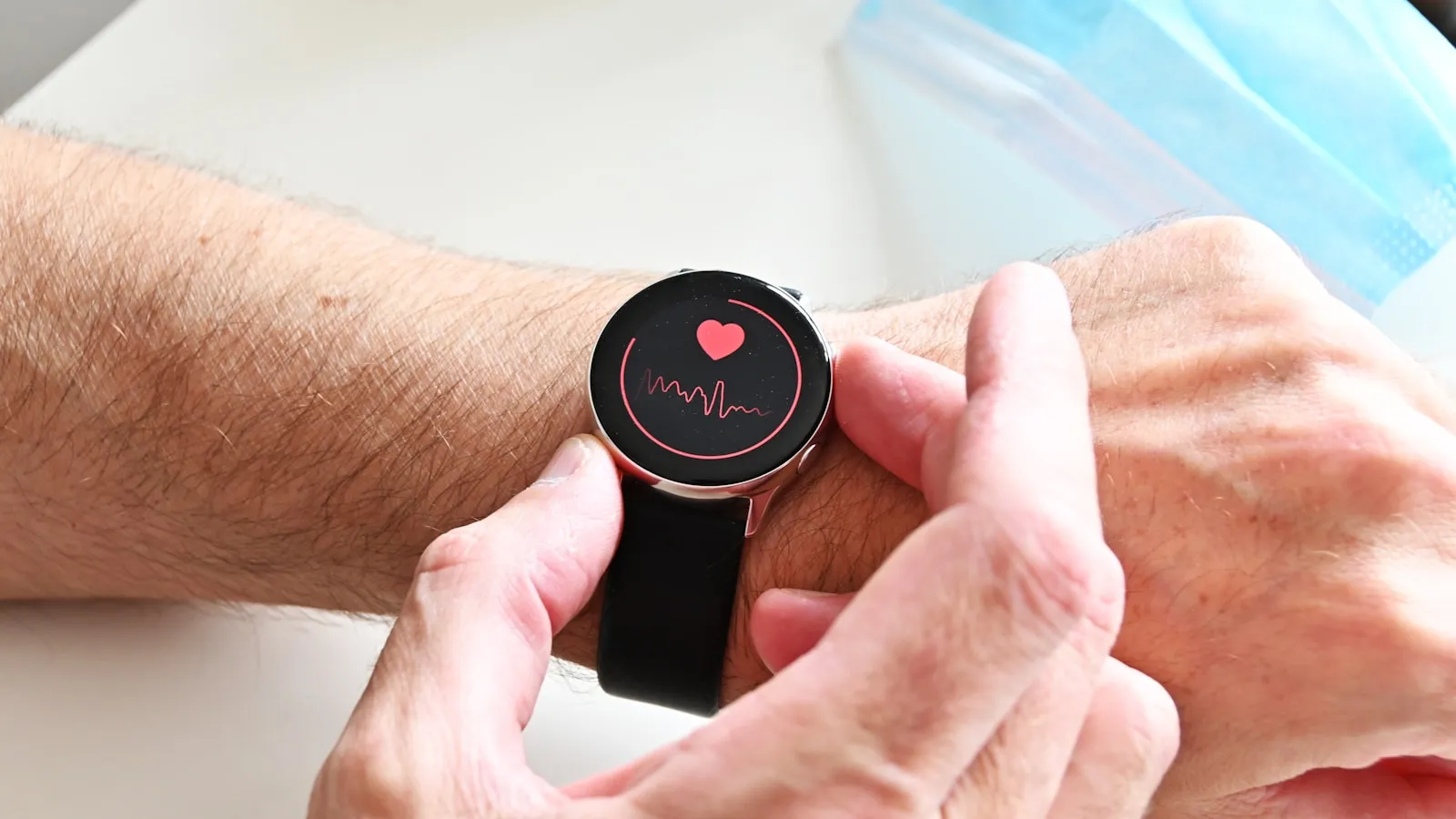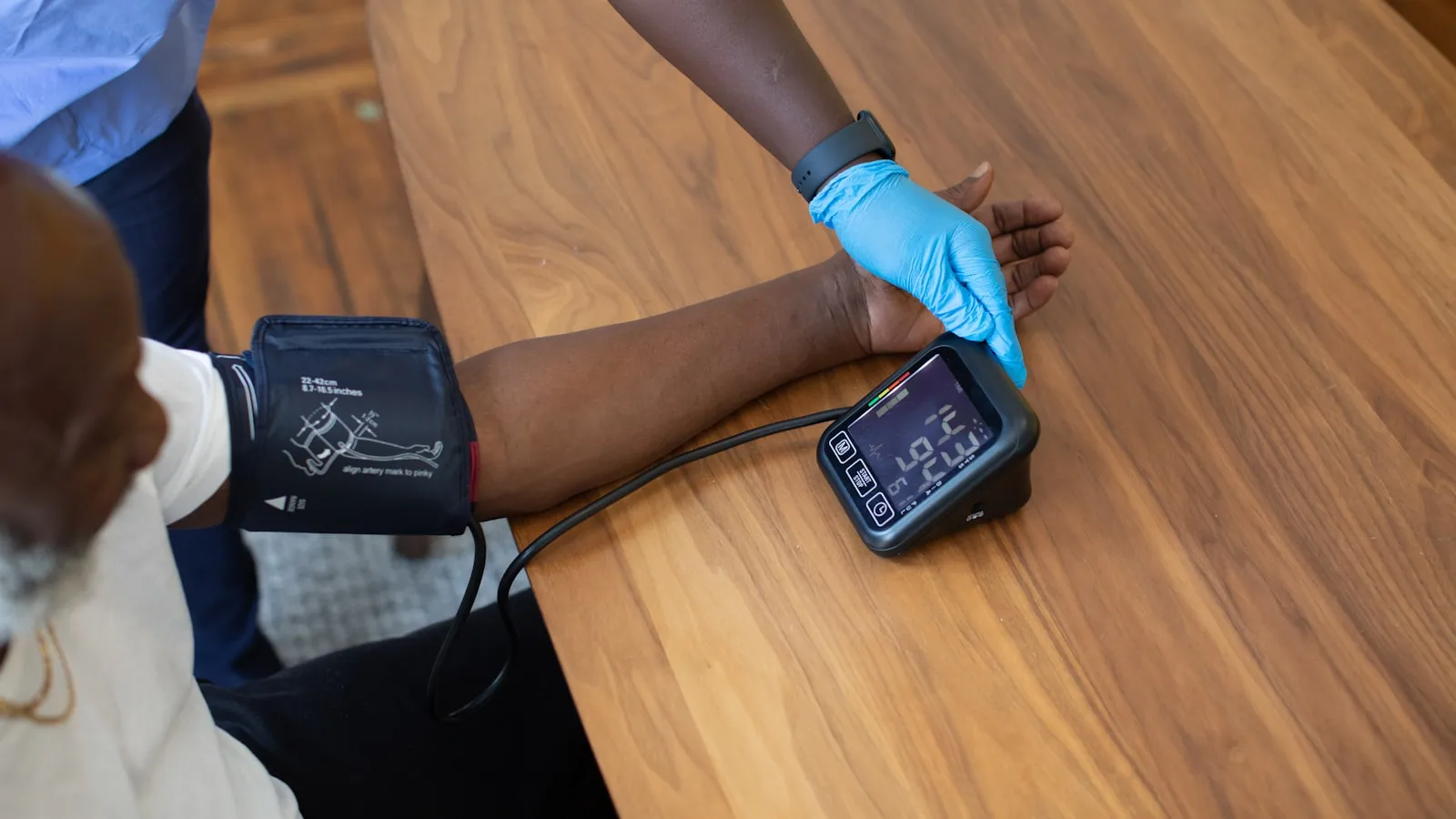
Heart rate and blood pressure are two different measurements that do not move together predictably. Your heart rate counts how often your heart beats per minute. Your blood pressure measures the force the blood exerts on your vessel walls. A low heart rate therefore guarantees no low blood pressure.
That is the mistake I meet most often in athletes.
A resting heart rate of 48 feels like proof that your heart is in order. It says something about your vagal tone and your fitness, and almost nothing about the pressure in your vessels.
What do those two numbers actually measure?
Your heart rate is a frequency: the number of contractions per minute. Your blood pressure is a force, expressed as two numbers. The upper figure is the peak during a contraction, the lower one the resting pressure between beats.
They share one system but describe different properties of it.
Compare it to plumbing. Heart rate is how often the pump kicks in, blood pressure is how tight the pipe sits. A pump running calmly can sit on a very tight system, and that is exactly what happens in many strength athletes.
| Feature | Resting heart rate | Blood pressure |
|---|---|---|
| What it measures | Beats per minute | Pressure on the vessel wall |
| What mainly drives it | Vagal tone and fitness | Vessel stiffness, volume, salt balance |
| Effect of endurance training | Falls clearly | Falls slightly |
| Effect of heavy strength training | Barely falls | Can rise |
| When to measure | Best just after waking | Seated, after five minutes of rest |
The fourth row explains most of the confusion. Endurance training mainly lowers your heart rate, strength training touches your blood pressure. Anyone who only lifts heavy and goes by heart rate is missing precisely the number that matches their training.
Imagine two strength athletes who both measure 52 beats per minute on waking. One has a blood pressure of 118 over 74, the other 146 over 92.
Same pulse, a very different story.
The second would probably never have had his blood pressure measured, because his heart rate told him everything was fine. That is exactly the reason to know both numbers rather than trusting one.
What strength training does to your pressure sits in training with high blood pressure.
Does a high heart rate mean high blood pressure?
Not automatically. During exercise they usually do rise together, because your heart pumps harder and faster. At rest that link largely disappears, and they can even move in opposite directions.
An example makes it clear.
In dehydration your blood volume drops. Your blood pressure falls, and your heart compensates by beating faster. High heart rate, low pressure, exactly the reverse of the intuition. You see the same pattern with blood loss and with standing for long periods in the heat.
The opposite happens too. Some people with high blood pressure have a perfectly tidy resting heart rate of 60. So you cannot derive one from the other, in either direction.
Why does the pulse on my monitor differ from my watch?
Because they measure in different ways and over different time windows. A blood pressure monitor derives your pulse from the pressure waves during a single inflation cycle of about thirty seconds. Your watch estimates it optically, from light reflection at your wrist, over a rolling window.
Two methods, two moments, so two numbers.
A difference of a few beats is normal and means nothing. Large, shifting differences are more interesting, because an optical sensor loses reliability precisely during an irregular rhythm.
If your watch and your cuff diverge consistently while you sit still, that is a reason to have the rhythm itself looked at. The triage for that sits in palpitations during exercise.
Is a low resting heart rate always good?
Usually, but it is not a free pass. A low resting heart rate belongs with endurance training and high vagal tone. At group level a higher resting heart rate tracks with a higher risk of cardiovascular disease and mortality, as a meta-analysis showed (PMID 26598376).
A UK Biobank analysis from 2020 found the same link, broken down by age and sex (PMID 32470091).
What matters is that the two numbers count separately. Your resting heart rate carries information your blood pressure does not, and the other way round. Following one and ignoring the other means looking at half the picture.
There is also a limit to the athlete explanation. Research from 2004 showed that enhanced vagal activity does not fully explain training-induced bradycardia (PMID 15233931). Your low heart rate partly comes from adaptation in the sinus node itself.
More on that value sits in resting heart rate and recovery.
How do you measure both properly?
For blood pressure: seated, back supported, feet flat, cuff at heart height, after five minutes of rest. Measure twice with a minute in between and record the second. Not right after coffee, not after training, and not with a full bladder.
The Hartstichting uses the same starting points.
For resting heart rate something else applies: measure it right after waking, before you get up. Everything that comes after, from your first espresso to the stairs, distorts the figure.
After a hard training day, do not measure your best number but your most honest one. A resting heart rate sitting five to ten beats above normal for three days running is a usable signal of incomplete recovery. That sits in recognising overtraining through your blood values.
What does this mean for your risk as an athlete?
That you need both numbers, plus some context. The standard risk calculation works with blood pressure, cholesterol, age and smoking, and takes no account of fitness far above average. In athletes the output therefore often lands askew.
What that calculation misses sits in cardiovascular risk in athletes.
In practice I would lay three things side by side. Your blood pressure, measured as above. Your resting heart rate, across weeks rather than days. And a blood panel with the values that touch your vessels and your oxygen transport.
For that last part, haemoglobin, hsCRP and your electrolytes are the most useful. They sit together in the heart panel.
The lesson I would most like to pass on: a low resting heart rate is pleasant news about your fitness, and no evidence at all about your blood pressure.
Every blood test result includes a professional assessment by a BIG-registered doctor. Discuss your results with your GP before making treatment decisions.
References
- Zhang D, Wang W, Li F. Association between resting heart rate and coronary artery disease, stroke, sudden death and noncardiovascular diseases: a meta-analysis. CMAJ, 2016;188(15):E384-E392. PMID 26598376.
- Age, sex and disease-specific associations between resting heart rate and cardiovascular mortality in the UK Biobank. PLoS One, 2020. PMID 32470091.
- Boyett MR, D'Souza A, Zhang H, et al. Enhanced cardiac vagal efferent activity does not explain training-induced bradycardia. Autonomic Neuroscience, 2004;111(2):126-133. PMID 15233931.
- Hartstichting. Measuring blood pressure.
Author
Enhanced Health
Dr. Naimi, BIG-registered physician, oversees the medical standards behind our content and assessments. Read our medical policy
Related Tests
Related Posts

Palpitations and your thyroid: when to have your TSH tested

Atrial fibrillation symptoms: what endurance athletes should know