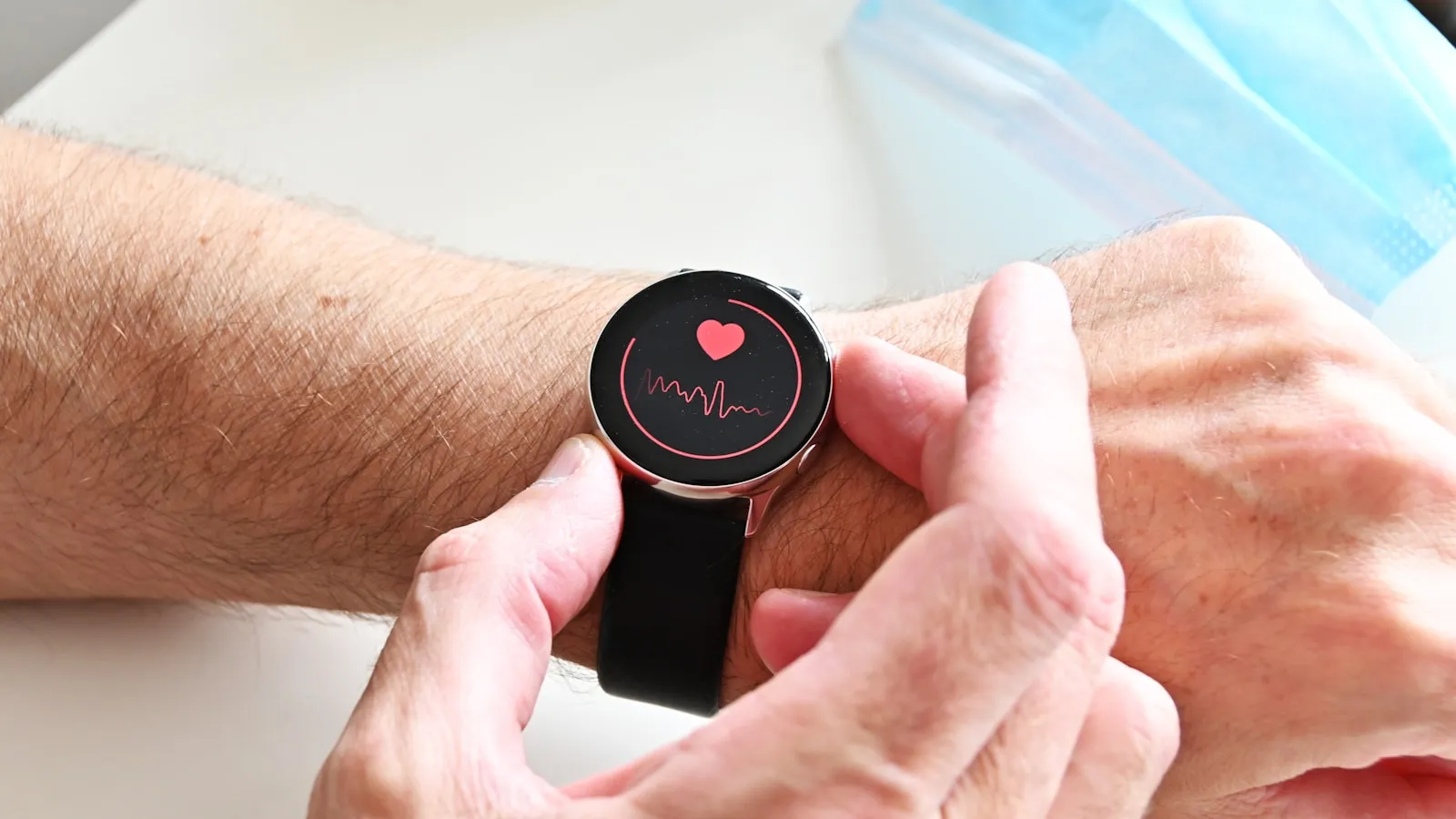
Palpitations and your thyroid are connected because thyroid hormone speeds your heart rate and lowers the excitation threshold of your heart muscle. With an overactive thyroid, palpitations are often the first thing noticed. One tube of blood containing TSH largely rules that out.
It is one of the few causes with a concrete answer.
That makes this test attractive as a first step. Most other explanations for palpitations cannot be measured at all.
How does your thyroid cause palpitations?
Thyroid hormone raises your heart's sensitivity to adrenaline. Your heart rate rises, your heart muscle contracts more forcefully, and extra beats arise more easily. With an excess of hormone you feel that as pounding, a fast pulse at rest, or isolated skipped beats.
The effect sits in the baseline rate.
A resting heart rate sitting ten to twenty beats above your usual figure for no obvious reason is the most useful signal. In athletes that stands out more, because they usually know their own normal well.
Which thyroid values are relevant?
TSH first, then free T4. TSH is the hormone your brain uses to drive your thyroid, and it responds sensitively to deviations. A low TSH points towards an overactive thyroid, a high TSH towards an underactive one.
That direction feels inverted, and it is.
If your thyroid makes too much hormone, your pituitary dials the instruction back. So TSH falls precisely when the thyroid is overactive. Free T4 then shows how much hormone is actually circulating.
| Result | What it usually means | What you may notice |
|---|---|---|
| TSH low, free T4 high | Overactive thyroid | Palpitations, weight loss, feeling hot, restlessness |
| TSH low, free T4 normal | Subclinically overactive | Often few or no symptoms |
| TSH high, free T4 low | Underactive thyroid | Fatigue, feeling cold, slow heart rate |
| TSH and free T4 normal | Thyroid unlikely as the cause | Look further at iron or electrolytes |
That second row is the category most often waved away. Subclinical means only the TSH deviates, without symptoms that stand out, and that group turns out not to be risk-free.
The values themselves are explained in TSH levels explained and thyroid and your metabolism.
Does a result inside the normal range count too?
Apparently yes, and that is the finding that makes this topic interesting. Baumgartner and colleagues followed more than 30,000 people and saw that thyroid values within the normal range tracked with the risk of atrial fibrillation. A higher free T4 matched a higher risk (PMID 29061566).
Read that again: within the normal range.
Imagine two athletes both told their result is normal, one with a TSH of 1.9 and the other with 0.4.
The first has a free T4 in the middle of the range. The other has a TSH of 0.4 and a free T4 sitting against the upper limit.
Both are told everything is fine.
For the first that is accurate. For the second the result is formally normal, but sits at the end of the range that tracked with higher risk in the research. That is not a reason for treatment, but it is a reason to repeat it in three months rather than tick it off.
A 2024 meta-analysis examined subclinical thyroid dysfunction and incident atrial fibrillation, and confirmed that this category counts (PMID 38165911). Subclinical is therefore not a synonym for unimportant.
That does not mean a normal result with a high-normal T4 should be treated. It means the result carries information that the word normal alone does not convey. What that means for your rhythm sits in atrial fibrillation in endurance athletes.
How do you tell an overactive thyroid from overtraining?
On the symptom list they look strikingly alike. Palpitations, poor sleep, weight loss, irritability and a raised resting heart rate fit both. The difference sits in the course and in your training log, not in the symptoms themselves.
Two questions usually separate them.
First: does it respond to rest? With overload your resting heart rate falls after a genuine rest week. With an overactive thyroid little changes, because the cause is independent of your training load.
Second: does it match your heat perception? Heat intolerance, sweating without effort and trembling hands point towards the thyroid. Heavy legs, falling motivation and worse session quality point towards load.
Both tracks can run at once, and that is not rare. The load side sits in recognising overtraining through your blood values, the underactive side in an underactive thyroid.
When should you test your thyroid for palpitations?
If the symptom lasts longer than a few weeks, or if second symptoms come with it. Unintended weight loss, heat intolerance, trembling hands or a structurally higher resting heart rate are the strongest reasons. For a single skipped beat after a hard session it is not needed.
Fasting is not required for this.
Do test on an ordinary day, so not straight after a heavy training block or a night with two hours of sleep. For comparability over time it helps to keep roughly the same time of day.
Concretely this means TSH and free T4. TSH alone is a reasonable start, but with symptoms the combination gives a fuller picture. You can test them separately with the TSH test or alongside your heart values via the heart panel.
What if your thyroid turns out normal?
Then three measurable trails remain. Your iron status, your electrolytes and your inflammatory markers, in that order of yield. In athletes with palpitations plus fatigue, iron is the most common finding.
After that it becomes pattern recognition.
Note when the symptom arrives, how long it lasts and whether it disappears during exercise. Extra beats that fall away as your heart rate climbs are usually benign, and that distinction sits in premature heartbeats in athletes.
Baman and colleagues showed that the share of extra beats only starts to count clinically above ten percent of your daily total (PMID 20348027). A handful of noticeable skipped beats a day falls nowhere near that.
The full triage sits in palpitations during exercise. For dizziness or fainting during exertion the rule is: contact your doctor the same day.
What stays with me about this topic: the thyroid is the cheapest explanation to rule out, and at the same time the one considered last.
Every blood test result includes a professional assessment by a BIG-registered doctor. Discuss your results with your GP before making treatment decisions.
References
- Baumgartner C, da Costa BR, Collet TH, et al. Thyroid function within the normal range, subclinical hypothyroidism, and the risk of atrial fibrillation. Circulation, 2017;136(22):2100-2116. PMID 29061566.
- Singh H, et al. Subclinical thyroid dysfunction and the risk of incident atrial fibrillation: a systematic review and meta-analysis. PLoS One, 2024. PMID 38165911.
- Baman TS, Lange DC, Ilg KJ, et al. Relationship between burden of premature ventricular complexes and left ventricular function. Heart Rhythm, 2010;7(7):865-869. PMID 20348027.
- Hartstichting. Heart rhythm disorders.
- Thuisarts. I have palpitations.
Author
Enhanced Health
Dr. Naimi, BIG-registered physician, oversees the medical standards behind our content and assessments. Read our medical policy
Related Tests
Related Posts
Heart rate and blood pressure: why the two numbers say different things

Atrial fibrillation symptoms: what endurance athletes should know