Premature heartbeats are extra beats that arrive too early, and in a healthy heart they are almost always harmless. Nearly everyone has them and most people never feel them. Your heart does not skip a beat, it actually adds one.
What you feel is the pause afterwards.
That pause gives the ventricle extra time to fill, which makes the next beat more forceful. That forceful beat is the thump you feel in your chest, not the extra beat itself.
What are premature heartbeats exactly?
A premature beat is a heartbeat arriving earlier than the normal rhythm dictates. The impulse starts outside the sinus node, in the atria or in the ventricles. A short pause then follows before the usual rhythm takes over again.
There are two kinds, and the distinction counts.
Atrial premature beats come from the upper chambers and are rarely a problem. Ventricular premature beats come from the lower chambers, and those are monitored when the numbers get large. You cannot feel which of the two you have. That needs an ECG.
How many premature beats a day are too many?
It depends on their share of your total beats, not on the number you feel. Baman and colleagues found that a ventricular ectopic burden above 24 percent best separated people with impaired from normal pump function. The lowest burden that produced a reversible cardiomyopathy in their group was 10 percent (PMID 20348027).
Convert that and it becomes usable.
A heart beats roughly 100,000 times a day. Ten percent is then 10,000 extra beats, and 24 percent nearly 24,000. Someone feeling five an hour sits at about 120 a day, well under a tenth of a percent.
| Number per day | Share of your beats | What that usually means |
|---|---|---|
| A few to a few hundred | Under 1 percent | Counts as normal |
| Around 1,000 | About 1 percent | Often still harmless, worth noting |
| Around 10,000 | About 10 percent | The research threshold in the literature |
| Above 24,000 | Above 24 percent | Strongly raised chance of pump impairment |
The figures in that table come from research in patients already referred for rhythm complaints. They are a scale to set your own experience against, not a cut-off for yourself.
Imagine two athletes who both notice roughly 10 skipped beats an hour on a quiet evening. In one, the Holter counts 180 across a full day; in the other, more than 12,000.
Same experience, a seventyfold difference.
The first sits at about 0.2 percent of his daily total and belongs in the top row of the table. The second sits near 12 percent and falls into the category cardiologists watch. Neither could have known that without measuring.
The only thing that establishes the real number is a 24-hour Holter. By feel almost everyone overestimates, because you only count the beats you notice.
Why do you feel them mostly at rest and after training?
Because your heart rate is low then and your vagal tone high. Against a quiet rhythm of fifty beats an extra beat stands out sharply. During exercise your heart runs fast and isolated extra beats blend into the tempo, so you barely notice them.
In trained athletes that effect is larger.
A low resting heart rate is exactly the state in which you notice an outlier. That means your symptom can increase while your fitness improves, which feels counterintuitive. Why your resting heart rate falls sits in resting heart rate and recovery.
The hour on the sofa after a hard session is therefore the classic moment.
When are premature beats during exercise concerning?
When they increase during effort instead of disappearing. That is the most useful distinction there is and it is rarely written down anywhere. Extra beats that fall away as your heart rate climbs usually point to a benign form.
The reverse is a reason to investigate.
Beyond that the same limits apply as for other rhythm symptoms. Dizziness, near-fainting, chest pain or breathlessness that does not match your effort belong with a doctor. Fainting during exertion always warrants investigation, even if you are otherwise extremely fit.
A family history of sudden cardiac death at a young age belongs in that same conversation. What a clinical exercise test sees of this sits in the exercise stress test explained.
Does quitting coffee help?
Probably less than you hope. Almost every Dutch page on this topic names caffeine as the first culprit, but the targeted research does not support that advice. Newby and colleagues concluded in 1996 that caffeine restriction has no role in symptomatic ventricular premature beats (PMID 8983684).
That is one study from 1996, with a small group.
So I do not read it as proof that coffee is harmless. I read it as a reason to test it yourself rather than adopt the advice unquestioned. Two weeks without, then look honestly at whether anything changed.
Among the athletes I speak to, sleep debt is by far the strongest trigger, followed by alcohol. Caffeine sits surprisingly low in that ranking. How caffeine works otherwise sits in caffeine and pre-workout.
Which blood values belong with this?
Your electrolytes and your thyroid. Potassium and magnesium drive electrical conduction in the heart muscle, and low values increase the tendency towards extra beats. Thyroid hormone lowers the excitation threshold, which makes extra beats easier to trigger.
Both can be ruled out from one draw.
Baumgartner and colleagues showed that even thyroid values within the normal range tracked with the risk of atrial fibrillation (PMID 29061566). That concerns a different arrhythmia, but it underlines that a result need not be abnormal to mean something.
Look at potassium, magnesium and TSH. With heavy sweating and long sessions, electrolytes and hydration is the starting point.
These values sit together in the heart panel.
What do you actually do with this?
Note two things: when they come and whether they disappear during exercise. That second question answers half your uncertainty and costs you nothing. Do an easy endurance run and watch what happens once your heart rate passes 130.
If they vanish there, that is a reassuring sign.
If the symptom persists for weeks, a Holter and a blood panel are the two steps with a concrete outcome. If you feel a rhythm that stays fast and irregular for a long stretch, something else is going on: see atrial fibrillation in endurance athletes.
An irregular feeling that moves neatly with your breathing is a third category again, described in sinus arrhythmia. The full triage sits in palpitations during exercise.
What strikes me most: people are alarmed by the sensation, while the count almost always turns out modest once it is properly measured.
Every blood test result includes a professional assessment by a BIG-registered doctor. Discuss your results with your GP before making treatment decisions.
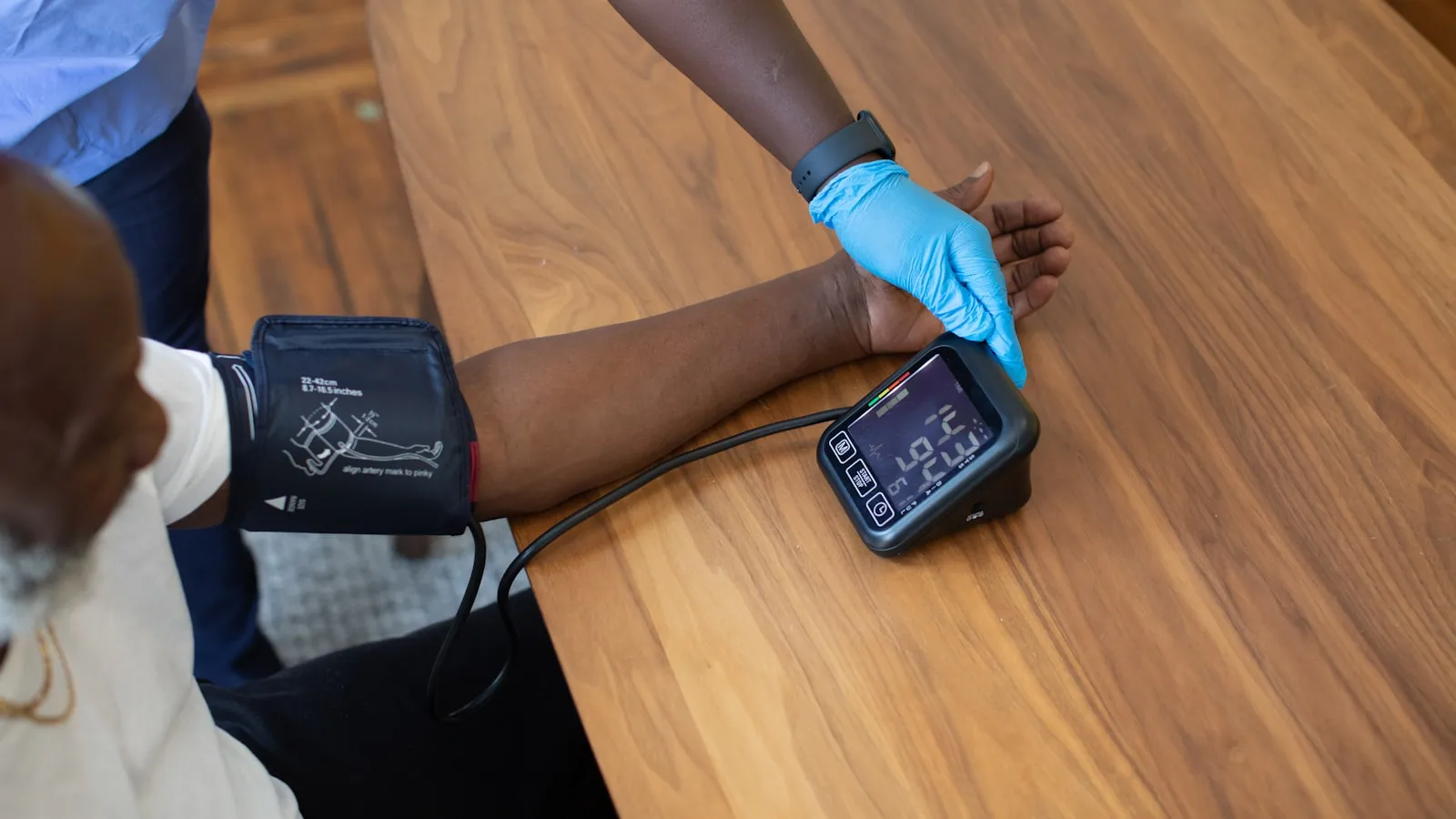
If you track at home, remember that heart rate and blood pressure are not the same signal.
References
- Baman TS, Lange DC, Ilg KJ, et al. Relationship between burden of premature ventricular complexes and left ventricular function. Heart Rhythm, 2010;7(7):865-869. PMID 20348027.
- Newby DE, Neilson JM, Jarvie DR, Boon NA. Caffeine restriction has no role in the management of patients with symptomatic idiopathic ventricular premature beats. Heart, 1996;76(4):355-357. PMID 8983684.
- Baumgartner C, da Costa BR, Collet TH, et al. Thyroid function within the normal range, subclinical hypothyroidism, and the risk of atrial fibrillation. Circulation, 2017;136(22):2100-2116. PMID 29061566.
- Hartstichting. Heart rhythm disorders.
- Thuisarts. I have palpitations.
Author
Enhanced Health
Dr. Naimi, BIG-registered physician, oversees the medical standards behind our content and assessments. Read our medical policy
Related Tests
Related Posts

Palpitations and your thyroid: when to have your TSH tested
Heart rate and blood pressure: why the two numbers say different things