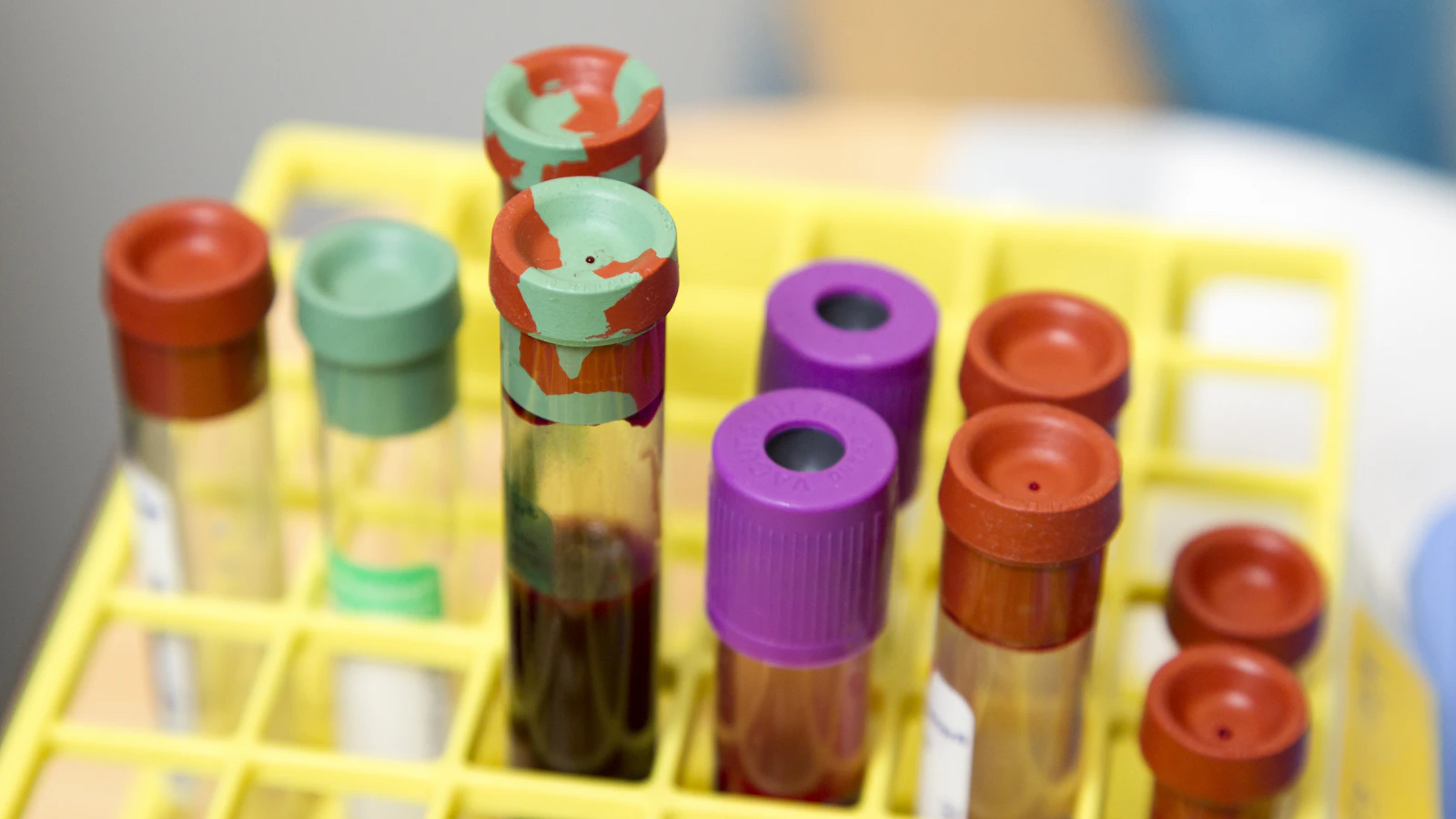
A complete blood count measures three things: your red blood cells, your white blood cells and your platelets. It is the most requested blood test in the Netherlands, and probably the most misread. The reason is simple. The reference ranges were built for the average person, and you train four times a week.
That gap is wider than you think.
Hard training can temporarily double your white blood cells, and endurance work dilutes your haemoglobin with extra plasma (PMID 10688281). Two values that look abnormal while nothing is wrong. I have yet to see a Dutch article on the blood count that mentions this, and that is exactly why your result scares you for no reason.
What is a complete blood count?
A complete blood count is a tally of the cells in your blood. The lab measures how many red cells, white cells and platelets you have, how large those red cells are and how much haemoglobin sits inside them. It measures no hormones, no cholesterol and no vitamins. It counts cells, nothing more.
Each of those cells does something different. Red cells carry oxygen to your muscles. White cells are your immune defence. Platelets stop bleeding.
For an athlete that is an interesting combination, because all three respond to training. Your oxygen transport drives your endurance, and your immune defence decides whether you finish the training week or spend it in bed.
Which values are in a complete blood count?
Usually eleven to thirteen numbers across three groups. The red series (haemoglobin, haematocrit, erythrocytes, MCV, MCH), the white series (leukocytes, sometimes split into neutrophils and lymphocytes) and the platelets. Below is what each number measures and which way training pushes it.
| Value | What it measures | Typical adult range | What training does to it |
|---|---|---|---|
| Haemoglobin (Hb) | Oxygen-carrying protein in your red cells | Men 8.5 to 11.0 mmol/l, women 7.5 to 10.0 mmol/l | Can fall through plasma dilution in endurance training |
| Haematocrit | Share of your blood made up of cells | Men 0.40 to 0.50, women 0.36 to 0.46 l/l | Falls as plasma volume expands, rises with dehydration |
| Erythrocytes | Number of red blood cells | Men 4.5 to 5.5, women 4.0 to 5.0 x10¹²/l | Same dilution effect as haemoglobin |
| MCV | Average size of your red cells | Roughly 80 to 100 fl | Barely moves through training itself |
| MCH | Amount of haemoglobin per red cell | Roughly 1.7 to 2.1 fmol (27 to 33 pg) | Barely moves through training itself |
| Leukocytes | Total white blood cell count | Roughly 4.0 to 10.0 x10⁹/l | Can rise sharply for hours after a hard session |
| Neutrophils | Immune cell aimed at bacteria | Roughly 1.5 to 7.0 x10⁹/l | Rises most steeply right after exertion |
| Lymphocytes | Immune cell aimed at viruses | Roughly 1.0 to 4.0 x10⁹/l | Dips for a few hours after hard exertion |
| Platelets | Cell fragments involved in clotting | Roughly 150 to 400 x10⁹/l | Can rise briefly after intense exertion |
Reference ranges differ per laboratory, so always read the range printed on your own result. The numbers above point you in a direction; they are not a standard.
Why does training change your blood count?
Because training literally dilutes your blood and moves your immune cells around your body. Those are two separate mechanisms, and together they explain most abnormal-looking results in athletes. Neither one means something is wrong.
The first is plasma volume expansion. Endurance training makes your body produce more blood plasma, sometimes ten to twenty percent more. The number of red cells stays the same, but they swim in more fluid. The result: your haemoglobin and haematocrit read lower while your oxygen transport held steady or even improved. Sports medicine calls this sports anaemia or pseudo-anaemia (PMID 10688281).
The second is the white response. After a hard session your neutrophils shoot up and your lymphocytes dip for a few hours. That lymphocyte dip was long read as an open window for infection. More recent work corrects that picture: the cells do not vanish, they relocate to tissues where they are needed (PMID 32139352).
Imagine two athletes who both get a leukocyte count of 11.4 x10⁹/l, just over the upper limit. The first did a heavy leg session last night. The second has not trained in two weeks and has a sore throat. Same number, entirely different story.
What does the leukocyte differential tell you?
The differential splits your total white cells into types, and that split often says more than the total. Neutrophils point towards bacteria, lymphocytes towards viruses, eosinophils towards allergy. Two people with the same total can carry a very different immune story.
For an athlete this is the most useful line on your result. A raised total driven mainly by neutrophils fits the response to a hard session. A raised total with plenty of lymphocytes does not fit that at all, and points more towards a virus.
The types you usually see listed:
- Neutrophils. The largest group. Rises in bacterial infection, but also right after exertion.
- Lymphocytes. Aimed at viruses. Dips for a few hours after a hard workout.
- Monocytes. The clean-up crew, active after inflammation or an injury.
- Eosinophils. Raised in allergy or hay fever.
So request your blood count with a differential if you want to know something about your immune defence. Without that split you are left with one number hiding three stories.
When should you get blood drawn for a reliable count?
Rested, hydrated and not straight after a hard session. This is the part almost every Dutch explainer on the blood count skips, even though it shifts your result more than most supplements you take. The timing of your draw is a variable in its own right.
Three things that move your values before the needle goes in:
- Your last workout. A hard session can keep your white cells and platelets raised for hours. A rest day in between gives a calmer picture.
- Your hydration. Getting drawn dehydrated concentrates your blood and pushes haemoglobin and haematocrit up. After two litres of water the same cells look different.
- Your posture. Twenty minutes of standing before the draw can measurably raise your haematocrit compared with sitting or lying down.
My own rule of thumb: draw on a morning after a rest day, drinking normally, with no alcohol the night before. Not because the other values are wrong, but because that way you measure your baseline instead of your yesterday.
How do you read an abnormal value in your blood count?
By putting the value next to your context, not next to the reference range alone. A number just outside the limit means something very different in an endurance athlete mid-build than in someone who has been tired on the sofa for three weeks. This table is the triage I use myself.
| What you see | Often training-related when... | Discuss with your GP when... |
|---|---|---|
| Haemoglobin and haematocrit slightly low | You do a lot of endurance work, you feel fine and your performance holds | You are also tired, short of breath, or your ferritin is low |
| Leukocytes slightly high | You drew within a day of a hard session and otherwise feel fine | The value stays high on a calm repeat, or you have a fever |
| Lymphocytes low | You drew shortly after intense exertion | It persists, or you keep catching infections |
| Platelets slightly high | You drew right after hard exertion | It is repeatedly high, or you bruise unexplainably |
| Haematocrit high | You drew dehydrated, for instance after a sauna or a long ride | It is repeatedly high. See high haematocrit in athletes |
| MCV high | Rarely training-related | Almost always worth discussing. Think alcohol or a vitamin B12 deficiency (PMID 27542607) |
The right-hand column is not a diagnosis. It is a reason for a conversation.
What strikes me again and again with athletes: they panic about the red series (where training is often the explanation) and shrug at a raised MCV (where it rarely is). That is exactly the wrong way round.
What does a complete blood count not measure?
Your iron stores, your hormones, your inflammation and your metabolism. This is the most important limitation, and the most underrated. Your blood count can look tidy while your iron stores sit at the bottom.
That happens because your body protects your haemoglobin for as long as it can. Your ferritin, the store cupboard, empties first. Only once that is genuinely empty does your haemoglobin drop. In that in-between phase it is called iron deficiency without anaemia, and your blood count still looks normal while your performance is already sagging.
For an athlete that is a large gap. If you want to know your iron status, you need ferritin. If you want to know whether quiet inflammation is at play, you need hs-CRP. The sedimentation rate (ESR) sometimes sits on the same request form, but reacts far more slowly than CRP (PMID 31598629).
RIVM and the NHG guidelines describe the blood count as a first orientation, not a final verdict. That is how you should read it too.
Where do you start?
Draw once, calmly, and keep the result. A single blood count is a photograph; two measurements a few months apart are a film, and the film says more. A value that sits stably just outside the range is a different thing entirely from a value that is sliding.
Our complete blood count measures the red series, the white series and your platelets, with an assessment by a BIG-registered doctor included. If you want your whole biomarker profile placed next to your training, 360 Health is the broader panel.
Further reading per value: high white blood cell count, low red blood cell count, high MCV, the MCH value and the ESR value. The wider context is in blood values explained for athletes.
References
- Fallon KE, Fallon SK, Boston T. Sports haematology. Sports Medicine. 2000. PMID 10688281.
- Campbell JP, Turner JE. Can exercise affect immune function to increase susceptibility to infection? Exercise Immunology Review. 2020. PMID 32139352.
- Kratz A, et al. Erythrocyte sedimentation rate and C-reactive protein in acute inflammation. American Journal of Clinical Pathology. 2020. PMID 31598629.
- Croonen EA, et al. Prevalence of potential underlying aetiology of macrocytic anaemia in Dutch general practice. BMC Family Practice. 2016. PMID 27542607.
- NHG. NHG guideline on anaemia. Accessed 2026.
- RIVM. Blood testing and reference values. Accessed 2026.
Disclaimer
Every blood test result includes a professional assessment by a BIG-registered doctor. This article gives general information and is not a substitute for medical advice. For treatment decisions, discuss your results with your GP.
Author
Enhanced Health
Dr. Naimi, BIG-registered physician, oversees the medical standards behind our content and assessments. Read our medical policy
Related Tests
Related Posts
MPV blood value: what the size of your platelets says

Total protein blood test: what it says about your protein intake