TRT Monitoring
Independent monitoring panel for men on TRT: testosterone (total and free), SHBG, albumin, hemoglobin, hematocrit and PSA.
Your hematocrit describes how much of your blood consists of red cells. Lab reports often abbreviate it as Hct. For an endurance athlete that is a deceptive number. It is a concentration, and training mainly changes the plasma those cells float in. A falling Hct after a hard block therefore rarely means you have lost red cells. Usually the plasma volume has grown. At the same time a dehydrated morning can lift your result. Measurement conditions decide a large share of this number.
Doctor's Assessment Included
Hematocrit is the share of your blood volume made up of red blood cells. Your report usually shows the abbreviation Hct, sometimes Ht. A value of 0.45 l/l stands for 45 percent red cells.
That matters for performance, because red cells carry oxygen to your muscles.
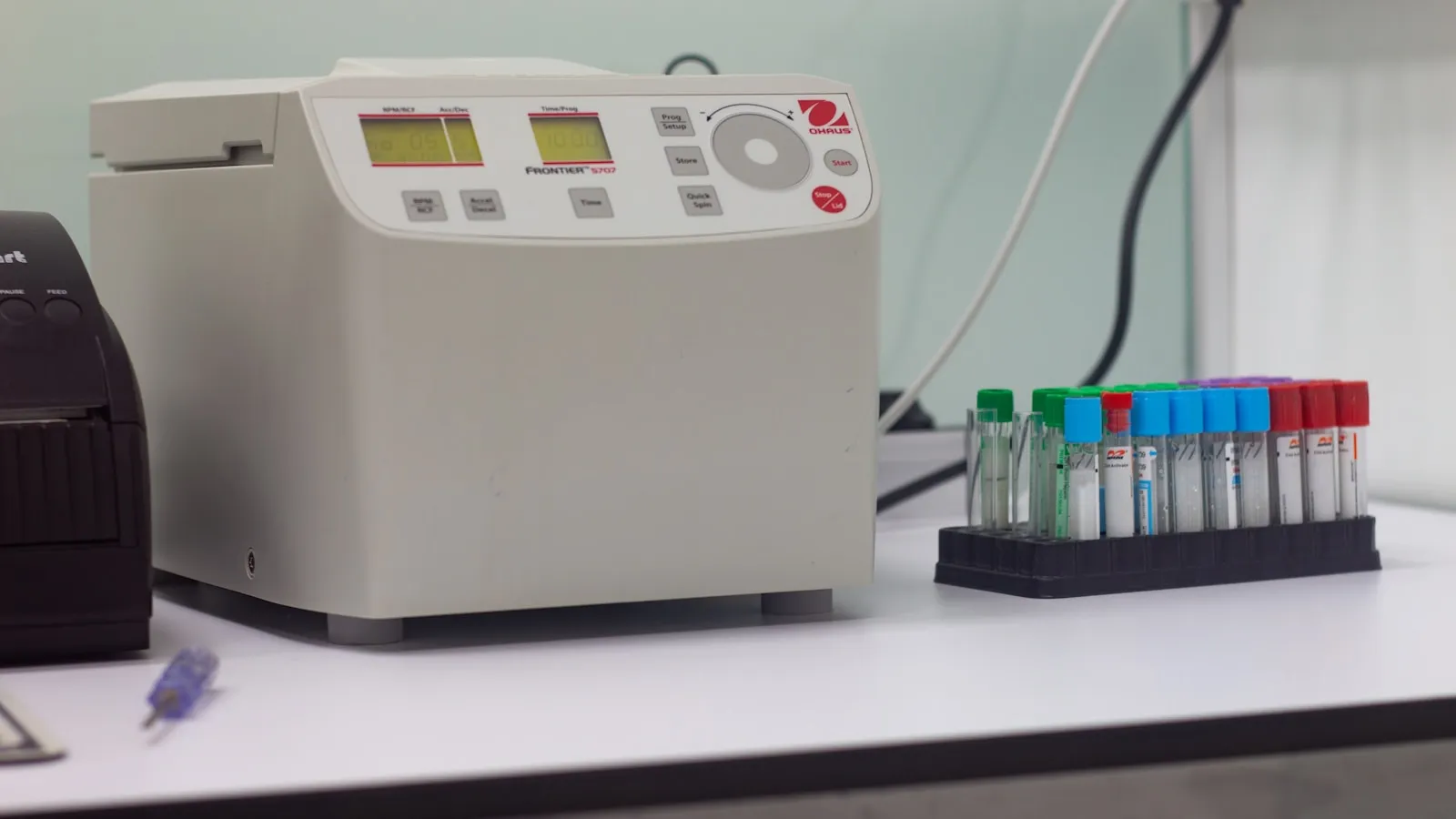
How the value is produced matters. The cell counter does not spin your blood. It multiplies the red blood cell count by the mean cell volume.
Hematocrit is therefore a calculation, not a direct measurement. If your MCV shifts, your Hct shifts with it.
Reference values differ per laboratory. Star-shl publishes these adult bands:
| Group | Reference value (l/l) |
|---|---|
| Men | 0.40 – 0.50 |
| Women | 0.35 – 0.45 |
This band describes the general population. It does not describe a performance optimum. A higher hematocrit does not automatically make you faster.
The top of the band is emphatically not a target.
Put the result next to your haemoglobin. As a rule of thumb the hematocrit percentage sits around three times the haemoglobin in g/dl. The Netherlands reports haemoglobin in mmol/l, so convert first using a factor of 1.61.
For a trained athlete the key property of this value is that concentration is not mass. Your Hct says how densely the cells are packed. It says nothing about how many red cells you hold in total.
Endurance training expands plasma volume. The literature describes increases of roughly 9 to 25 percent. That is broadly 300 to 700 millilitres of extra plasma.
The cells spread across a larger volume, so hematocrit falls. Your total haemoglobin mass stays the same or rises.
This is called pseudoanaemia or dilutional anaemia. The name misleads, because there is no deficiency. If anything, a larger plasma volume improves stroke volume and heat dissipation.
It is a desirable training adaptation, not a problem to correct.
In practice that means something uncomfortable. Exactly when your form is best, your Hct looks lowest. Anyone alarmed by the number at that moment draws the wrong conclusion.
The question is not whether the value fell. The question is whether your iron store explains the fall.
That is why ferritin always belongs with this result. A genuine deficit starts with an empty store, not with a low concentration. Suppose your ferritin is good and your hematocrit slightly low.
You are probably looking at plasma volume expansion. If your ferritin is low, there is something to act on.
At the other end of the scale sits altitude. Living at altitude raises red cell production and lifts the value. After returning it falls again, over weeks.
The same route applies to smoking, sleep apnoea and EPO. The difference between an adaptation and a problem lies in the cause. Not in the height of the number.
For an athlete the timing of the draw largely decides what comes out. The biggest source of noise is your fluid balance on the morning of the test. A hard session the night before, a sauna or a poorly replenished night lifts your hematocrit artificially.
Schedule the draw on a rest day or early in a recovery week. Drink what you normally drink that morning. Avoid intensive training in the preceding 24 hours.
That way you measure your blood and not your hydration.
Different rules apply around an altitude camp. Measure once before departure, so you own a personal baseline. Do not measure immediately on return, but let a few weeks pass.
The adaptation builds and fades, so one isolated Hct tells you nothing about the trend.
Sensible reasons to test are unexplained loss of form and recovery that structurally takes longer. A higher heart rate at a familiar load counts too. Request the full red series then: hematocrit, haemoglobin, red blood cells, MCV and ferritin.
Isolated values here almost always lead to the wrong conclusion.
If you repeat later in the season, keep the same time of day. Keep the same position in the week too. Only then is the comparison fair.
With a falling Hct an athlete notices training first. Recovery between sessions takes longer than you are used to. Your heart rate sits higher at a load you know well.
The closing part of an effort feels heavier and your finishing speed drops. General complaints occur too: persistent fatigue, breathlessness on exertion and dizziness on standing quickly. The problem is that this pattern also fits under-recovery, low energy availability and overtraining.
The symptom picture therefore identifies no cause. An iron deficit is, however, the simplest explanation to exclude, with a single blood draw.
A raised hematocrit makes blood more viscous, which works against transport rather than for it. Athletes then report headache, a flushed face and tingling in the hands or feet. Itching after a hot shower is a striking feature.
During effort the heart rate can run higher than the pace justifies. Often there are no complaints at all and the value surfaces in a routine test. Watch the context.
Was it taken after a sweat session or a poorly hydrated day? Then it probably describes your fluid balance. If the value stays high with good hydration, discuss it with a doctor.
For an athlete the largest gain is not in raising the value. It is in measuring it reliably, and in protecting the building blocks underneath it.
Start with hydration around the draw. Drink normally on the morning of the test and skip the sauna. A dehydrated measurement can mask an empty iron store completely.
The concentration rises while the store falls.
Next, protect your iron. Endurance athletes lose more iron than non-athletes. It goes through sweat and through the gut.
Red cell breakdown in the sole of the foot adds to it. Hard exertion also raises hepcidin, so absorption from the gut drops temporarily. Prefer not to take iron-rich food directly after a heavy session.
Do not supplement without a demonstrated deficiency. A higher hematocrit improves no performance measure, and iron accumulates in the body. Have your ferritin measured first.
Finally, altitude training raises the value temporarily, but that effect fades. Do not build your season on a single number. The trend across several measurements says far more than one isolated result.
This marker is included in the following test panels.
Independent monitoring panel for men on TRT: testosterone (total and free), SHBG, albumin, hemoglobin, hematocrit and PSA.
Medical reviewer
Dr. Naimi oversees the medical standards behind our content and assessments.
Medical policyDoctor's Assessment Included
Every result includes a professional assessment from a BIG-registered doctor. For treatment decisions, discuss your results with your GP.
Hematocrit
€10,-