A DEXA scan measures your body fat percentage more accurately than anything you can use at home: repeated on the same day, precision lands near one percent. That is also its most important limitation. A difference smaller than about 1.2 percent body fat is not a change, it is noise.
That figure is why scanning monthly is wasted money.
I think DEXA is the most honest measurement you can buy. Which is exactly why it is a shame to use it too often.
What does a DEXA scan actually measure?
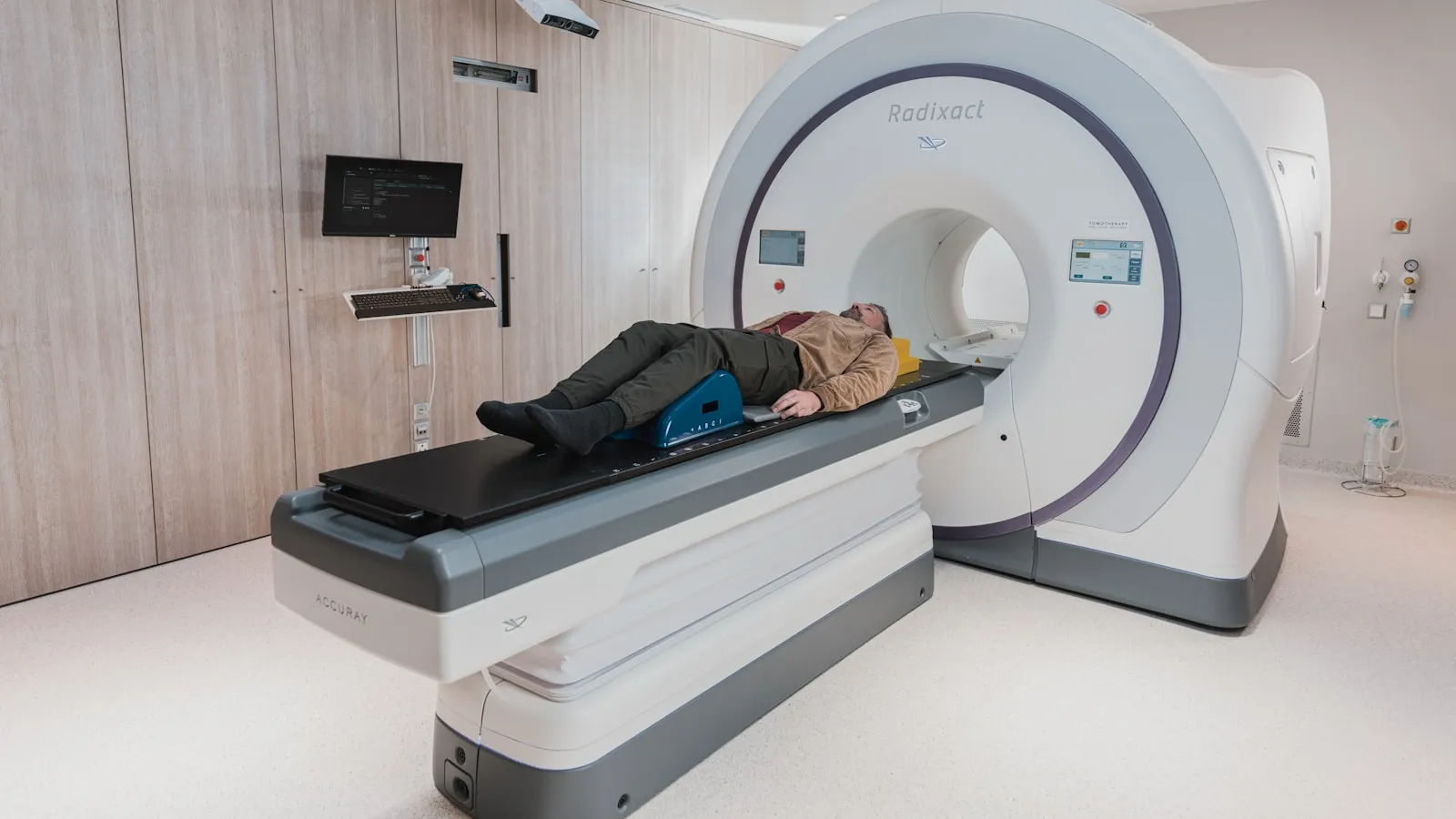
Three compartments: fat mass, fat-free soft tissue and bone mineral. The scanner passes X-rays at two energy levels through your body and measures how much of each level is absorbed. Because fat, muscle and bone attenuate those levels differently, the machine can separate them.
You lie still on a table for seven to fifteen minutes.
The big advantage is segmentation. You get more than a total percentage: left versus right, trunk versus limbs, and on most machines an estimate of your visceral fat in grams. That last figure is a different number from the visceral fat rating on a scale, and the two are not interchangeable. What that value means is in visceral fat.
Radiation exposure from a body composition scan is low, on the order of what you pick up from background radiation in an ordinary day. RIVM tracks that background exposure for the Netherlands. Small, but not zero, which is one more reason not to scan every month.
How accurate is a DEXA scan really?
More accurate than the rest, and still not exact. Repeat the scan on the same day and body fat percentage typically varies by less than one percent. Repeat it on another day and that variation grows, because your fluid balance and stomach contents have changed too.
| Situation | Typical spread | What you may read from it |
|---|---|---|
| Two scans, same day, standing up between | around 1 percent body fat | the device error itself |
| Two scans, different days | somewhat wider | device plus your daily variation |
| Least significant change | around 1.2 percent body fat | below this: no demonstrable change |
| Total fat mass, elite athletes | around 280 grams, roughly 2 percent | each population needs its own threshold |
Zemski and colleagues scanned resistance-trained athletes twice on the same day and on consecutive days, arriving at a least significant change near 1.2 percent body fat (PMID 30454952). Barlow and colleagues did the same in rugby players and found a precision error of about 280 grams of fat mass, concluding that every population needs its own threshold (PMID 26072358).
That is the sentence missing from every clinic page selling the scan.
Say you lose 0.8 percent body fat across eight weeks according to two DEXA scans: you do not know whether you lost anything. Lose 3 percent and you do.
My own rule is simple because of that. Under one and a half percent, I act on nothing.
How often should you repeat a DEXA scan?
Often enough that a change larger than the measurement error fits in between. For most people that means once every three to six months. In an active cut or bulk your body fat shifts enough to read something meaningful after twelve weeks; at maintenance it takes longer.
Two scans a year deliver more than six.
The start is an exception. A first scan at the beginning of a block is worth having even if you only repeat it much later, because you then hold a real starting point instead of a guess from your scale.
In between, measure more cheaply. A skinfold measurement or a scale at home is too coarse for an absolute figure but fine for tracking direction between two scans.
How do you prepare for a DEXA scan?
By repeating it exactly as you did the last one. Arrive fasted, at the same time of day, without having trained, after the toilet, and with no metal on you. Wear the same kind of clothing. Differences in fluid balance and stomach contents are the biggest source of variation between two scans.
The fasted part is the one most often skipped.
A litre of fluid weighs a kilo and is read partly as fat-free mass by the scanner. Scan fasted once and after breakfast the next time, and you are mostly measuring your breakfast.
Do not schedule a scan in the days after a very heavy training week either. Muscle damage comes with fluid accumulation in the tissue, and that counts as fat-free mass.
Is a DEXA scan worth it?
If the decision you are making is bigger than the price, yes. A scan at the start and end of a four-month block tells you whether you lost fat or muscle, and no cheaper method makes that distinction reliably. For weekly checks it is overkill.
A body composition scan also falls outside a medical indication, so expect to pay yourself. Prices vary by centre, so ask before you book.
My advice is to plan two scans before you book the first. One measurement gives you a number; two give you an answer.
What a DEXA scan does not answer is the metabolic question. How much fat you carry is a different thing from what your metabolism does with it, and that shows up sooner in your triglycerides and fasting insulin. Those sit together in the 360 health panel.
The full comparison across every method is in body fat percentage: what is healthy and how to measure it.
Every blood test result includes a professional assessment from a BIG-registered doctor. For treatment decisions, discuss your results with your GP.
References
- Zemski AJ, Keating SE, Broad EM, Slater GJ. Same-day vs consecutive-day precision error of dual-energy X-ray absorptiometry for interpreting body composition change in resistance-trained athletes. Journal of Clinical Densitometry, 2019;22(1):104-114. PMID 30454952.
- Barlow MJ, Oldroyd B, Smith D, et al. Precision error in dual-energy X-ray absorptiometry body composition measurements in elite male rugby league players. Journal of Clinical Densitometry, 2015;18(4):546-50. PMID 26072358.
- Ackland TR, Lohman TG, Sundgot-Borgen J, et al. Current status of body composition assessment in sport. Sports Medicine, 2012;42(3):227-49. PMID 22303996.
- Esco MR, Snarr RL, Leatherwood MD, et al. Comparison of total and segmental body composition using DXA and multifrequency bioimpedance in collegiate female athletes. Journal of Strength and Conditioning Research, 2015;29(4):918-25. PMID 25353076.
- RIVM. Radiation in the Netherlands, background exposure.
Autor
Enhanced Health
Powiązane badania
Powiązane artykuły
Skeletal muscle mass: what is normal and how much can you add?
InBody measurement: what the numbers mean and where they miss