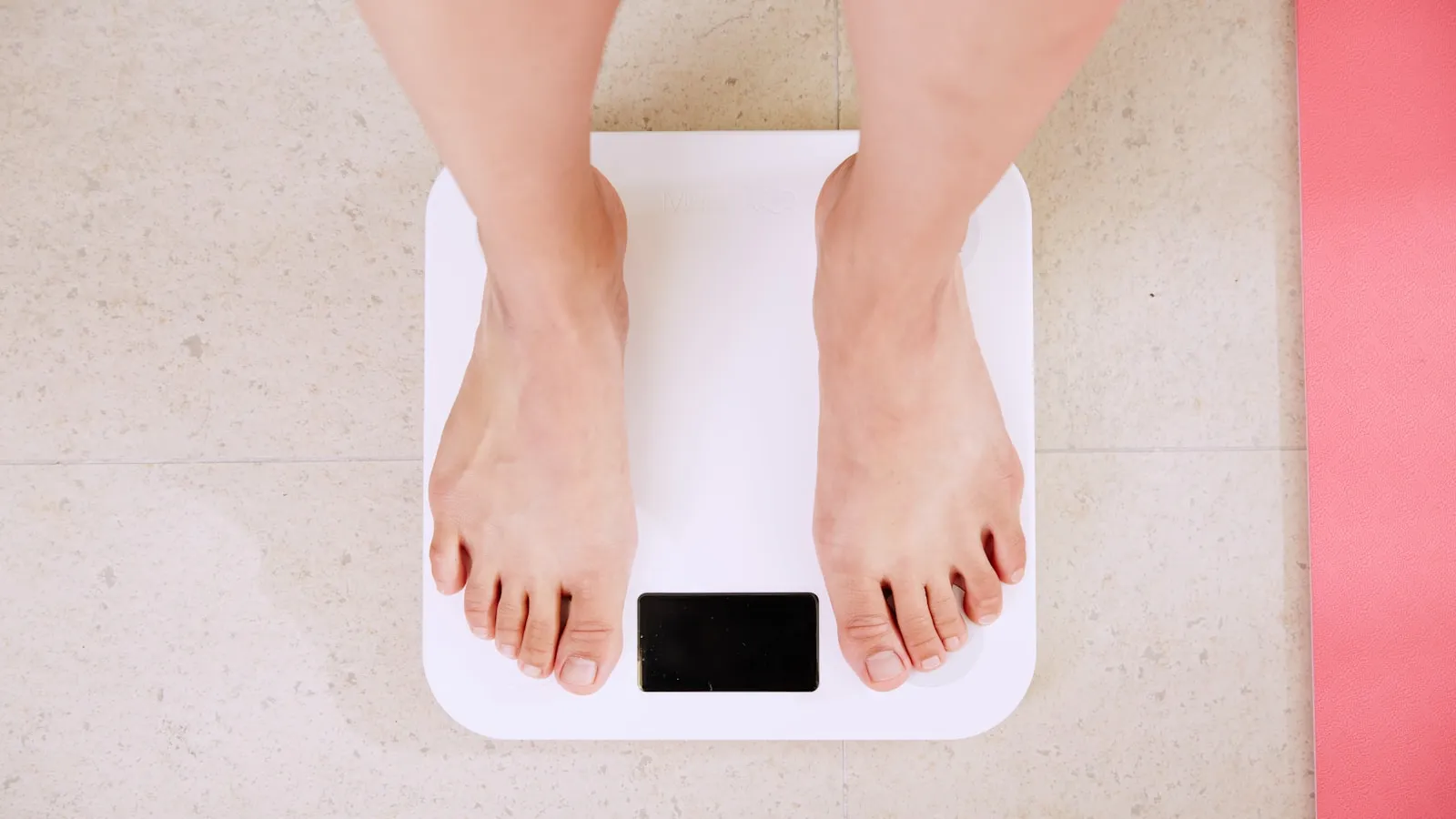
Your scale says "visceral fat: 9" and you have no idea whether that is bad. Short answer: that number is an estimate, not a measurement. What is happening around your organs shows up more reliably in a handful of blood values than in the figure on your bathroom floor.
Visceral fat is the most misunderstood number in the gym. Everyone chases the figure. Almost nobody knows what it measures.
That is a shame, because of all your fat tissue this is the part that talks loudest to your blood values. If you are going to measure anyway, you may as well measure well.
What exactly is visceral fat?
Visceral fat is the fat inside your abdominal cavity, between and around your organs: your liver, intestines and pancreas. It sits behind your abdominal muscles, so you cannot pinch it. Unlike subcutaneous fat, this tissue is metabolically active. It releases fatty acids and inflammatory signals into your blood.
That last part is the whole point. Subcutaneous fat mostly sits there. Visceral fat participates.
The difference is in the drainage. Fatty acids from visceral tissue travel through the portal vein straight to your liver, before the rest of your body sees them. Researchers describe this as one of the routes by which abdominal fat is associated with insulin resistance and altered blood lipids (Neeland et al., 2019).
Some visceral fat is normal and useful. It holds your organs in place. The question is how much, not whether.
What does the visceral fat number on your scale mean?
That value almost always comes from a BIA scale: bioelectrical impedance analysis. The device sends a weak current through your body, measures the resistance and estimates your fat distribution from it. So it is not looking inside your abdomen. It is calculating from your weight, height, age and the measured resistance.
That is not a flaw, but it is a limit. An estimate you repeat every morning works fine for spotting a trend. As an absolute number it is a lot softer than it looks.
Take a concrete case. Stand on the scale fasted at 7am, then again the next day at 8pm after a heavy leg session and three litres of fluid. Same person, same week, and the visceral value can still differ by one to two points. Nothing in your abdomen changed, only your fluid balance.
My advice stays simple: always measure at the same moment, under the same conditions, and read the line across eight weeks rather than today's reading.
How much visceral fat is too much?
On the most common household scales the visceral fat rating runs from 1 to 59, and 1 to 12 is generally presented as the normal range. Higher values may point to more abdominal fat. It remains a manufacturer's estimate rather than a medical result, and the cut-off is not a switch that flips.
| Value (BIA scale 1 to 59) | How manufacturers usually present it | What you might look at alongside it |
|---|---|---|
| 1 to 6 | Normal range | Tracking the trend is enough |
| 7 to 12 | Upper end of the normal range | Waist circumference and blood lipids |
| 13 and above | Raised | Blood lipids, fasting insulin, liver values |
This is exactly the table you see everywhere online, and almost nowhere does it say the table is device-specific. That is what the next section is about.
A tape measure is surprisingly informative in the meantime. Your waist circumference tracks reasonably well with how much visceral fat you carry, and the Dutch RIVM uses waist circumference in its national health survey as one of the measures for overweight. Our guide to measuring your waist covers how to do it without error.
Why do Tanita, InBody and DEXA disagree?
Because they do not use the same unit. A BIA rating of 9, an InBody result in square centimetres and a DEXA result in grams are three different things. Putting them side by side makes no sense. A 9 on one device is not a 9 on another.
| Method | What actually happens | Unit | Main limitation |
|---|---|---|---|
| BIA scale (Tanita and similar) | Estimate from electrical resistance plus a formula | Rating 1 to 59 | Highly sensitive to fluid and food |
| InBody and similar segmental BIA | Estimate of visceral fat area | cm2 | Still an estimate, different formula |
| DEXA | X-ray absorption, abdominal fat is derived | Grams or cm2 | Derived, varies by software version |
| CT or MRI | Actual fat area on a cross-section | cm2 | Reference method, not for home use |
| Tape measure | The circumference of your waist | cm | Indirect, but cheap and repeatable |
The practical lesson: pick one method and stay with it. Anyone who stands on a Tanita this month and an InBody at the gym next month is measuring noise and calling it progress.
Researchers use CT and MRI as the reference precisely because everything else estimates. In daily practice that is no disaster, as long as you know what you are holding.
Which blood values say something about visceral fat?
Because visceral fat releases substances into your blood, it can be read indirectly. Blood lipids, fasting insulin and inflammatory markers often shift alongside the amount of abdominal fat. No single value measures visceral fat directly, but together they give a picture a BIA estimate cannot.
This is the part the scale manufacturers skip, and I understand why. They sell the device, not the follow-up.
Four groups come up most often:
- Triglycerides and HDL cholesterol, usually read together. The ratio between them appears regularly in research on fat distribution (Despres, 2012).
- Fasting insulin, from which HOMA-IR is calculated. Insulin can move years before your glucose does, as we set out in fasting insulin and HOMA-IR.
- hs-CRP, a sensitive inflammatory marker that more often reads higher with more abdominal fat.
- ALT and gamma-GT, liver values that may say something about fat storage in the liver.
Note the wording. These values may be associated with how much visceral fat you carry. They establish nothing on their own, and a single out-of-range result means little by itself.
If you want to know which values belong alongside them, that is covered in measuring metabolic health.
Why is a muscular athlete often the furthest off?
BIA calculates using assumptions about how an average body is built. A lot of muscle mass, a lot of glycogen and variable fluid intake fit those assumptions badly. As a result a trained lifter's visceral value can jump from day to day without anything having changed.
Two lifters, both 92 kilos, both showing a visceral value of 8. One has just carb-loaded for a meet, the other is in week six of a cut. That same 8 means something entirely different for each of them, and no scale knows that.
Glycogen binds water. Fill your muscles with carbohydrate and your resistance changes, so your reading changes. The same applies after a salty meal, after alcohol, and for women at different points in the cycle.
To be clear: the device is not broken. You are just asking it for something it cannot deliver.
What if your visceral number is high but your blood values are normal?
That happens, and it is not a contradiction. The scale estimates, your blood measures. If the estimate reads high while your triglycerides, fasting insulin and liver values sit within range, the estimate is often the weak link. The reverse happens just as easily.
Take two men aged 40. Both 1.80 metres, both showing a visceral value of 11 on the same scale.
The first has triglycerides of 0.9 mmol/l and a waist of 88 centimetres. The second sits at 2.4 mmol/l with a waist of 104 centimetres. Same number on the display, a very different story underneath.
That is exactly why I would never sail on a single source. The scale gives a direction. The tape measure corrects it. The blood tells you whether your body notices.
What you do in that situation is nothing hasty. Repeat the measurement a few weeks later under the same conditions and see whether the line moves. If a blood result is out of range, discuss it with your GP.
How often is it worth measuring?
For your scale and your tape measure, once every two weeks is enough to see a line without drowning in noise. Weighing daily is fine too, as long as you read the weekly average. A single measurement says almost nothing. Ten in a row does.
The reason is simple. Day-to-day variation in a BIA estimate is larger than the change you build in a week.
In practice this works nicely: same scale, same morning of the week, fasted, after the toilet and before drinking. Put it in a notes app rather than in your head.
A lifter who measures every Monday morning for eight weeks ends up with eight points and a clear line. Someone who measures three times at random has three numbers and an opinion.
Does visceral fat change with age?
For many people it does. Even if your weight stays the same, the distribution can shift towards your abdomen over the years. For women that shift often coincides with menopause. For men it usually runs more gradually.
That explains the classic complaint: the same weight as ten years ago, a different trouser size.
Muscle mass plays into this. Anyone who keeps training strength from their forties onwards holds on to more fat-free mass, and that influences both your distribution and your resting energy expenditure. Which values belong alongside that is covered in healthy ageing as an athlete.
Age is no reason to measure differently. It is a reason to read the line across years, not only across weeks.
How do you lose visceral fat?
Visceral fat responds to an energy deficit, and it often appears to move early in the process. You cannot train it off in one spot: ab exercises do nothing about the fat behind them. What counts is a sustainable deficit, strength and endurance training, sleep and alcohol intake.
That "you cannot spot-reduce it" is not an opinion, it is the boring truth half the fitness industry talks around.
The full version, including what changes first and in what order, is in reducing visceral fat. If you are mid-cut, cutting is the practical side. If you are gaining instead, see lean bulk.
And if you want to know whether your abdominal fat is mostly subcutaneous or visceral, we cover that difference in subcutaneous versus visceral fat.
What do you measure if you want to track this properly?
A workable combination is three things side by side: the same scale under the same conditions, your waist with a tape measure, and a set of blood values now and then. The scale gives the trend, the tape gives the check, and the blood gives context neither of the other two can.
For the blood side you might look at a lipid profile for your triglycerides and HDL, or at fasting insulin and HOMA-IR for the insulin side. If you want a wider view, the 360 Health panel brings a larger number of markers into view.
The Dutch Voedingscentrum sticks to waist circumference and lifestyle for the general population, and for most people that is enough. If you train seriously, you usually want slightly more resolution than a tape measure.
Start small. Measure your waist tomorrow morning, fasted, write it down, and repeat it in eight weeks the same way. That costs nothing and says more than three weeks of staring at a BIA number.
References
- Neeland IJ et al. Visceral and ectopic fat, atherosclerosis, and cardiometabolic disease: a position statement. Lancet Diabetes Endocrinol, 2019. PMID 31301983
- Despres JP. Body fat distribution and risk of cardiovascular disease: an update. Circulation, 2012. PMID 22949540
- Ross R et al. Waist circumference as a vital sign in clinical practice. Nature Reviews Endocrinology, 2020. PMID 32020062
- RIVM, Dutch Health Survey and Lifestyle Monitor, figures on overweight and waist circumference in the Netherlands.
Every blood test result includes a professional assessment from a BIG-registered doctor. For treatment decisions, discuss your results with your GP.
Author
Enhanced Health
Dr. Naimi, BIG-registered physician, oversees the medical standards behind our content and assessments. Read our medical policy
Related Tests
Related Posts
Measuring your waist: how to do it right and what it means

Lean bulk: gaining size without wrecking your blood values