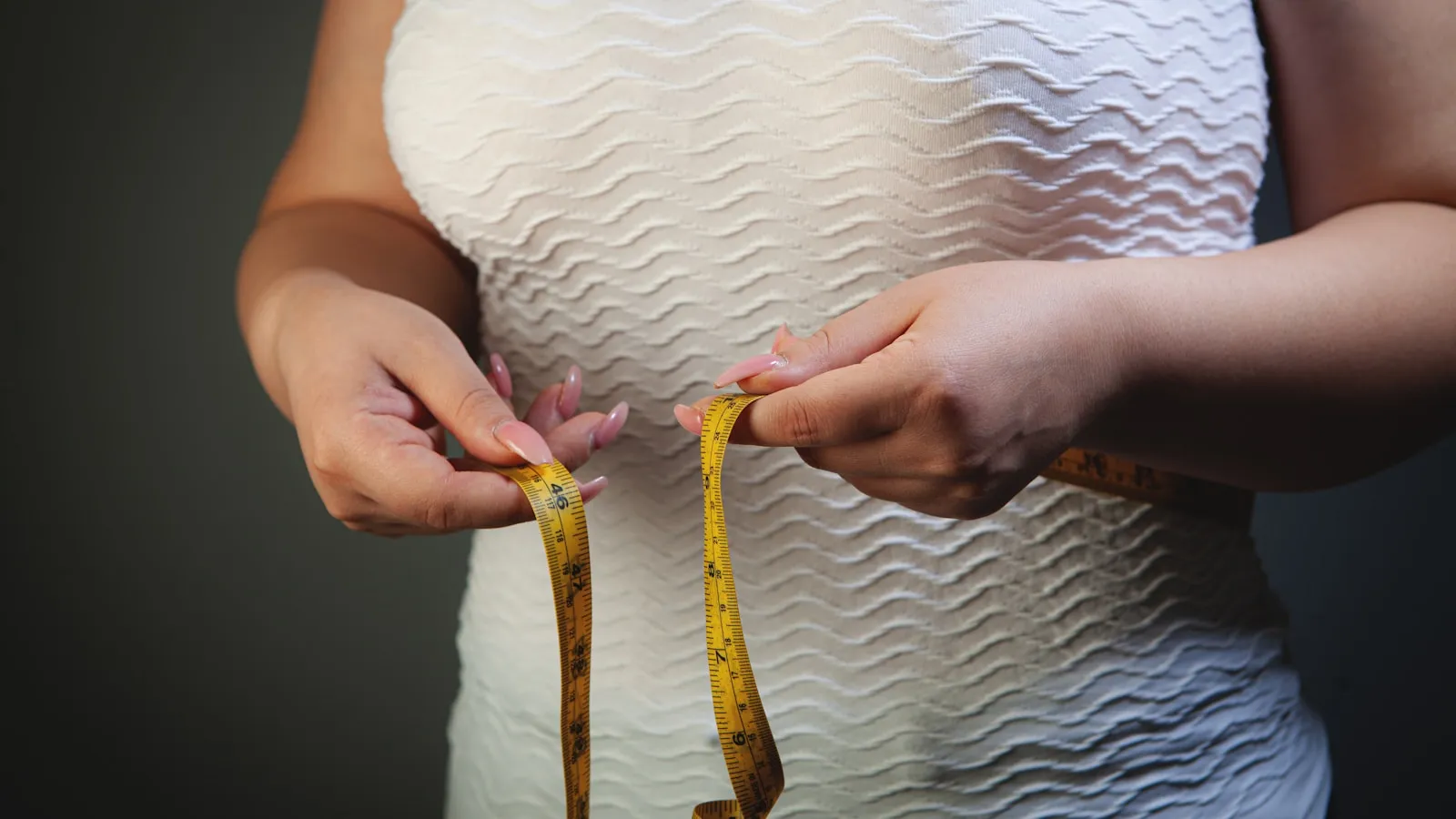
You measure your waist standing, at the end of a normal exhale, with a tape that sits snug without cutting into your skin. The most commonly used spot is midway between your lowest rib and the top of your hip bone. Keeping the same spot and the same moment matters more than the exact height.
That last part is where it usually goes wrong at home. Not because people cannot measure, but because they measure slightly differently each time and then compare the results.
Where exactly do you measure your waist?
There are two common spots: midway between your lowest rib and your hip bone, or at the narrowest point of your waist. Both are used, and they do not give the same number. International working agreements on waist circumference describe the site as an explicit choice that you then apply consistently (Ross et al., 2020).
So pick one, write down which one you picked, and never change it again. Sounds excessive. In practice it is worth up to three centimetres.
Practically: on bare skin, tape horizontal all the way round, with a mirror to check the tape does not ride up or down at the back.
Which measurement errors do people make most?
Four errors explain nearly all the noise. Measuring over clothing, sucking your stomach in, measuring at the wrong time of day, and pulling the tape too tight. Each of those four shifts the number enough to hide a real change or invent one.
| Error | Effect on the number | Fix |
|---|---|---|
| Measuring over clothing | Often 1 to 2 cm too high | Measure on bare skin |
| Sucking in or inhaling deeply | 1 to 3 cm too low | Measure at the end of a normal exhale |
| Measuring in the evening after eating | Often 1 to 2 cm above fasted | Always measure fasted, in the morning |
| Pulling the tape too tight | Up to 2 cm too low | Snug, but the skin must not dent |
Add those up and you have five centimetres of slack. That is more than a successful eight-week block delivers.
My advice: measure three times in a row and note the average. It costs twenty extra seconds and removes most of the randomness.
What is a healthy waist circumference?
Research and Dutch health statistics often cite thresholds around 94 and 102 centimetres for men, and around 80 and 88 centimetres for women. The Dutch RIVM uses waist circumference in its Lifestyle Monitor as one of the measures for overweight. These are population thresholds, not a personal result.
A threshold is not a switch. Someone at 95 centimetres is not suddenly different from someone at 93.
What the number does do is say something about how much fat you carry around your organs. That is exactly the type of fat that talks to your blood values, as we explain in visceral fat and in subcutaneous or visceral fat.
What is the waist-to-height ratio?
Your waist divided by your height, in the same unit. A systematic review described 0.5 as a usable boundary, with the rule of thumb that your waist stays under half your height (Browning et al., 2010). The advantage is that your height is factored in automatically.
Run the numbers. At 1.82 metres, that boundary lands at 91 centimetres.
For tall and short people this works better than a fixed centimetre threshold, because 94 centimetres at 1.68 metres means something different from 94 at 1.95 metres.
Why is waist circumference sometimes more informative than BMI?
Because BMI looks only at weight and height and knows nothing about distribution. Two people with the same BMI can carry completely different amounts of abdominal fat. Research on fat distribution describes exactly that distribution as relevant to blood lipids and insulin sensitivity (Despres, 2012).
For athletes that gap is even wider. BMI counts muscle mass as excess weight, and a tape measure does not.
That is why the combination beats either one: weight for the trend, circumference for the distribution, blood for the context.
What if you carry a lot of muscle?
Your waist is still usable, but the population thresholds fit less well. Heavy strength athletes can have a wider waist from oblique and trunk mass without much fat being present. The change over time then tells you more than the absolute value.
A powerlifter at 1.80 metres with a 96 centimetre waist and visible abs is a different story from someone at the same 96 centimetres with a soft belly. Same number, different composition.
That is exactly why I would put your circumference next to something else. Blood lipids such as triglycerides and the cholesterol to HDL ratio give context a tape measure cannot, for instance through a lipid profile.
Which values belong alongside those is covered in measuring metabolic health. If you are in a building block, lean bulk is relevant, and during a cut, reducing visceral fat.
Tomorrow morning, fasted, pick up a tape measure, measure three times, and put the average in your notes with the date next to it. Repeat in eight weeks the same way.
References
- Ross R et al. Waist circumference as a vital sign in clinical practice. Nature Reviews Endocrinology, 2020. PMID 32020062
- Browning LM et al. A systematic review of waist-to-height ratio as a screening tool for the prediction of cardiovascular disease and diabetes. Nutr Res Rev, 2010. PMID 20819243
- Despres JP. Body fat distribution and risk of cardiovascular disease: an update. Circulation, 2012. PMID 22949540
- RIVM, Lifestyle Monitor and Health Survey, figures on waist circumference in the Netherlands.
Every blood test result includes a professional assessment from a BIG-registered doctor. For treatment decisions, discuss your results with your GP.
Author
Enhanced Health
Related Tests
Related Posts

Lean bulk: gaining size without wrecking your blood values

Cutting: losing fat without wrecking your performance