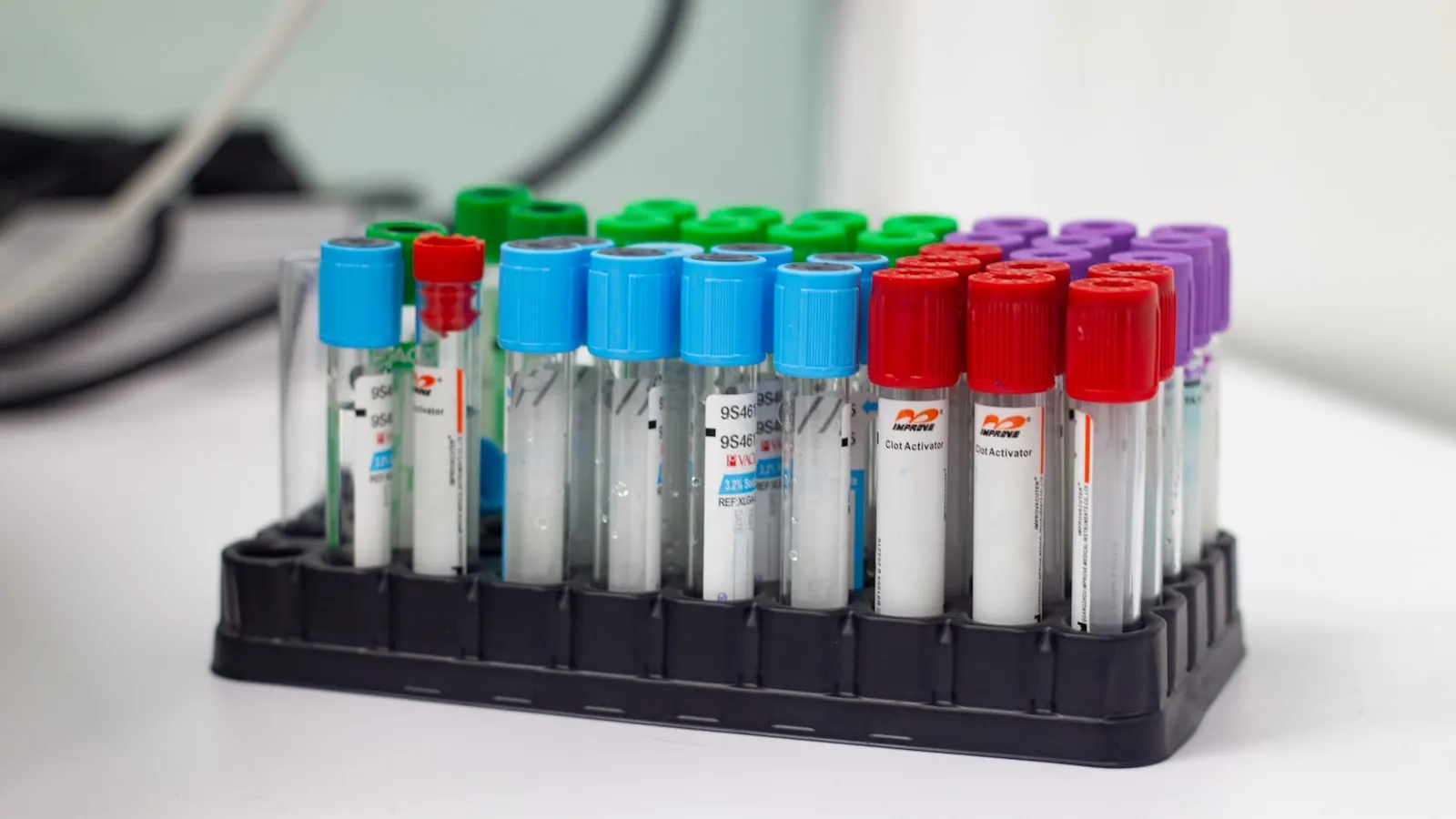
Granulocytes are the largest group of white blood cells in your blood. In a healthy adult they make up roughly 55 to 70 percent of your total leukocytes, and they are your fastest response to bacteria, fungi and damaged tissue. Your lab report rarely shows them as one line. It splits them into three.
That is exactly where the confusion starts.
What strikes me about almost every Dutch explainer: you learn what granulocytes are, and then it stops. How to read those three numbers next to each other, and why yesterday's training shifts them, is missing.
What are granulocytes exactly?
Granulocytes are white blood cells with granules in their cytoplasm. Those granules are packed with substances that break down invaders. There are three kinds: neutrophils, eosinophils and basophils. Together they form your innate immunity, the part that reacts immediately without having to learn who the enemy is first.
The rest of your white cells, your lymphocytes and monocytes, have no granules. They are called agranulocytes. They are your learned immunity: slower to start, but with memory.
Your body makes granulocytes in your bone marrow and sends them into the blood almost straight away. They live briefly. A neutrophil often circulates less than a day before it moves into tissue or is broken down. You are not measuring a stock, you are measuring a flow.
Which three types of granulocytes are there?
Neutrophils, eosinophils and basophils. They differ sharply in number and in what they respond to. Neutrophils are by far the largest group and target bacteria. Eosinophils step in for allergy and parasites. Basophils are the smallest group and play a part in allergic reactions.
| Type | Share of your leukocytes | Reference range (absolute) | Mainly responds to |
|---|---|---|---|
| Neutrophils | 40 to 70 percent | 1.5 to 7.0 x10⁹/l | Bacteria, tissue damage, acute inflammation |
| Eosinophils | 1 to 4 percent | 0.0 to 0.5 x10⁹/l | Allergy, hay fever, parasites |
| Basophils | 0 to 1 percent | 0.0 to 0.1 x10⁹/l | Allergic reactions, histamine release |
Reference ranges differ per laboratory. Always read the limits printed on your own result, not another lab's. Work on reference intervals in healthy adults shows the spread between populations is real (PMID 33586915).
Absolute count or percentage: which do you read?
Read the absolute count. The percentage only says how the pie is divided, not how big the pie is. A percentage can jump while the actual number of cells stays flat or even falls, simply because another cell type dropped.
This is the most common reading error I come across, and labs do not help by printing both columns side by side.
Say your neutrophils sit at 4.2 x10⁹/l, comfortably mid-range. Your total leukocytes are 5.6 x10⁹/l because your lymphocytes are low after a hard Sunday. Your neutrophil percentage is then 75 percent, above the upper limit of 70. The lab flags it red. Nothing is wrong with your neutrophils.
It works the other way too. A normal-looking percentage can hide a clearly raised absolute count if your total is up as well. If you want to know what your immune system is doing, read the column with x10⁹/l after it.
What do high granulocytes mean?
Usually that your immune system is responding to something. A bacterial infection is the best known cause, but tissue damage, stress, smoking, pregnancy and corticosteroids push your granulocytes up too. In athletes there is one more cause that appears on no Dutch explainer page: a hard training session in the previous 24 hours.
Which of the three is raised tells you more than the total. Mainly neutrophils up fits a bacterial trigger or exertion. Mainly eosinophils up points more towards allergy.
A single raised measurement without symptoms is a different thing from a value that stays high. The difference is in the repeat, not in the first number.
What do low granulocytes mean?
Low granulocytes nearly always mean low neutrophils, because they dominate the group. The medical term is neutropenia. Viral infections are the most common cause, and the value usually recovers on its own within a few weeks. Some medicines, a vitamin B12 or folate deficiency, and an autoimmune reaction can also play a part.
There is one more explanation that is rarely mentioned: a share of people naturally run a lower neutrophil count with nothing wrong. You can read that in low neutrophil count.
Thuisarts consistently describes an abnormal blood count as a reason for follow-up, not as a diagnosis in itself. That is how I would read it too.
What does your training do to your granulocytes?
It shifts them, and not subtly. During intense exertion your neutrophils rise as cells detach from your vessel walls and flush out of your spleen. No new cells are made; they simply all land in the count at once. Your lymphocytes do the opposite in the hours afterwards and dip below your baseline.
The effect is large enough to colour a result. Neutrophils are also not one uniform group: research describes distinct subtypes with different behaviour (PMID 30816340), which explains why the same total can look different in two people.
Sports medicine has described these shifts as normal physiology in trained people since the 1990s (PMID 10688281). Newer work argues athletes do not get ill from it: the cells do not vanish, they redistribute to the lungs, gut and skin (PMID 32139352).
The practical conclusion is dull and effective. Put a rest day between your last hard session and your draw, and you measure yourself instead of your training schedule.
When should you discuss your granulocyte value with your GP?
When it stays abnormal on a calm repeat, or when you have symptoms that stand apart from it. Persistent fever, unexplained weight loss, night sweats, repeated infections or unusual bruising belong in a conversation, whatever your blood count shows.
The NHG guidelines treat an abnormal blood count as a reason to look further, not as an outcome. Your GP can help you decide whether further steps are needed.
I would not wait until you think you see a pattern in your own measurements. One calm repeat and a conversation cost you two weeks.
Where do you start?
Order your blood count with the differential, and draw on a calm morning. Without a leukocyte differential you are left with a single total that hides several explanations. Our complete blood count test measures your white series alongside your red cells and platelets, with an assessment by a BIG-registered doctor.
How the values hang together is in complete blood count explained. If your total is high, read high white blood cell count. If your lymphocytes drop after a hard week, look at low lymphocyte count.
References
- Ng LG, Ostuni R, Hidalgo A. Heterogeneity of neutrophils. Nature Reviews Immunology. 2019. PMID 30816340.
- Fallon KE, Fallon SK, Boston T. Sports haematology. Sports Medicine. 2000. PMID 10688281.
- Reference intervals of white blood cell parameters for healthy adults in Japan. International Journal of Laboratory Hematology. 2021. PMID 33586915.
- Campbell JP, Turner JE. Can exercise affect immune function to increase susceptibility to infection? Exercise Immunology Review. 2020. PMID 32139352.
- NHG. Dutch College of General Practitioners, haematology in primary care. Accessed 2026.
- RIVM. Blood testing and reference values. Accessed 2026.
- Thuisarts. My blood result is abnormal. Accessed 2026.
Disclaimer
Every blood test result includes a professional assessment by a BIG-registered doctor. This article gives general information and is not a substitute for medical advice. For treatment decisions, discuss your results with your GP.
Author
Enhanced Health
Related Tests
Related Posts

Frequent colds when you train hard: what your blood says about it

High basophil count: what the rarest white blood cell means