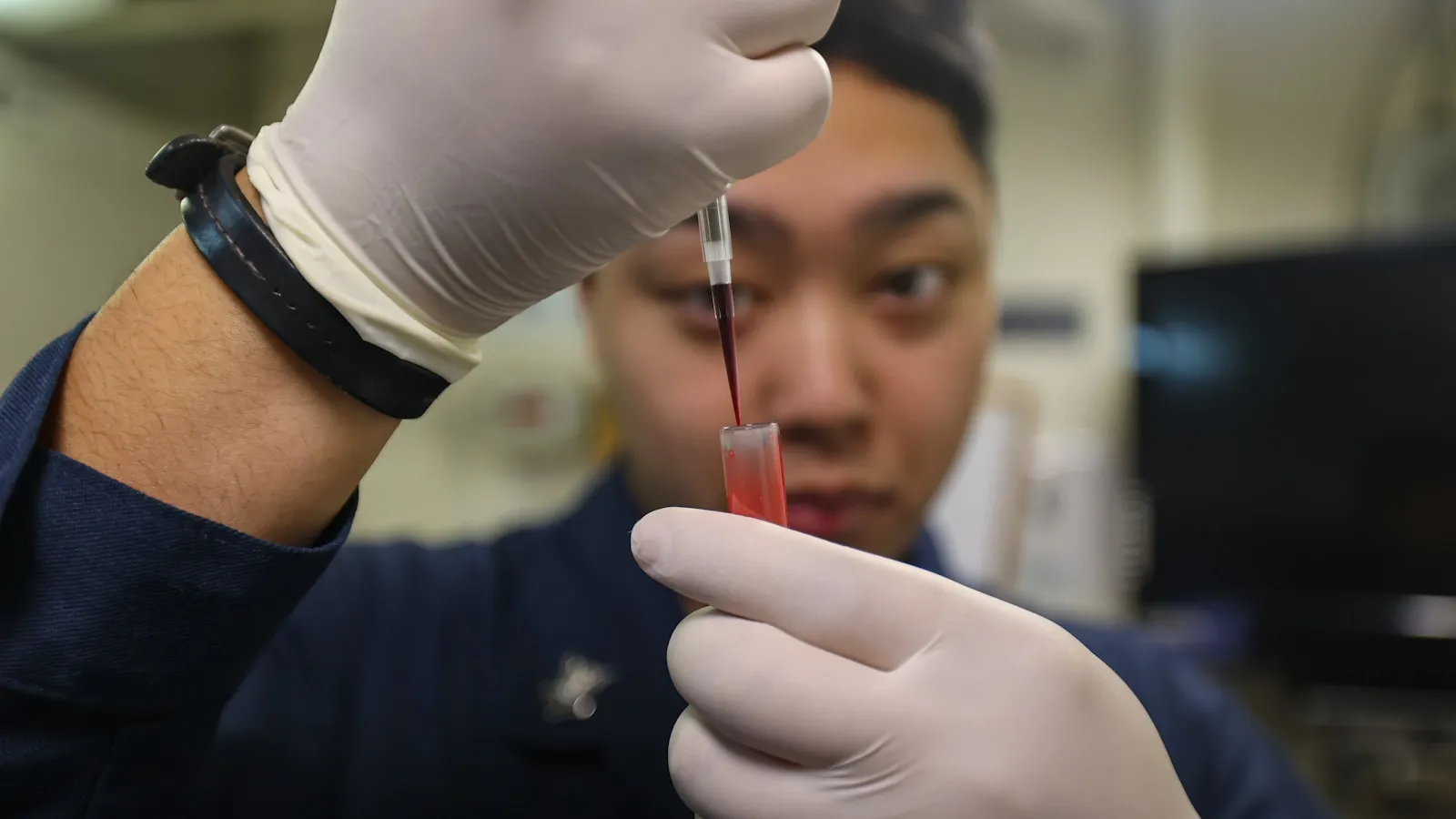
A low neutrophil count means fewer of these immune cells are circulating in your blood than the reference range suggests, usually below 1.5 x10⁹/l. The medical term is neutropenia. A viral infection is the most common explanation, and the value often recovers on its own within a few weeks.
There is a second explanation that appears on no Dutch explainer page.
For a substantial share of people, the lower limit of 1.5 simply does not apply. Not because they are ill, but because that limit was largely derived from populations of European ancestry. That is not a detail. It is the difference between a normal result and an unnecessary work-up.
What does a low neutrophil count mean?
It means few neutrophils were in your blood vessels at that moment. Neutrophils are your first line against bacteria and fungi, and they live briefly: often less than a day in circulation. So you are measuring a flow, not a stock, and that flow varies from day to day.
How low the value is matters more than the fact that it is low. Mildly low and severely low are medically very different things.
Your neutrophils are also not one uniform group. Research describes distinct subtypes with their own behaviour and lifespan (PMID 30816340), which explains why the same total can play out differently in two people.
What is a normal neutrophil value?
Most Dutch labs use roughly 1.5 to 7.0 x10⁹/l for adults. Below that lower limit the term is neutropenia, and it is usually graded in three steps. Only the most severe grade is clearly linked to a higher infection risk.
| Grade | Absolute neutrophil count | How it is usually read |
|---|---|---|
| Normal | 1.5 to 7.0 x10⁹/l | Within the common reference range |
| Mildly low | 1.0 to 1.5 x10⁹/l | Often without consequence, a repeat is usual |
| Moderately low | 0.5 to 1.0 x10⁹/l | Asks for an explanation and follow-up |
| Severely low | Below 0.5 x10⁹/l | Always discuss with a doctor straight away |
Reference ranges differ per laboratory and per method. Work on reference intervals in healthy adults shows sizeable differences between populations (PMID 33586915). Always read the limits printed on your own result.
Why does the reference range not fit everyone?
Because a common genetic variant, the Duffy-null genotype, goes together with a naturally lower neutrophil count in the blood. The cells are there; they simply distribute differently between blood and tissue. It carries no increased infection risk.
The numbers are not subtle. In a study of 120 Black adults in the United States, 66.7 percent carried the Duffy-null genotype. Their median neutrophil count was 2,820 cells per microlitre, against 5,005 in participants without the variant. Almost a quarter of the Duffy-null group, 23.8 percent, sat below 2,000 cells per microlitre (PMID 35994632).
Under the common Dutch lower limit, some of those people would be flagged as abnormal with nothing wrong. The researchers therefore argue for separate reference ranges, and for dropping the old term "benign ethnic neutropenia" in favour of wording that names the actual cause (PMID 30117263).
I think this is the most useful finding in the whole topic, and also the best hidden. Anyone with a persistently low value and no symptoms would do well to raise it with their GP before further testing follows.
Which other causes of low neutrophils are there?
A viral infection is the most common. Beyond that, certain medicines play a part, including some anti-inflammatories, antibiotics and thyroid medication. A vitamin B12 or folate deficiency can slow production, and an autoimmune reaction can break cells down faster.
| Cause | What you see alongside it | How you recognise it |
|---|---|---|
| Viral infection or just recovered | Lymphocytes variable, matching symptoms | Usually recovers within weeks |
| Duffy-null genotype | Otherwise completely normal blood count | Stable and low for years, no infections |
| Medication | Only neutrophils lowered | Onset matches starting the drug |
| B12 or folate deficiency | Often raised MCV too | Look at the red series alongside |
| Autoimmune reaction | Sometimes other cell lines low too | Needs further testing |
| Severely low with fever | Feeling ill, fever | Contact a doctor immediately |
The last row is the only one that cannot wait. The rest calls for a repeat and a conversation.
Does hard training lower your neutrophils?
No, training usually does the opposite. During and just after exertion your neutrophils rise, as cells detach from your vessel walls and flush out of your spleen. Your lymphocytes are the cells that fall afterwards, not your neutrophils.
That matters practically. If you draw right after a hard session and your neutrophils are still low, you measured that value against the current.
Say you did a heavy leg session last night and your neutrophils read 1.3 x10⁹/l this morning. Training would have pushed that number up, not down. That argues for repeating the measurement calmly rather than waving it away as training noise.
When should you discuss a low neutrophil value with your GP?
Always below 0.5 x10⁹/l, and certainly alongside fever. Beyond that, with any low value that persists on a calm repeat, or that comes with repeated infections, persistent fever, mouth ulcers, unexplained weight loss or night sweats.
Thuisarts describes an abnormal blood result as a reason for follow-up, not a diagnosis in itself. The NHG guidelines approach neutropenia the same way: a finding that asks for context. Your GP can help you decide whether further steps are needed.
Bring your earlier results to that conversation if you have them. A value that has hovered around the same point for five years tells a different story from one that was normal last year.
Where do you start?
Repeat the measurement calmly and order your blood count with the differential. Without a leukocyte differential you only see your total leukocytes, and a low neutrophil value can disappear inside that entirely. Our complete blood count test splits your white series out, with an assessment by a BIG-registered doctor.
How to read the values together is in complete blood count explained. For the group neutrophils belong to, read granulocytes explained. If your lymphocytes are the ones dropping, see low lymphocyte count. If your total is high instead, high white blood cell count is the next step.
References
- Merz LE, et al. Absolute neutrophil count by Duffy status among healthy Black and African American adults. Blood Advances. 2023. PMID 35994632.
- Ethnic benign neutropenia: A phenomenon finds an explanation. Pediatric Blood and Cancer. 2018. PMID 30117263.
- Ng LG, Ostuni R, Hidalgo A. Heterogeneity of neutrophils. Nature Reviews Immunology. 2019. PMID 30816340.
- Reference intervals of white blood cell parameters for healthy adults in Japan. International Journal of Laboratory Hematology. 2021. PMID 33586915.
- NHG. Dutch College of General Practitioners, haematology in primary care. Accessed 2026.
- RIVM. Blood testing and reference values. Accessed 2026.
- Thuisarts. My blood result is abnormal. Accessed 2026.
Disclaimer
Every blood test result includes a professional assessment by a BIG-registered doctor. This article gives general information and is not a substitute for medical advice. For treatment decisions, discuss your results with your GP.
Author
Enhanced Health
Dr. Naimi, BIG-registered physician, oversees the medical standards behind our content and assessments. Read our medical policy
Related Tests
Related Posts
MPV blood value: what the size of your platelets says

Total protein blood test: what it says about your protein intake