
An exercise stress test rarely takes longer than fifteen minutes. You ride against resistance that steps up every minute, with electrodes on your chest and a cuff on your arm. Someone watches your ECG while you listen to your legs.
Every Dutch page about the bike test explains how that quarter of an hour goes.
Almost none explains what the test does not see. I find that the strangest blind spot in the whole topic, because that is exactly what decides what your result is worth.
What does an exercise stress test involve?
You ride or walk against rising resistance while a doctor tracks your ECG, heart rate, blood pressure and symptoms. The test stops when you cannot continue, or earlier if something looks off. The point is to see how your heart behaves under load, not at rest.
In the Netherlands that usually happens on a stationary bike, sometimes on a treadmill. Resistance climbs in steps, and each step adds power that gets counted in watts.
The Hartstichting describes that procedure in plain language, and the description is accurate.
What it leaves out is how to weigh the outcome. That is where this piece starts.
What gets measured during an exercise stress test?
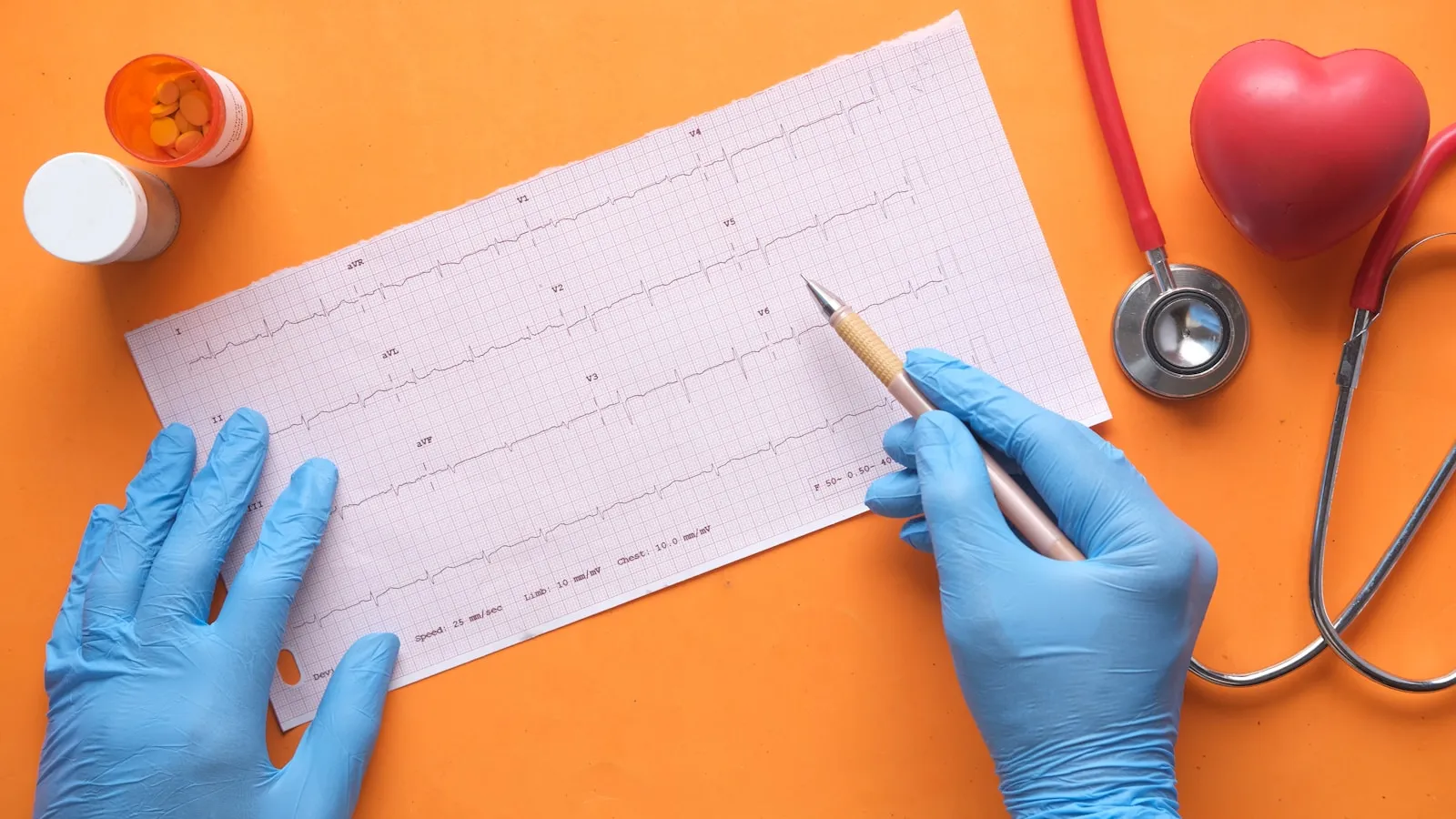
Four things at once. Your ECG looks for changes in the ST segment, your blood pressure is taken every few minutes, your heart rate is followed continuously, and your power output in watts is recorded. Symptoms count too: chest pain, dizziness, breathlessness.
The ECG is the reason the test exists. The rest is context, though that context often turns out to be more useful than the ECG itself.
ST depression does not automatically mean a narrowing. No ST depression does not automatically mean a clean coronary artery either.
It is a signal with odds inside it, not a result with certainty inside it.
What does an exercise stress test miss?
Narrowings that do not yet limit flow under load. The ECG only reacts when too little blood reaches a piece of heart muscle while you ride. Plaque that slowly thickens the wall without squeezing the flow usually gives no such signal.
That difference is bigger than it sounds. Plaque often sits for years in vessels that barely restrict flow, and that is precisely the type an exercise test cannot pick up.
A normal result is therefore reassuring about today, and says less about the next ten years.
| What the exercise test does see | What it does not see | What can fill that gap |
|---|---|---|
| ST depression from a flow-limiting narrowing | Plaque that does not squeeze the flow yet | Vascular imaging a cardiologist may consider |
| Your blood pressure response to rising load | Your blood pressure on an ordinary workday | Home readings spread over several days |
| Rhythm disturbances arising in those 15 minutes | Rhythms that appear a few times a month | Longer rhythm recording, agreed with your doctor |
| Your maximum power output in watts | Why that power output comes out low | Blood values such as iron, haemoglobin and thyroid |
| Symptoms that surface during exertion | Your risk over the coming ten years | Risk estimation plus lipids and ApoB |
| How fast your heart rate drops afterwards | Silent inflammation in your blood vessels | hs-CRP as context, not as a replacement |
That third column does not replace the first. These are different questions with different answers, and your doctor decides which of them applies to you.
Why does a normal result feel so reassuring?
Because you earned it under maximum load. You sweated, your heart went almost to its top setting, and nothing showed up. That feels like proof, while the test only checked whether too little blood reached somewhere during that quarter of an hour.
It is a real answer to a real question. It is just a smaller question than the one you were actually asking.
That is where most of the confusion sits, I think. The test answers: is something limiting my flow right now. Your head hears: my arteries are fine.
The arithmetic that page one leaves out
The test properties were summarised back in 1989. Gianrossi pooled 147 studies of exercise-induced ST depression and landed on an average sensitivity of roughly 68 percent and a specificity of roughly 77 percent (PMID 2661056).
Those two numbers are not a law of nature. They vary widely by study population and by the threshold you pick, and the authors say so themselves.
What matters more is what they do to people like you.
Imagine 1,000 readers aged 34, training five times a week, none of them smokers, none with symptoms. Assume 2 percent of them have a meaningful coronary narrowing. That is 20 people with it, and 980 without.
Of those 20 the test picks up about 14, since sensitivity sits near 68 percent. Of the 980 healthy ones about 23 percent get a falsely abnormal result, which is 225 people.
Add them up: 239 abnormal results, of which 14 are real.
So roughly one in seventeen positive results is genuine. The other sixteen are noise, with a follow-up pathway and a few uneasy weeks attached.
This is exactly the argument Diamond and Forrester wrote down in 1979: your probability beforehand decides what the result means afterwards (PMID 440357). Same test, same abnormality, different reader, different conclusion.
In a 62-year-old with pressing chest pain the arithmetic flips. There an abnormal result is more often right than wrong, and there the test earns its place.
None of that is criticism of the test. It is criticism of the idea that a result carries meaning apart from the person.
How much does an exercise stress test cost?
That depends on the route. If the test runs through a hospital referral, it usually falls under insured care and comes off your own risk excess. If you arrange it yourself at a sports medical centre, you pay for it, and those rates differ per centre.
Ask two things beforehand. Is a doctor assessment included in the price, and do you take your raw numbers home.
Without those two you bought an afternoon of cycling.
Some supplementary policies reimburse part of a sports medical examination. Your insurer is the only reliable source there, because the terms shift per policy and per year.
Which number from the test is most useful?
Your power output. How many watts you could push before you stopped is the result that still says something when the ECG showed nothing. Research links higher fitness to lower long-term mortality, and that association held all the way into the fittest group.
Mandsager followed 122,007 people who did this kind of exercise test. Higher fitness went together with lower mortality, and the researchers found no upper limit above which the benefit stopped (PMID 30646252).
That is an association, not proof of cause.
It is still the only part of your result you can move yourself. My point: keep that watt number, because in two years it is your only honest comparison point and nobody else is storing it for you.
What can blood testing add here?
Something different, which is exactly why the two should not be mixed up. A bike test looks at flow right now. Blood values such as cholesterol, ApoB and hs-CRP help estimate what may happen to your artery wall over years.
The two sit alongside each other. This is not a choice between them, and a blood panel does not replace a cardiac investigation.
The Hartstichting lists the classic risk factors clearly, and the NHG standard on cardiovascular risk management describes how your GP works with them. What that calculation misses in a fit thirty-something sits in cardiovascular risk in athletes.
ApoB counts your risk particles instead of the fat inside them. Why that difference matters sits in ApoB as a cardiovascular marker, and the wider lipid story sits in cholesterol and your heart.
Silent inflammation is measured with hs-CRP, which in athletes also rises after a hard session.
What do you discuss with your doctor?
Not whether you want the test, but what the result could mean in your situation. Ask what your probability beforehand roughly was, what an abnormal result would then produce, and which follow-up comes attached. Those three questions change the conversation more than any preparation does.
Whether an exercise stress test suits you is your doctor to decide. I can only explain what the machine does and does not see, so that conversation gets sharper.
If a larger heart shows up in the measurements, in trained people that is often an adaptation. Where the boundary roughly sits is covered in athletes heart explained.
A concrete next step: write your maximum watt figure, your maximum heart rate and your recovery heart rate on one line, with the date next to it. That line is worth more in two years than the report letter.
If you want the blood side alongside it as context, that runs through the lipid panel or more broadly through 360 Health.
Every blood test result includes a professional assessment from a BIG-registered doctor. For treatment decisions, discuss your results with your GP.
References
- Gianrossi R, Detrano R, Mulvihill D, Lehmann K, Dubach P, Colombo A, McArthur D, Froelicher V. Exercise-induced ST depression in the diagnosis of coronary artery disease. A meta-analysis. Circulation, 1989. PMID 2661056.
- Diamond GA, Forrester JS. Analysis of probability as an aid in the clinical diagnosis of coronary-artery disease. New England Journal of Medicine, 1979. PMID 440357.
- Mandsager K, Harb S, Cremer P, Phelan D, Nissen SE, Jaber W. Association of cardiorespiratory fitness with long-term mortality among adults undergoing exercise treadmill testing. JAMA Network Open, 2018. PMID 30646252.
- Hartstichting. Heart investigation: the exercise test.
- NHG. Dutch GP standard on cardiovascular risk management.
Author
Enhanced Health
Related Tests
Related Posts
Athlete's heart: when a bigger heart is normal, and when it is not

Heart rate while training: why your zones are probably wrong