The symptoms of atrial fibrillation are a fast, irregular heartbeat lasting minutes to hours, breathlessness, dizziness and fatigue that does not match your effort. In endurance athletes the loss of power is often the most striking part. Your usual pace suddenly feels heavy.
A substantial share of people notice nothing at all.
That last point makes the topic difficult. A rhythm disorder you cannot feel is found by chance, or not at all.
What does atrial fibrillation feel like?
Like an engine running unevenly. Your heart rate is fast and completely irregular, without a pattern, and it lasts longer than a single skipped beat. Many people describe fluttering in the chest, combined with a sense that the power has drained from their legs.
Duration is the most useful feature.
An isolated extra beat lasts a fraction of a second. Atrial fibrillation persists, from several minutes to several hours, and sometimes longer. If you can sit with the sensation and it stays, that is a different story from a single thump.
| What you feel | Fits atrial fibrillation | Fits something else |
|---|---|---|
| Duration | Minutes to hours | A fraction of a second |
| Pattern | Completely irregular | Regular, or moving with your breathing |
| Rate | Fast, even at rest | Normal to low at rest |
| Performance | Clear loss of power | Power stays the same |
| During exercise | Remains present | Often disappears |
That bottom row is practical. Many benign rhythm sensations resolve as soon as your heart rate rises. Atrial fibrillation does not.
A rhythm that moves neatly with your breathing is almost always something else, described in sinus arrhythmia. Isolated extra beats sit in premature heartbeats in athletes.
Are endurance athletes at higher risk of atrial fibrillation?
With prolonged, intensive endurance training the risk appears raised. That sounds contradictory, since exercise protects the heart in almost every other way. For this specific arrhythmia the relationship is not straight but curved.
Researchers call it a U-curve.
Moderate activity goes with a lower risk than a sedentary life. At very high loads sustained for years that advantage reverses. A prospective study described this dose-response for lone atrial fibrillation (PMID 26333377), and an analysis of years spent in endurance sport found the same pattern (PMID 25169984).
A national cohort study from 2019 confirmed the dose-response character in the general population (PMID 31519947).
Worth stating plainly: these are group-level associations, in groups that trained intensively for decades. They predict nothing about your heart and are not a reason to stop exercising.
So how much training is too much?
No threshold exists that holds at an individual level. The studies work with categories such as years of endurance training or hours per week, and the risk increase only appears in the highest segment: people running high volume for decades, often men over forty.
For most recreational athletes this does not apply.
What does apply is the structural side. Research from 2022 examined the right heart in lifelong recreational endurance athletes with and without paroxysmal atrial fibrillation (PMID 35760278). An endurance athlete's heart adapts, and atria handling more volume for years grow larger.
What makes that adaptation normal, and when it is not, sits in athlete's heart.
Why do endurance athletes have fewer strokes despite more atrial fibrillation?
Because stroke risk is not determined by the rhythm alone. Endurance athletes usually score more favourably on blood pressure, weight, blood sugar and fitness, and those are all factors in the same risk calculation. The rhythm is one ingredient, not the whole recipe.
That changes how a diagnosis should be read.
Atrial fibrillation in a fit fifty-year-old with low blood pressure is not the same as the same diagnosis in someone with obesity and diabetes. Why the standard risk calculation often misfires in athletes sits in cardiovascular risk in athletes.
Two men of 58 with the same diagnosis make that difference visible. One has cycled for thirty years, weighs 74 kilos and has a blood pressure of 118 over 74. The other has not trained in a decade, weighs 104 kilos and has a blood pressure of 152 over 94.
Same arrhythmia, a different risk picture.
On paper both say atrial fibrillation. The rest of their profile decides what that diagnosis means in practice, which is exactly why the result alone is not the whole story.
The Hartstichting is clear that exercising with atrial fibrillation is usually fine when agreed with your doctor. The question is not whether you may move, but how hard and with what supervision.
Which blood values belong with this symptom?
Your thyroid comes first. Baumgartner and colleagues followed more than 30,000 people and saw that thyroid values within the normal range already tracked with atrial fibrillation risk, with a higher free T4 matching a higher risk (PMID 29061566).
That is a striking finding, because those results formally count as normal.
Beyond that the usual disruptors matter. Potassium and magnesium drive conduction, and on long sessions in the heat they drift out of line fastest. Inflammatory markers and iron status are useful when your symptom comes with fatigue.
Concretely: TSH, free T4, potassium and magnesium. They sit together in the heart panel.
The thyroid route is worked out in palpitations and your thyroid.
What do you do if you recognise this?
Get it recorded while it is happening. An ECG taken when you feel nothing yields almost nothing, because the rhythm has to be captured during an episode. That is why a doctor orders a Holter or an event recorder, sometimes for two weeks.
In the meantime, note the duration and the time of day yourself.
With dizziness, near-fainting, chest pain or breathlessness that does not match your effort, see a doctor the same day. Fainting during exertion always warrants immediate contact.
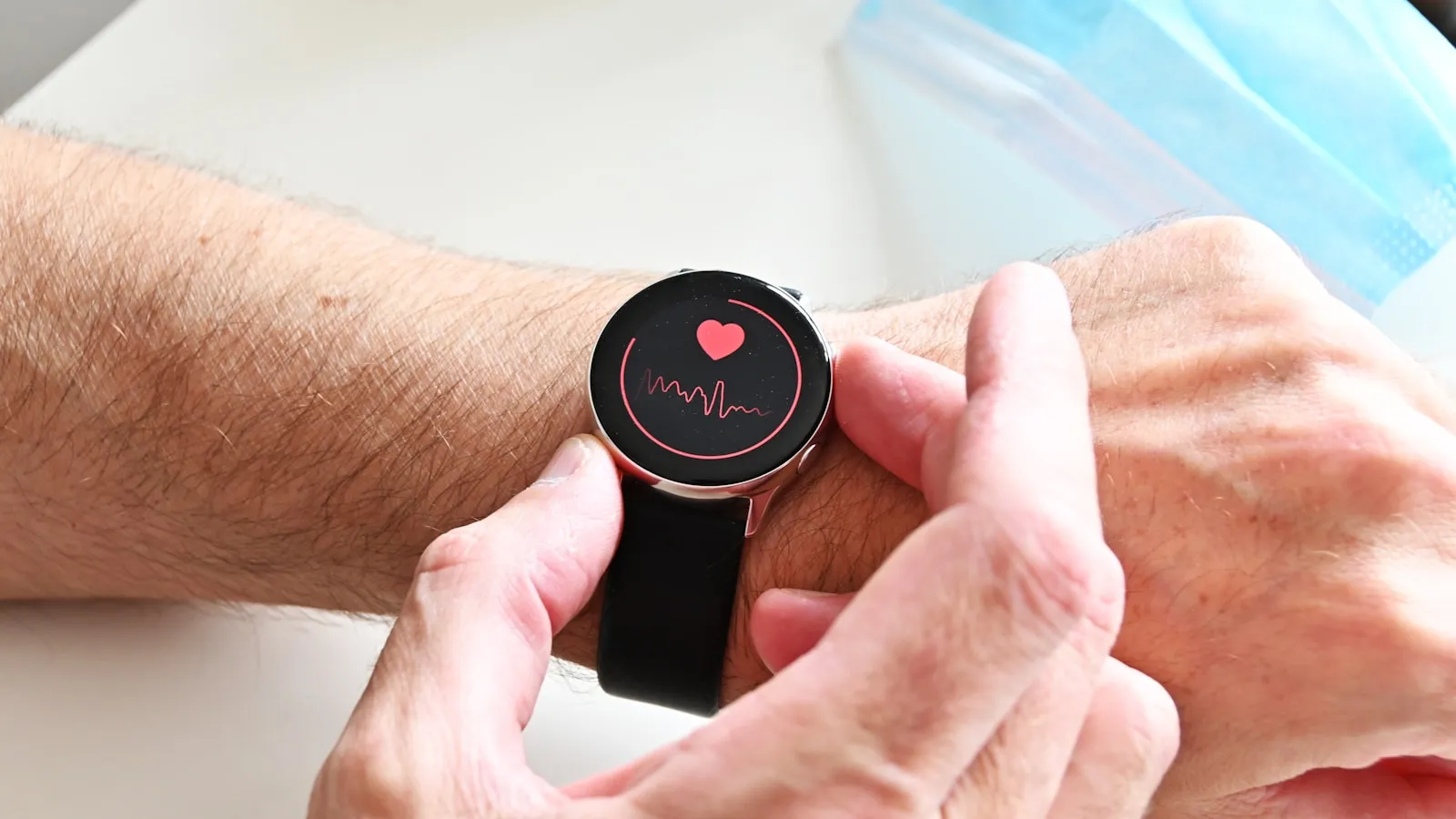
A smartwatch with rhythm notifications can give a hint, but it is not a diagnosis. Treat the alert as a reason for a real ECG, not a replacement for one. The broader triage sits in palpitations during exercise.
What I find most important here: the U-curve gets used online to frighten people away from endurance sport. That is the wrong lesson to draw from a nuanced finding.
Every blood test result includes a professional assessment by a BIG-registered doctor. Discuss your results with your GP before making treatment decisions.
References
- Emerging risk factors and the dose-response relationship between physical activity and lone atrial fibrillation: a prospective case-control study. Europace, 2016. PMID 26333377.
- Effect of years of endurance exercise on risk of atrial fibrillation and atrial flutter. The American Journal of Cardiology, 2014. PMID 25169984.
- Physical activity and risk of atrial fibrillation: a nationwide cohort study in general population. Scientific Reports, 2019. PMID 31519947.
- Right heart structure and function in lifelong recreational endurance athletes with and without paroxysmal atrial fibrillation. Journal of the American Society of Echocardiography, 2022. PMID 35760278.
- Baumgartner C, da Costa BR, Collet TH, et al. Thyroid function within the normal range, subclinical hypothyroidism, and the risk of atrial fibrillation. Circulation, 2017;136(22):2100-2116. PMID 29061566.
- Hartstichting. Can I still exercise with atrial fibrillation?
الكاتب
Enhanced Health
Dr. Naimi، طبيب مسجل في سجل BIG الهولندي، يشرف على المعايير الطبية لمحتوانا وتقييماتنا. اقرأ سياستنا الطبية
فحوصات ذات صلة
مقالات ذات صلة

Palpitations and your thyroid: when to have your TSH tested
Heart rate and blood pressure: why the two numbers say different things