
Calculating calories gives you an estimate, tracking calories turns it into data. But your count can easily be off by 10 to 20 percent, through labels, portions and digestion. That is not a problem, as long as you measure consistently and adjust on your weight.
I do not count on the last kilocalorie myself. Consistency beats precision, every single time.
How do you track calories?
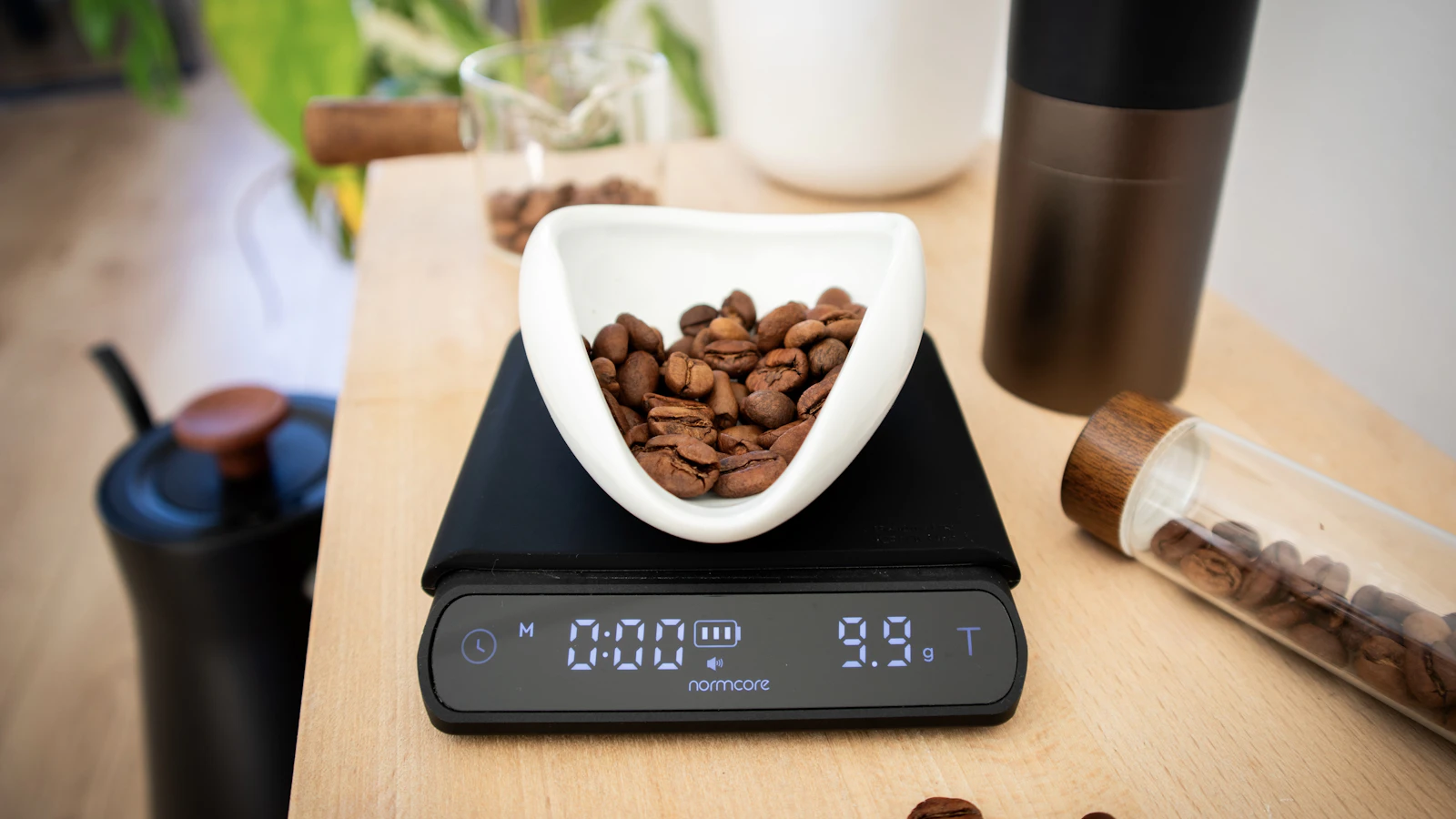
You track calories with an app and a kitchen scale, or with set portions you know. Weigh your food in grams, scan the labels and log everything you take in. Anyone who guesses by eye is structurally off. A ten euro scale makes your count a lot more reliable at once.
Start with your biggest meals, that is where most of the gain sits. The coffee and the handful of nuts you simply add afterwards.
Log your drinks too. Juice, soda and alcohol count and are the most often forgotten.
Why is your calorie count not always right?
Your count is off because every link has a margin of error. Labels are legally allowed to deviate, you easily misjudge portions, and not all calories are absorbed equally. On top of that, your food itself costs energy to digest. Together that explains why your total on paper and your weight do not always match.
Dutch nutrition values come from the NEVO database of the RIVM, but those remain averages per product. Your specific piece of chicken or bread can differ.
| Source of error | Typical deviation |
|---|---|
| Label may legally deviate | up to 20% |
| Estimating a portion by eye | 20 to 30% |
| Thermic effect of food | around 10% of your intake |
| Cooking and absorption | varies per product |
The thermic effect is largest for protein: your body burns part of those calories during digestion. Read more about protein in how much protein per day for muscle growth.
How accurate does your calorie counting need to be?
You do not need to count perfectly, you need to count consistently. If you measure the same way every day, a fixed deviation is not a problem: you can still see whether your weight moves the right way. The trend over weeks is your real ruler, not the number from a single day.
Calculate your starting number in calculating your calorie needs or with our calorie needs calculator. That is your departure point.
Take an athlete who diligently logs 2,000 kcal but does not lose fat. His count is probably 15 percent too low. No big deal, because the scale corrects him on its own.
When do you adjust your intake?
You adjust your intake when your weight trend over two to three weeks moves the wrong way. If your weight does not move as your goal needs, shift by 100 to 200 kcal and wait another two weeks. Do not change something every day, because daily swings come mostly from water and gut content.
Weigh yourself every morning at the same time and take the weekly average. That filters out the noise.
If you diet for a long time, your burn drops with it. A review by Trexler and colleagues (2014) shows how your energy expenditure adapts under sustained energy restriction. You re-set your maintenance via how many calories per day for maintenance.
How do you check in your blood whether you are on track?
Your blood does not tell how much you ate, but it does show how your body responds to your nutrition. If your weight stalls despite a clean deficit, your thyroid, glucose and insulin give context. That way you know whether the issue is your count or your metabolism. Always discuss a deviating value with your GP.
If fat loss structurally fails, look beyond your app. Read our piece on fasting insulin and HOMA-IR and on weight loss and your blood values.
If you want a starting point, our 360 health blood test measures your thyroid, blood sugar and insulin among others.
My advice: log consistently, weigh your food for your biggest meals and steer on the trend of your weight, not on one day. If the trend is wrong while you do everything right, look at your blood. The full approach to nutrition around your training is in our plan for muscle growth and recovery.
References
- Mifflin MD, St Jeor ST, Hill LA, et al. A new predictive equation for resting energy expenditure in healthy individuals. American Journal of Clinical Nutrition. 1990. PMID: 2305711.
- Trexler ET, Smith-Ryan AE, Norton LE. Metabolic adaptation to weight loss: implications for the athlete. Journal of the International Society of Sports Nutrition. 2014. PMID: 24571926.
- RIVM. Dutch Food Composition Database (NEVO). 2023.
Disclaimer
Every blood test result includes a professional assessment by a BIG-registered doctor. This article gives general information and is not a substitute for medical advice. A blood test is a tool to walk into the conversation with your GP better informed, not a diagnosis in itself. For treatment decisions, discuss your results with your GP.
Author
Enhanced Health
Dr. Naimi, BIG-registered physician, oversees the medical standards behind our content and assessments. Read our medical policy
Related Tests
Related Posts
ZMA supplement: what zinc, magnesium and B6 do to your testosterone
Tongkat ali side effects: banned in the Netherlands, and why