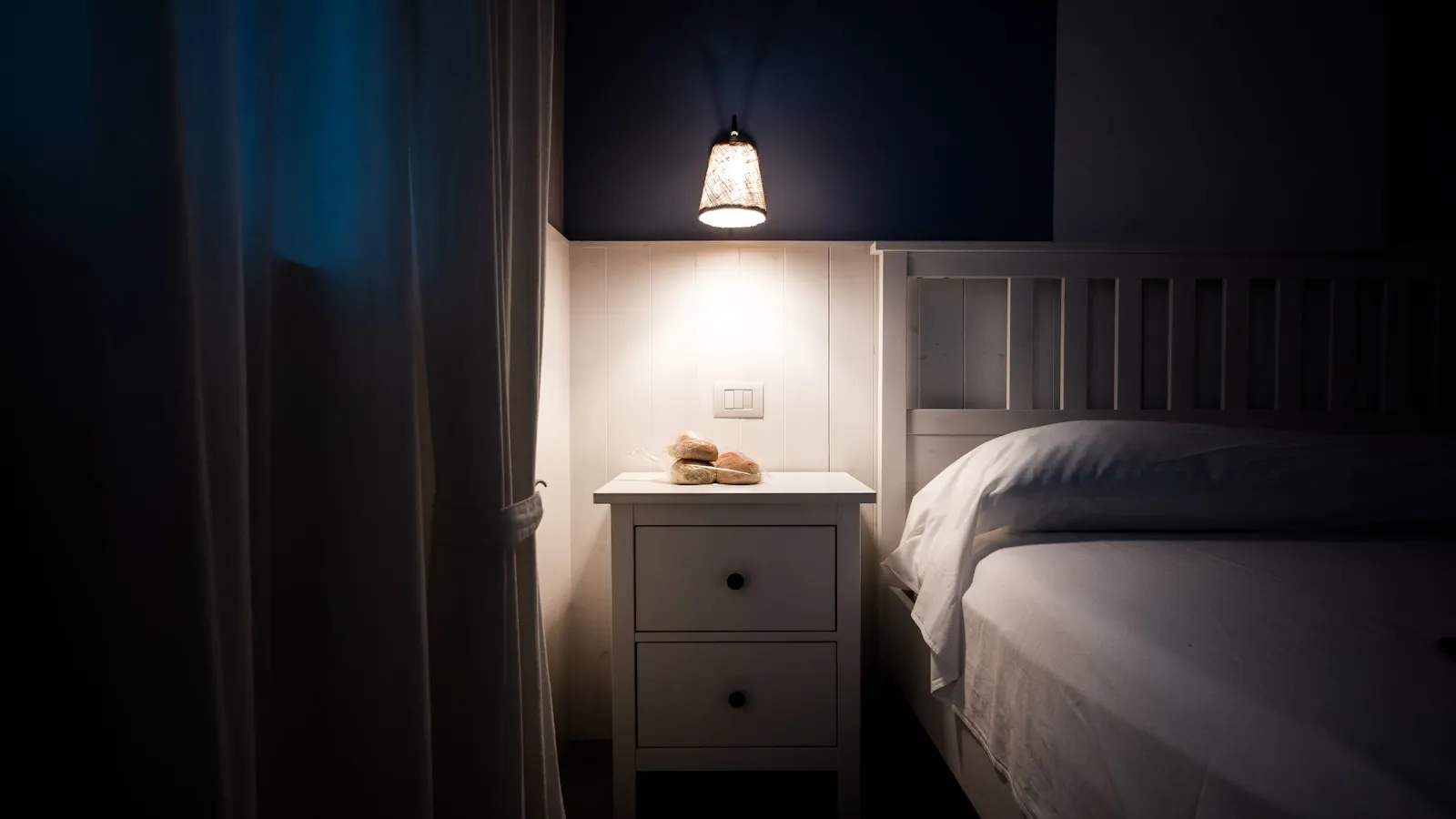
Waking briefly between sleep cycles is normal and happens to everyone, usually without you remembering it. The problem starts when you stay wide awake afterwards. The most common causes are alcohol, an overheated room, a full bladder, stress, and the natural rise in your cortisol towards morning.
One thing stands out about the Dutch search results on this: almost all of them come from mattress shops and supplement sellers. Conveniently, the solution then sells itself.
Why do you wake up at night?
Usually through a combination of your sleep architecture and a trigger. Between two cycles you sleep lightly, and at that moment the threshold for waking is low. An uncomfortable bedroom temperature, a bladder, a noise or a thought is then enough.
| Cause | How it feels | What you can do |
|---|---|---|
| Alcohol in the evening | Asleep fast, then restless from 03:00 | Skip it on training days above all |
| Overheated bedroom | Waking sweaty, duvet off | Ventilate, aim for roughly 16 to 19 degrees |
| Full bladder | Every night at about the same time | Limit drinking in the last hour before bed |
| Stress and rumination | Awake with a spinning head | Get up, do something dull, go back when sleepy |
| Snoring plus daytime sleepiness | Waking with a jolt, partner hears breathing pauses | Not a blood test but a conversation with your GP |
That last row is the most important one in the table. You do not detect sleep apnoea with a blood test.
If you snore heavily, your partner hears your breathing stop and you are sleepy during the day, see your GP. No panel replaces that.
Why does it always seem to be around three?
Because you sleep more lightly in the second half of the night. Your deep sleep sits mostly in the first two cycles, so after about four hours you are easier to wake. At the same time your cortisol is already climbing towards morning, which makes dropping off again harder.
That cortisol is not a fault in your system. It is the alarm your body sets itself, and it starts hours before you hear it.
In people who slept only four hours a night for six nights, evening cortisol sat higher than in the rested condition (PMID 10543671). So sleep debt and higher cortisol reinforce each other, which often makes the next night choppier too.
Imagine a lifter of 38 who has two beers at 23:00 after a heavy deadlift session. He falls asleep within ten minutes at 23:30 and is wide awake at 03:15. That is not coincidence and it is not age: that is the second half of the night plus alcohol.
Does this change with age?
Yes. Your deep sleep declines from your twenties onward, and after age fifty evening cortisol rises by about 19.3 nmol/l per decade (PMID 10938176). Less deep sleep plus more evening cortisol makes your night naturally more fragile.
That is annoying, but it is also reassuring. If you lie awake more at 45 than you did at 25, you are not necessarily doing something wrong.
The full explanation of those stages is in sleep stages explained.
What can you have measured?
A blood test does not measure your sleep, but it does show what is happening in the systems around it. Think of cortisol for your stress axis, fasting glucose for your blood sugar regulation and hs-CRP for low-grade inflammation. A deviating value is a starting point for a conversation, not an explanation in itself.
If you wake at night feeling hungry and restless, the link with your blood sugar is worth exploring. We wrote about that in blood sugar dips and energy.
Our 360 health blood test measures those values in a single draw. What you do with them is a conversation with your GP.
What do you do tonight when you are lying awake?
Do not lie there tossing. Thuisarts, the Dutch GP information service, advises getting up if you have been awake for more than about 20 minutes, doing something calm in dim light, and only going back when you feel sleepy again. Your bed should stay the place where you sleep, not the place where you worry.
Do not check your phone to see what time it is. That number never helps you.
My advice: cut the alcohol on your training days this week and turn your bedroom two degrees cooler. Those are the two dials that act fastest.
The rest of the approach is in better sleep for athletes. What consistently short sleep costs you is in sleep deprivation.
References
- Spiegel K, Leproult R, Van Cauter E. Impact of sleep debt on metabolic and endocrine function. Lancet. 1999. PMID 10543671.
- Van Cauter E, Leproult R, Plat L. Age-related changes in slow wave sleep and REM sleep and relationship with growth hormone and cortisol levels in healthy men. JAMA. 2000. PMID 10938176.
- Thuisarts. I want to sleep better: sleep advice. Accessed 2026.
- Hersenstichting. The sleep cycle. Accessed 2026.
Disclaimer
Every blood test result includes a professional assessment by a BIG-registered doctor. This article gives general information and is not a substitute for medical advice. For treatment decisions, discuss your results with your GP.
Autor
Enhanced Health
Powiązane badania
Powiązane artykuły

Rest days: how many you need and why they make you stronger
Resting heart rate: what your heart rate at rest says about recovery