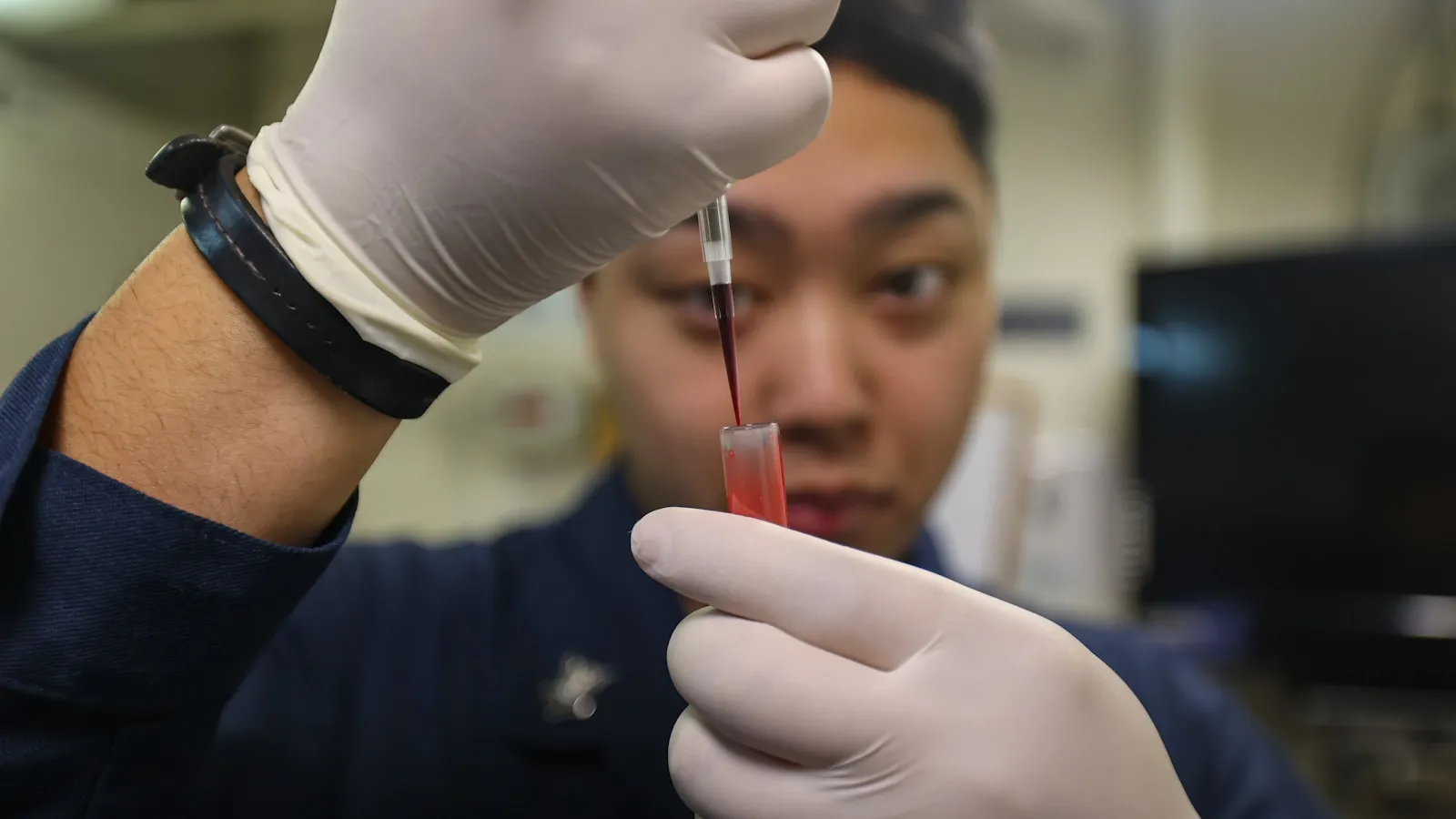
A high eosinophil count means more of these white blood cells are circulating than expected, usually above 0.5 x10⁹/l. The medical term is eosinophilia. In the Netherlands the most common explanation is an everyday one: an allergy, and hay fever or house dust mite allergy above all.
How high the value sits decides what it means.
That is exactly what the Dutch pages on this topic leave out. You get one threshold and one list of causes, in which a mild hay fever rise is named in the same breath as conditions you will rarely meet. That is not much help when you are holding your own result.
What are eosinophils in the blood?
Eosinophils are a small group of white blood cells, making up about 1 to 4 percent of your total leukocytes. They belong to your granulocytes and carry granules full of enzymes. Their original job is attacking parasites, but in the Netherlands you mostly see them act during allergic reactions.
They spend most of their life outside your blood, in your tissues: your gut wall, your airways, your skin. Your blood value is a snapshot of the traffic between them.
Your eosinophils also swing across the day. They usually sit higher in the morning than in the afternoon, which is one more reason to book repeat measurements at the same time of day.
What does it mean if your eosinophils are high?
The first question is how high the absolute count is. The literature splits eosinophilia into three grades, and those three carry very different consequences. A mildly raised value is often seasonal and harmless in Dutch practice; a severely raised value always asks for an explanation.
| Grade | Absolute eosinophil count | What usually sits behind it |
|---|---|---|
| Normal | Up to 0.5 x10⁹/l | Within the common reference range |
| Mildly raised | 0.5 to 1.5 x10⁹/l | Allergy, hay fever, eczema, asthma, drug reaction |
| Moderately raised | 1.5 to 5.0 x10⁹/l | Asks for an explanation and follow-up |
| Severely raised | Above 5.0 x10⁹/l | Always discuss with a doctor |
This grading follows an international consensus proposal for classifying eosinophilic disorders (PMID 22460074). More recent review work describes the same tiered approach in daily practice (PMID 37274287).
Say your value reads 0.7 x10⁹/l and it is mid-May. You have been sneezing for three weeks and your eyes itch. Your blood is probably telling you what your nose already did. That same 0.7 in November with no symptoms is a different conversation, though it stays a mild rise.
Which causes of high eosinophils are there?
Allergy comes first, followed by reactions to medicines. Asthma and eczema often travel with it. Parasitic infections are the largest cause worldwide, but rare in the Netherlands and usually linked to recent travel. Some autoimmune conditions and, far more rarely, blood disorders can also play a part.
| Cause | What you see alongside it | How you recognise it |
|---|---|---|
| Hay fever or house dust mite | Usually mildly raised | Symptoms match the season |
| Asthma or eczema | Mildly to moderately raised | Known diagnosis, longer-standing symptoms |
| Reaction to a medicine | Can climb quickly | Onset matches a new drug |
| Parasitic infection | Often gut symptoms | Recent travel outside Europe |
| Autoimmune condition | Often raised CRP too | Symptoms across several organs |
| Persistently above 1.5 x10⁹/l | No allergy that explains it | Always discuss with your GP |
The last row is the only one that goes to the GP without further thought. The rest is context you can often place yourself.
One thing I think matters here: a drug reaction is easily missed because people do not think about their own medication list when they see a blood result. Take that list to your appointment.
What if your eosinophils are low?
A low or even unmeasurable eosinophil value is usually not a problem. The lower limit of the reference range is zero, so there is little room to fall. Acute stress, a corticosteroid course and an acute infection push the value towards zero temporarily.
Labs therefore often simply report 0.0 with nothing behind it. If the rest of your blood count is normal, a low eosinophil value on its own is rarely a reason for follow-up.
It is one of the few values where low is calmer than high.
Does your training affect your eosinophils?
Far less than it affects your other white cells. Exertion mainly pushes your neutrophils up and your lymphocytes down afterwards. Your eosinophils move with the general stress response and can dip briefly, but the effect is small next to the rest of the differential.
Sports medicine has described these shifts as normal physiology in trained people for decades (PMID 10688281).
Practically that means you cannot blame a raised eosinophil value on your training. If it is high, it is high for another reason.
When should you discuss a raised value with your GP?
With any value above 1.5 x10⁹/l, and with a milder rise that persists without an allergy or medicine explaining it. Also with symptoms that stand apart from it: persistent fever, unexplained weight loss, night sweats, stubborn skin rash or breathlessness.
Thuisarts describes an abnormal blood result as a reason to look further, not as a diagnosis. The NHG guidelines approach eosinophilia the same way: a finding that asks for context. Your GP can help you decide whether further steps are needed.
Bring three things to that conversation: when your symptoms started, which medicines you take, and whether you have recently travelled outside Europe. Those three answers explain the majority of raised values.
Where do you start?
Read the absolute count rather than the percentage, and set it beside the season and your medication list. Order your blood count with the leukocyte differential, or you will not see your eosinophils at all. Our complete blood count test splits your white series out, with an assessment by a BIG-registered doctor.
How to read the values together is in complete blood count explained. For the group eosinophils belong to, read granulocytes explained. If your total is high as well, high white blood cell count is the next step. For the rarest cell in the group, see high basophil count.
References
- Valent P, et al. Contemporary consensus proposal on criteria and classification of eosinophilic disorders and related syndromes. Journal of Allergy and Clinical Immunology. 2012. PMID 22460074.
- The multidisciplinary approach to eosinophilia. Frontiers in Oncology. 2023. PMID 37274287.
- Reference intervals of white blood cell parameters for healthy adults in Japan. International Journal of Laboratory Hematology. 2021. PMID 33586915.
- Fallon KE, Fallon SK, Boston T. Sports haematology. Sports Medicine. 2000. PMID 10688281.
- NHG. Dutch College of General Practitioners, haematology in primary care. Accessed 2026.
- RIVM. Blood testing and reference values. Accessed 2026.
- Thuisarts. My blood result is abnormal. Accessed 2026.
Disclaimer
Every blood test result includes a professional assessment by a BIG-registered doctor. This article gives general information and is not a substitute for medical advice. For treatment decisions, discuss your results with your GP.
الكاتب
Enhanced Health
فحوصات ذات صلة
مقالات ذات صلة

Frequent colds when you train hard: what your blood says about it

High basophil count: what the rarest white blood cell means