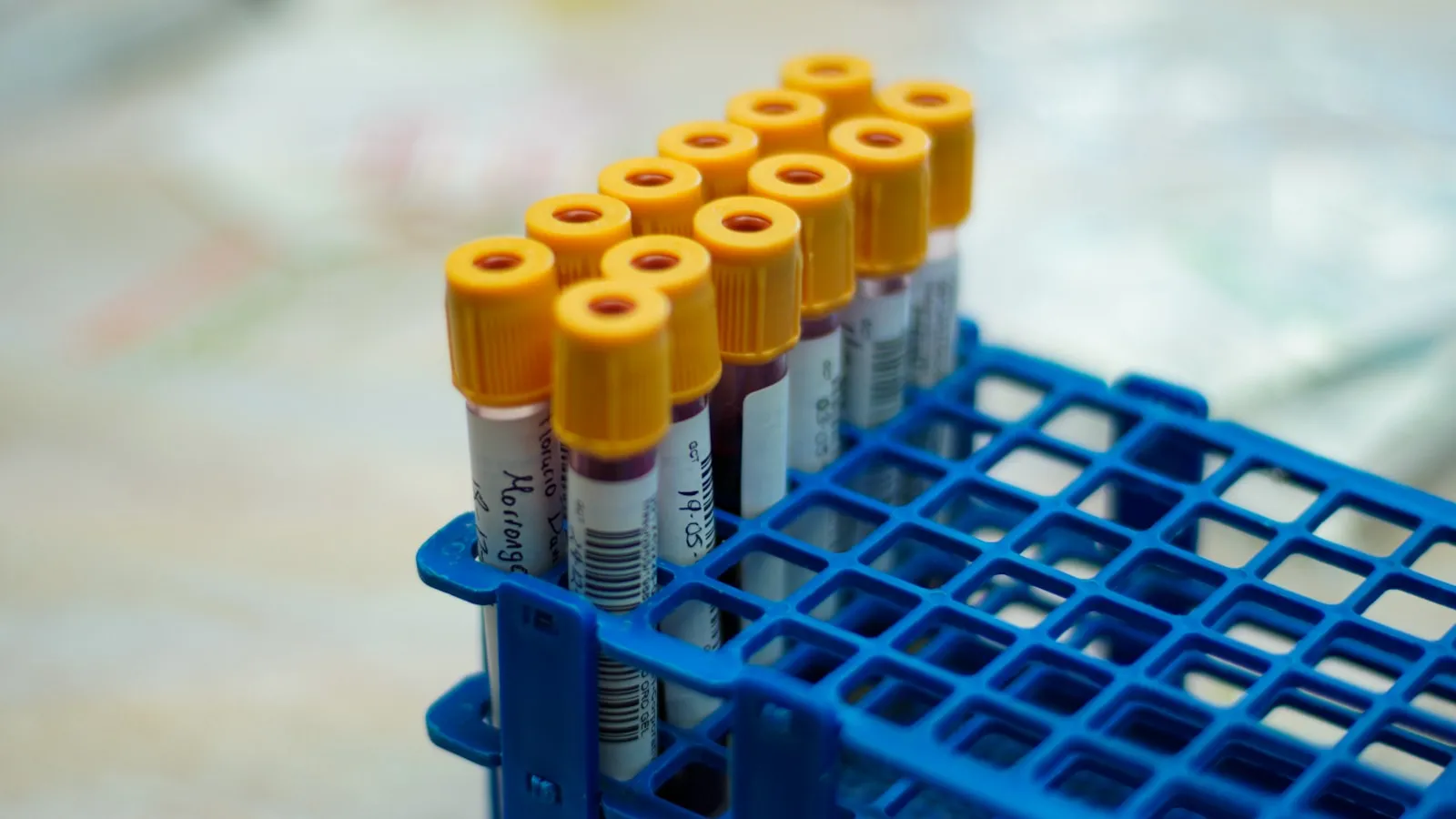
A glandular fever test comes in two flavours: a rapid test for heterophile antibodies, and EBV serology in which three specific antibodies are read together. The rapid test is quick and cheap, but misses a share of cases during the first week of illness. That timing issue is the main pitfall.
So a negative result on day three rules out very little.
I watch people act on exactly that and then spend weeks assuming it must be something else. When you draw blood decides what the result is worth here.
Which tests exist?
The heterophile antibody test, often called Monospot, looks for a general immune reaction typical of glandular fever. EBV serology looks at antibodies aimed specifically at the virus: VCA IgM, VCA IgG and EBNA-1 IgG. Alongside those, the blood count and liver values often move too.
| Test | What it shows | Main limitation |
|---|---|---|
| Rapid heterophile test | general reaction consistent with glandular fever | more often negative in week one and in young children |
| EBV serology | separates recent from past infection | only usable as a pattern, not singly |
| White cell differential | raised lymphocytes, often atypical in shape | fits many viral infections |
| Liver values | temporary rise in ALT and AST | says nothing about which pathogen |
De Paschale and Clerici set out at length where single assays fall short and why a pattern reading is needed (PMID 24175209). Klutts and colleagues turned that into a structured way of reading those patterns (PMID 19656988).
When is the best moment to test?
For the rapid test: after the first week of illness rather than inside it, because the antibodies need time to rise. For EBV serology the moment matters less, since you are reading a pattern across three antibodies. After an early negative, repeating is more useful than hunting for a different test.
That sounds dull and it prevents a lot of confusion.
Imagine a student with a sore throat since Monday, who has a rapid test on day 3 that comes back negative. Two weeks later the same test is positive, with nothing new having happened. The illness was already there; the antibodies were not.
What does a positive EBV result mean?
On its own, often little, because roughly nine in ten adults carry EBV antibodies from an earlier infection. A positive IgG mostly says you have had the virus at some point. The separation between recent and long ago lies in the combination with VCA IgM and EBNA-1 IgG.
EBNA-1 is the timestamp in that set.
Those antibodies only appear weeks to months after a first infection. If they are present, that points to something older. The full pattern overview is in Epstein-Barr virus symptoms.
Does the result change the treatment?
For most people it does not, and that is worth knowing beforehand. There is no drug against the virus itself, and Thuisarts, the Dutch GP-backed patient site, describes it as resolving on its own. The result mostly has value as an explanation and as a timestamp for your recovery.
For athletes there is a practical stake though.
With a confirmed picture, a separate pause applies to contact and collision sport in the first weeks, because of the chance of an enlarged spleen. That timeline is in how long glandular fever lasts. The sports-medicine position statements on participation after glandular fever address exactly this distinction (PMID 37186809).
And if you have been tired for months?
Then the usefulness of the test shifts. An EBV result rarely explains lasting fatigue months later, while other causes can. At that point ruling out treatable explanations is more useful than confirming a virus you already carried anyway.
So the order reverses.
Values that come into view then are ferritin, TSH, vitamin B12 and hs-CRP, bundled in the 360 health panel. What happens with lasting complaints after an infection is in post-viral syndrome, and the complete overview in blood test for fatigue.
The Dutch public health institute RIVM gives two to three months of fatigue as the ordinary course, so below that mark patience is often the right answer.
My advice: do not let an early negative rapid test end the conversation, and ask your GP whether repeating it or moving to serology adds anything here.
Every blood test result includes a professional assessment from a BIG-registered doctor. For treatment decisions, discuss your results with your GP.
References
- De Paschale M, Clerici P. Serological diagnosis of Epstein-Barr virus infection: problems and solutions. World Journal of Virology, 2012;1(1):31-43. PMID 24175209.
- Klutts JS, Ford BA, Perez NR, Gronowski AM. Evidence-based approach for interpretation of Epstein-Barr virus serological patterns. Journal of Clinical Microbiology, 2009;47(10):3204-10. PMID 19656988.
- Putukian M, O'Connor FG, Stricker P, et al. American Medical Society for Sports Medicine position statement: mononucleosis and athletic participation. Clinical Journal of Sport Medicine, 2023. PMID 37186809.
- RIVM. Glandular fever (ziekte van Pfeiffer), questions and answers.
- Thuisarts.nl. I have glandular fever (Ik heb de ziekte van Pfeiffer).
Author
Enhanced Health
Dr. Naimi, BIG-registered physician, oversees the medical standards behind our content and assessments. Read our medical policy
Related Tests
Related Posts

Post-exertional malaise: why the crash arrives 24 hours later

Long-term effects of glandular fever: what stays and what recovers