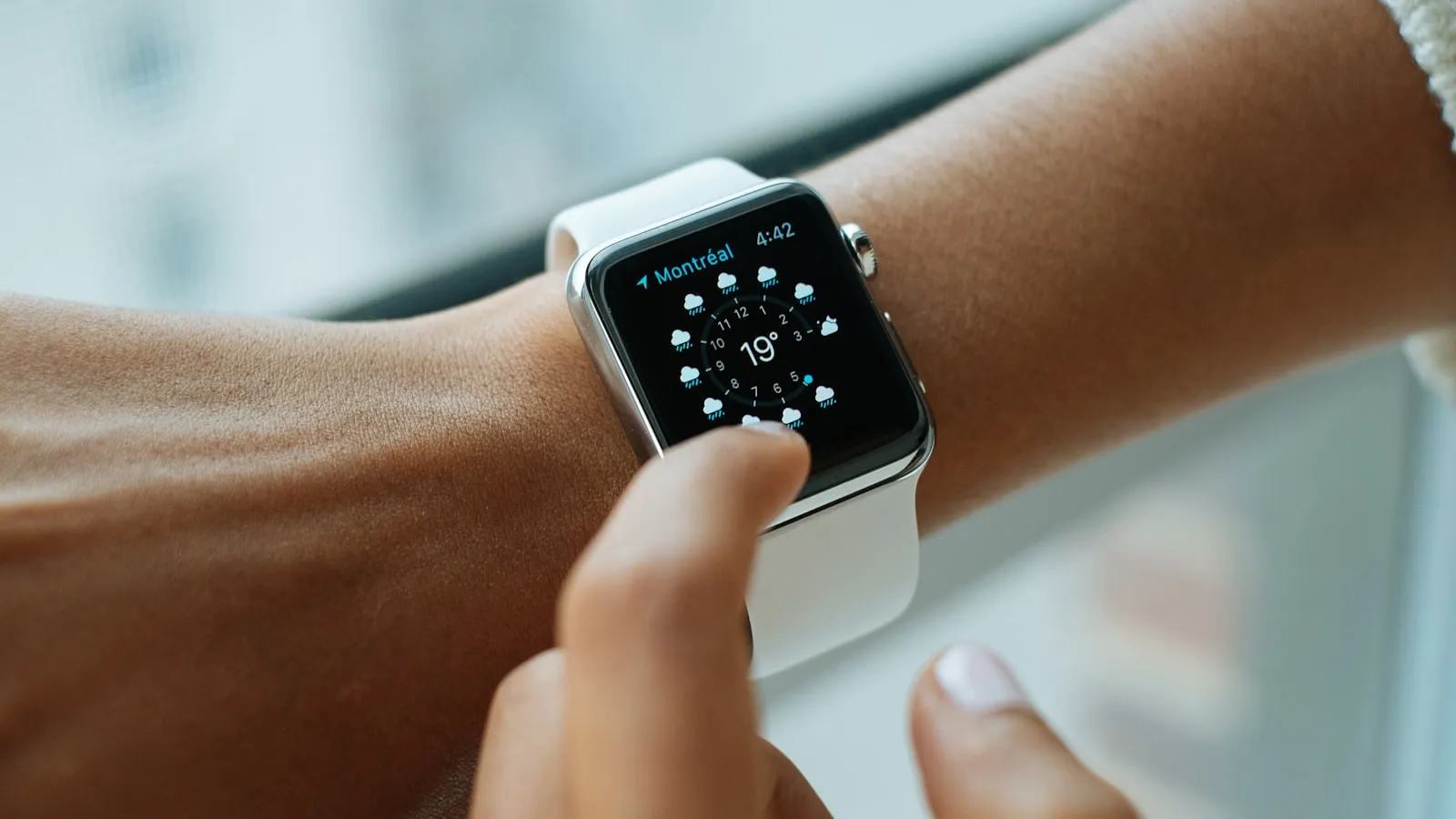
A sleep tracker does not measure sleep. It measures movement, heart rate, heart rate variability and skin temperature, then uses an algorithm to infer a sleep stage. In a comparison of seven consumer devices against polysomnography, they were good at telling whether you were asleep, weak at telling when you were awake, and inconsistent at staging (PMID 33378539).
That does not make your watch worthless. It makes it something other than it appears.
I wear one myself. I just believe the trend, not the report card.
What does a sleep tracker actually measure?
Movement through an accelerometer, heart rate and heart rate variability through an optical sensor, and on some devices your skin temperature. From that pattern the algorithm estimates whether you are asleep and in which stage. It does not look at your brain waves, while lab staging is based on exactly those.
In the Chinoy research, the devices reached a sensitivity of 0.93 or higher for detecting sleep. Specificity, which is detecting that you were lying awake, ran between 0.18 and 0.54 (PMID 33378539).
Translated: your watch is fairly sure you slept, and too often thinks you slept while you were tossing. The very nights you worry about are the nights it reads worst.
What does a blood test measure that your tracker cannot see?
Hormones and metabolic markers. Your tracker cannot measure cortisol, testosterone, glucose, hs-CRP or ferritin, and those are precisely the values that show what poor sleep does to the systems around it. The strap sees the behaviour; the blood sees the consequence.
| What you want to know | Sleep tracker (Whoop, Oura, watch) | Blood test |
|---|---|---|
| How long you slept | Reasonably reliable, sensitivity 0.93 or higher | Does not measure this |
| Whether you lay awake | Weak, specificity 0.18 to 0.54 | Does not measure this |
| Which sleep stage you were in | Inconsistent, worse during disrupted sleep | Does not measure this |
| Your resting heart rate and HRV | This is what the device is good at | Does not measure this |
| Your cortisol | Does not measure this | Yes, through cortisol |
| Your testosterone | Does not measure this | Yes, through testosterone |
| Your blood sugar regulation | Does not measure this | Yes, through fasting glucose and HbA1c |
| Low-grade inflammation | Does not measure this | Yes, through hs-CRP |
| Your iron stores | Does not measure this | Yes, through ferritin |
There is not a single row in that table where both columns say yes. That is the whole point.
They are not measuring the same thing better or worse. They are measuring different things.
When is your tracker enough?
When your question is about behaviour. If you want to know whether you go to bed too late during the week, whether your resting heart rate climbs in a heavy training week, or whether your HRV drops after a night of drinking, your watch handles that fine. Those are trends across weeks, and the device is strong enough for them.
Picture an athlete who sees his resting heart rate creep from 52 to 58 over three weeks. That is a usable signal. Whether he had 1h10 or 1h25 of deep sleep that night changes nothing about it.
Steer what you can change. You can change your bedtime; you cannot change your stage percentage.
When does a blood test add something?
When your behaviour is sorted and your recovery still lags. If you have slept seven to eight hours for weeks, you hold your rhythm, and you still feel flat in the gym, the answer is not another tracker app. Then the question is what is happening in your hormone and inflammation values.
That is where the two complement each other. Your tracker supplies the context (how you slept), your blood values supply the result (what your systems make of it).
Our Whoop blood test was built for exactly that: blood values alongside your Whoop data. If you want a broader panel with 36 markers for performance and hormones, look at InsideTracker.
What those panels show in practice is in recovery and longevity in 44 biomarkers and in performance, recovery and hormones in 36 biomarkers.
What if your tracker and your feeling disagree?
Believe your feeling, then look at the trend. If you feel rested while your watch hands you a bad score, there is probably little going on. If you have felt wrecked for weeks while your scores look fine, that says more about the limits of the device than about you.
There is even a name for people who feel worse because of their sleep score. Orthosomnia: the obsession with perfect sleep numbers that disturbs your sleep.
I have seen athletes rearrange a training day around a recovery score of 41 percent while feeling perfectly fine. That is the tail wagging the dog.
Where do you start?
Pick one thing to steer by. Point your tracker at your bedtime and your resting heart rate, ignore your stage percentages for a month, and only get blood drawn once your rhythm is in place and your recovery still disappoints.
How to build that rhythm is in better sleep for athletes. What the stage percentages mean is in sleep stages explained. And how deep sleep behaves over the years is in deep sleep.
References
- Chinoy ED, Cuellar JA, Huwa KE, et al. Performance of seven consumer sleep-tracking devices compared with polysomnography. Sleep. 2021. PMID 33378539.
- Van Cauter E, Leproult R, Plat L. Age-related changes in slow wave sleep and REM sleep and relationship with growth hormone and cortisol levels in healthy men. JAMA. 2000. PMID 10938176.
- Mah CD, Mah KE, Kezirian EJ, Dement WC. The effects of sleep extension on the athletic performance of collegiate basketball players. Sleep. 2011. PMID 21731144.
- Hersenstichting. Sleep and sleep quality. Accessed 2026.
Disclaimer
Every blood test result includes a professional assessment by a BIG-registered doctor. This article gives general information and is not a substitute for medical advice. For treatment decisions, discuss your results with your GP.
الكاتب
Enhanced Health
فحوصات ذات صلة
مقالات ذات صلة

Rest days: how many you need and why they make you stronger
Resting heart rate: what your heart rate at rest says about recovery