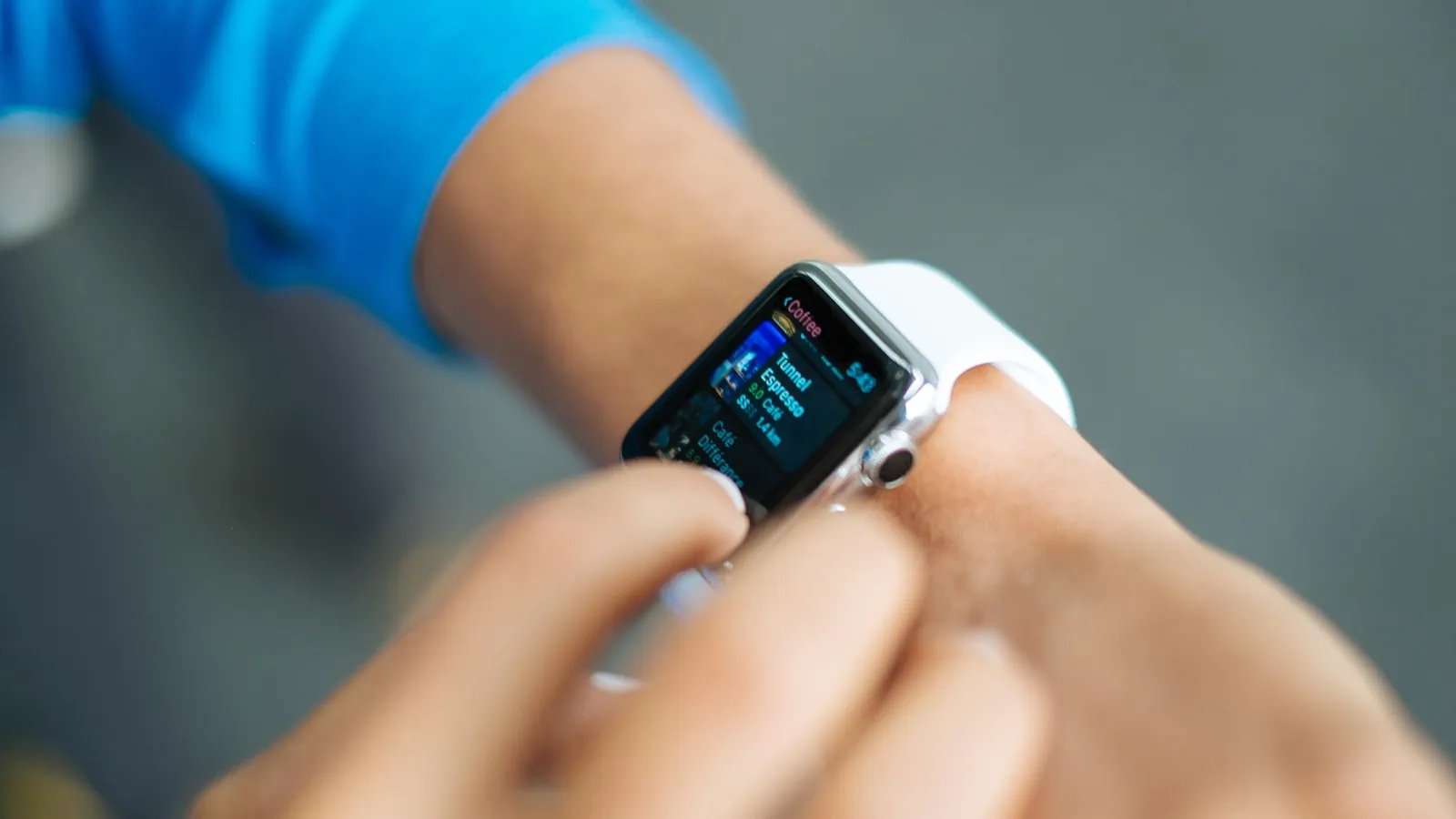
Your HRV status is not an absolute number but a comparison with yourself. Your watch measures heart rate variability during sleep, builds an average over about three weeks, and colours your status green or amber based on how your current value fits inside it.
That is why someone at 38 ms can read green while someone at 72 ms reads amber.
It confuses almost everyone the first time they look at it. I get asked why a lower number gives a better status more often than any other HRV question. The answer is that the system uses your threshold, not the average user's.
What does your HRV status actually mean?
It is a label showing whether your overnight HRV falls inside your own normal range. That range is built from readings over the past few weeks. So you need a run-in period before anything meaningful appears on your screen.
The labels differ per brand, but the logic is the same.
| Status | What it means | What you do with it |
|---|---|---|
| Balanced | Inside your own range of recent weeks | Train as planned |
| Low | Below your own range | Look at sleep, drink and load |
| High | Above your own range | Often good, sometimes a sign of overload |
| Unbalanced | Too much swing to set a range | Measure more consistently, same time and device |
| No status | Too few nights recorded so far | Keep measuring for two to three weeks |
Note the third row. A high status is usually favourable, but in heavily overloaded endurance athletes HRV can rise while performance drops. Green is not a guarantee.
How does your Garmin measure HRV?
With the optical heart rate sensor on the back of the watch, during your sleep. The device reads the light reflected through your skin and derives the time between your heartbeats from it. Daytime readings are not used for your status.
Measuring during sleep is a deliberate choice.
Overnight, your posture, breathing and activity are more or less fixed. That makes the noise smaller than in a daytime reading. The metric that comes out is a variant of RMSSD, even if your brand never uses that word (PMID 29034226).
Which metric means what sits in RMSSD or SDNN.
Why do my Garmin and my ring disagree?
Because they measure in a different place, at a different moment, and filter with their own algorithm. A watch on your wrist and a ring on your finger do not receive the same signal. Both then convert that raw signal with software no manufacturer publishes in full.
Research has worked this out properly. Six consumer devices were placed next to a reference measurement for sleep, heart rate and HRV, and agreement turned out to differ per device (PMID 36016077). An earlier review of commercial wearables found the same pattern for heart rate (PMID 32897239).
Picture two devices recording the same night and landing on 44 and 61 ms. Neither is broken. They are simply not measuring the same thing the same way.
The practical conclusion is simple. Pick one device, keep it for at least six months, and ignore your training partner's absolute number. How this relates to the published tables sits in HRV values by age.
Why is my HRV status suddenly low?
In most cases because of something from the night before. Alcohol, a late meal, a short night, a hard evening session or the start of a cold all push your overnight HRV down. That dip usually clears within a night or two.
Alcohol is the clearest item on the list.
Research in a large group of employees showed that drinking measurably disturbs autonomic regulation during the first hours of sleep (PMID 29549064). That explains the Sunday morning dip, and that dip says nothing about your training. More on it in alcohol and your blood values.
If the status stays low for several weeks while you train easy and sleep well, it is no longer noise. The triage per situation sits in low HRV score.
Should you adjust training based on HRV status?
Sometimes, but do not let your watch run your programme. A low status after a hard session is normal and no reason to scrap a training week. Three mornings low in a row while you sleep badly is a reason to move your hard session.
My own rule: the watch may shift a session, not delete it.
What a tracker does and does not see sits in more detail in sleep tracker versus blood values. If you want to know when to pull back a whole week, read deload week.
What does your watch not measure?
Everything in your blood. A sensor sees your heart rhythm, your movement and your skin temperature. It does not see your iron stores, your thyroid function or your inflammatory activity, and those are exactly the things that can explain a stubbornly low HRV.
That is the limit of every wearable.
The Dutch Hartstichting makes the same distinction clear: a consumer sensor is not a medical instrument and does not replace investigation when there is doubt. With symptoms like palpitations, dizziness or breathlessness, the next step is a conversation with your GP, not another app.
If you want your overnight data next to real values, Whoop gives you ferritin, TSH and hs-CRP in one draw. Book it in a quiet week.
Do one thing this week: check in your app how many nights your baseline currently holds. Below fourteen, your status still means little.
Every blood test result includes a professional assessment from a BIG-registered doctor. For treatment decisions, discuss your results with your GP.
References
- Miller DJ, et al. A validation of six wearable devices for estimating sleep, heart rate and heart rate variability in healthy adults. Sensors, 2022. PMID 36016077.
- Fuller D, et al. Reliability and validity of commercially available wearable devices for measuring steps, energy expenditure, and heart rate: systematic review. JMIR mHealth and uHealth, 2020. PMID 32897239.
- Pietila J, et al. Acute effect of alcohol intake on cardiovascular autonomic regulation during the first hours of sleep. JMIR Mental Health, 2018. PMID 29549064.
- Shaffer F, Ginsberg JP. An overview of heart rate variability metrics and norms. Frontiers in Public Health, 2017. PMID 29034226.
- Hartstichting. Heart rate and heart rhythm.
الكاتب
Enhanced Health
Dr. Naimi، طبيب مسجل في سجل BIG الهولندي، يشرف على المعايير الطبية لمحتوانا وتقييماتنا. اقرأ سياستنا الطبية
فحوصات ذات صلة
مقالات ذات صلة
Cardio before or after strength training? What decides the order

Overtraining symptoms: 8 signs and what else could be behind them