A high CK value is the rule rather than the exception in athletes. After a hard session your creatine kinase can climb unpleasantly fast within 24 hours, and that is usually just muscle damage that fades again. The problem is not your value. It is the reference you are comparing it against.
That reference does not apply to you.
Almost every Dutch lab report prints a range of roughly 25 to 200 U/l for men. That interval was established in people who do not train. Compare your post leg-session value against it and you will be shocked by a number that is entirely normal.
What is creatine kinase?
CK is an enzyme that manages energy in your muscle cells. If it is in your blood, it leaked there from muscle tissue. The more muscle fibres that take temporary damage, the more CK you measure. So it is a marker of muscle damage, and beyond that really nothing.
That "nothing" matters more than it sounds.
CK says nothing about the quality of your training, nothing about your muscle growth and nothing about whether you are doing well. A high value means a lot broke. Whether it broke usefully, your enzyme does not know.
The damage comes mainly from eccentric work: running downhill, lowering into a squat, a new exercise. That is the same loading that gives you muscle soreness.
What is a normal CK value for an athlete?
Higher than your lab report suggests. Research into reference intervals in athletes arrived at 82 to 1083 U/l in men and 47 to 513 U/l in women (PMID 17526622). That is an upper limit five times higher than the usual 200 U/l from the general population.
And it gets more specific.
The same research found a threefold difference between sports: in footballers the upper limit sat at 1492 U/l, in swimmers at 523 U/l. Same marker, same lab, a completely different normal. What your sport does to your muscles sets your reference.
| Group | CK reference interval | What that means |
|---|---|---|
| General population, men | Roughly 25 to 200 U/l | The range printed on your report |
| Trained athletes, men | 82 to 1083 U/l | Upper limit over five times higher |
| Trained athletes, women | 47 to 513 U/l | Structurally lower than in men |
| Footballers, men | Upper limit up to 1492 U/l | Lots of eccentric and explosive loading |
| Swimmers, men | Upper limit around 523 U/l | Little eccentric loading |
Take two men both showing a CK of 600 U/l. The swimmer sits above his sport-specific upper limit, the footballer sits well under it. Same number, different conversation.
Why is your CK high after training?
Because you trained. Physical exertion is the main cause of a raised CK, and after heavy unfamiliar loading the value can climb to a multiple of the upper limit within a day. It then falls back slowly over roughly a week.
The more unfamiliar the load, the higher the peak.
Your first squat session after a six-month break produces a far higher CK than the same session two weeks later. Your muscle adapts, and the second time far less leaks out. That effect is one of the best documented in exercise physiology.
Creatine as a supplement is often confused with this. It is a different substance from creatine kinase, despite the name.
When should you retest your CK?
After at least seven days without hard training. That is the only way to separate what came from your session and what is structural. Test earlier and you are mostly measuring your last workout, which you already knew about.
This is where most people go wrong.
They see a high CK, get a fright, and go back for another draw two days later. Usually they trained in those two days as well. The second result is then just as useless as the first, and the worry has doubled.
Rest a week, draw again, and compare. If your value stays raised after that, it becomes a question for your GP.
When is a high CK actually concerning?
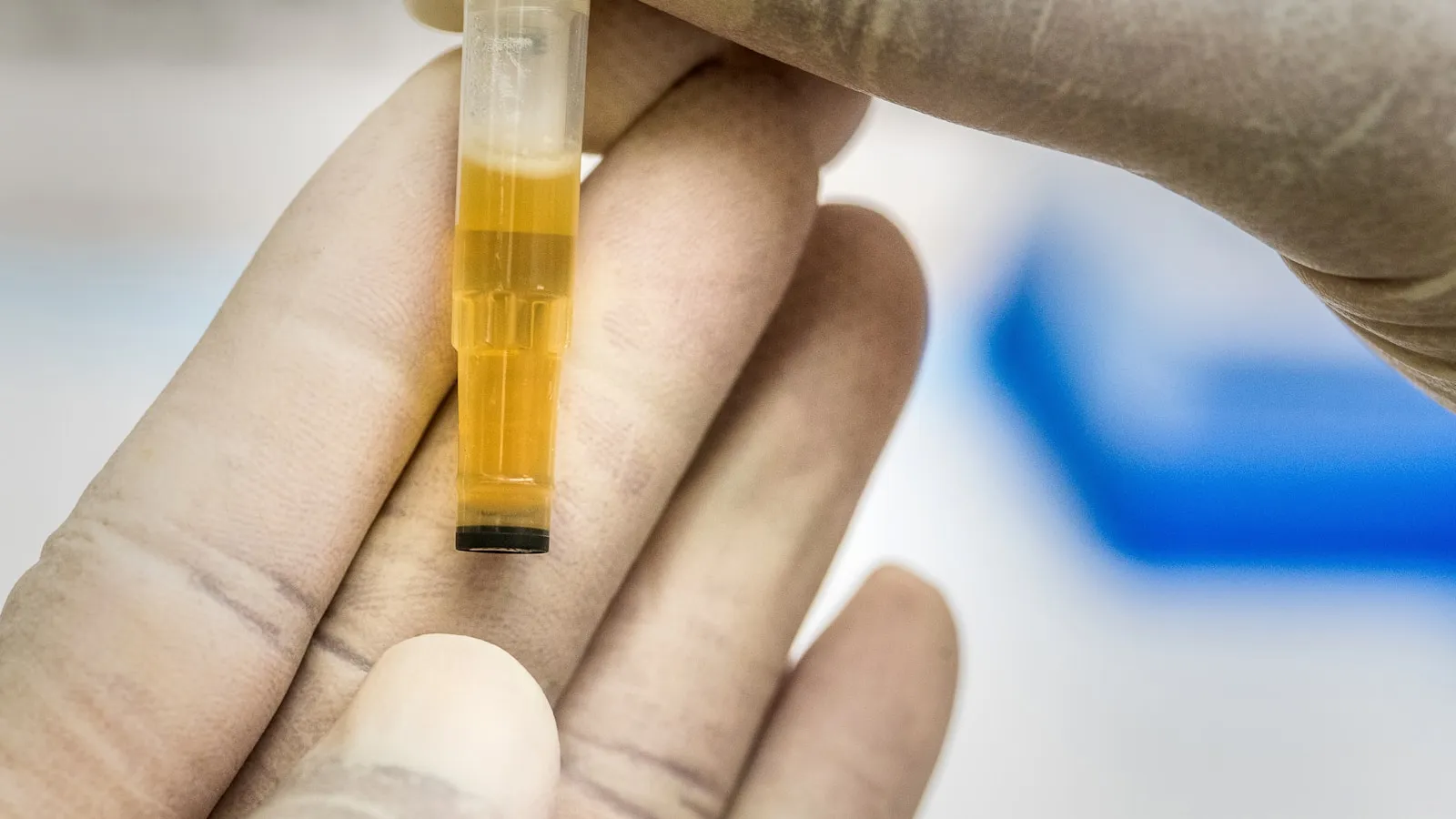
At very high values, or with symptoms that do not belong to an ordinary session. Dark or cola-coloured urine, marked swelling, pain far worse than the training justifies, or a value still high after a week of rest: those are reasons to call your GP, not to wait it out.
I do not want to be dramatic about this, because it is rare.
But it exists, and it is why you do not wave away an extremely high CK with "I just trained hard". Thuisarts describes when muscle complaints deserve further investigation. When in doubt, calling is cheaper than guessing.
What do you measure alongside it?
CK on its own is a fairly dumb number. It only becomes informative next to hs-CRP for inflammation and cortisol for your total stress load. Together they show a pattern a single value can never reveal.
The ECSS and ACSM consensus statement on overtraining is clear about this: there is no single blood value that demonstrates overtraining (PMID 23247672). It is always a pattern across weeks, alongside your performance, your sleep and your mood.
We work that pattern out in recognising overtraining through your blood values. And if you mainly want to know how to clear that damage faster, the ranking of techniques sits in faster recovery after training (PMID 29755363).
What do you do with this number?
Look at your calendar first, not at the reference range. When did you last train hard, and what did you do? In nine out of ten cases the answer to your raised CK is there, and not in the lab.
Book your next measurement after a week without a hard session, in the morning, and compare it with your previous one at the same time of day. Then you are measuring yourself, not your Monday.
A panel such as InsideTracker gives you CK alongside inflammation and hormones in one draw, which makes that comparison over time a good deal fairer.
Every blood test result includes a professional assessment from a BIG-registered doctor. For treatment decisions, discuss your results with your GP.
References
- Mougios V. Reference intervals for serum creatine kinase in athletes. British Journal of Sports Medicine, 2007. PMID 17526622.
- Meeusen R, et al. Prevention, diagnosis, and treatment of the overtraining syndrome: joint consensus statement of the European College of Sport Science and the American College of Sports Medicine. Medicine & Science in Sports & Exercise, 2013. PMID 23247672.
- Dupuy O, et al. An evidence-based approach for choosing post-exercise recovery techniques to reduce markers of muscle damage, soreness, fatigue, and inflammation: a systematic review with meta-analysis. Frontiers in Physiology, 2018. PMID 29755363.
الكاتب
Enhanced Health
Dr. Naimi، طبيب مسجل في سجل BIG الهولندي، يشرف على المعايير الطبية لمحتوانا وتقييماتنا. اقرأ سياستنا الطبية
فحوصات ذات صلة
مقالات ذات صلة
Hyrox times: what is a good finish time per level and per station?
Hyrox weights by division: one table for Open, Pro, Doubles and Relay