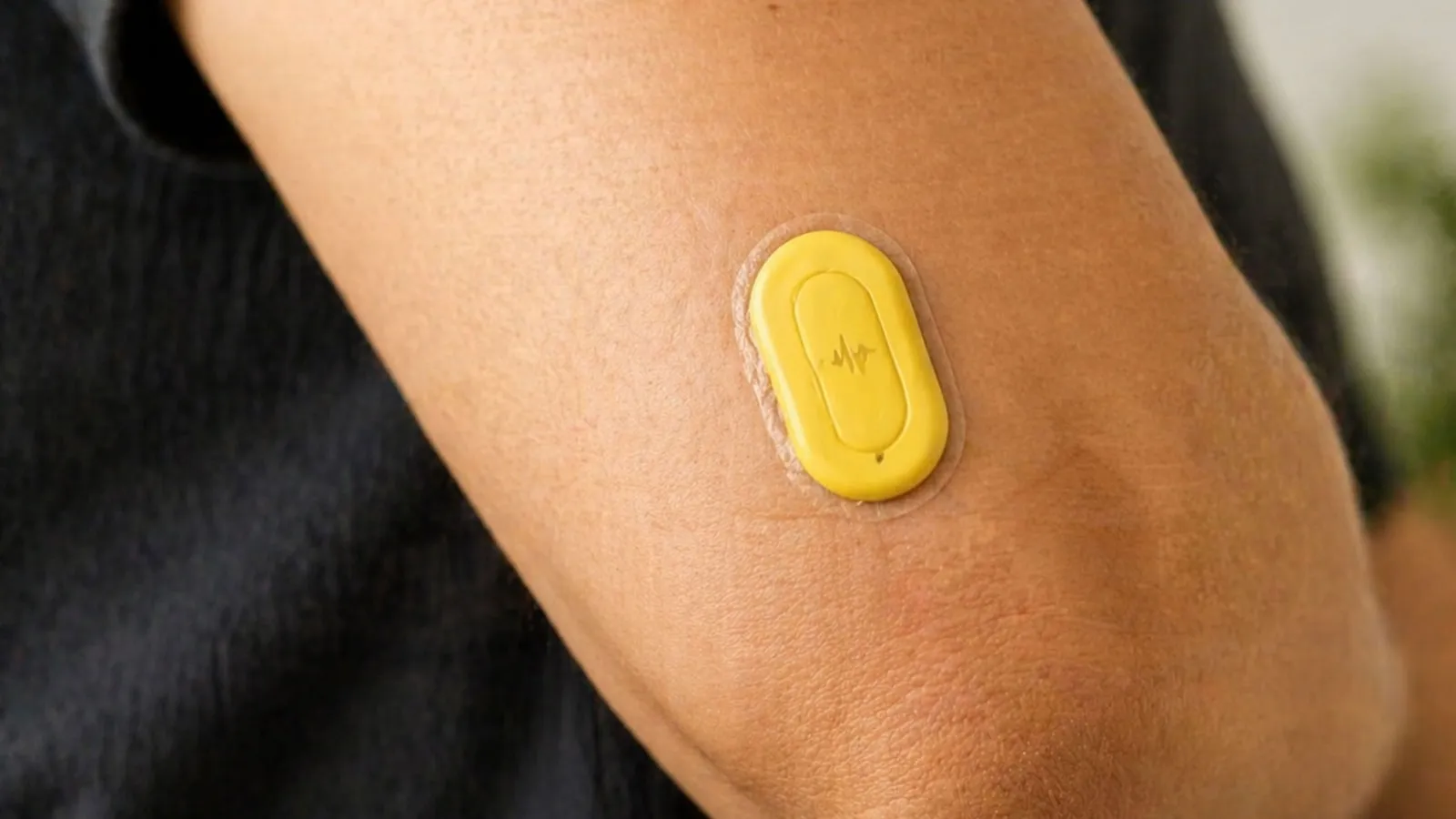
A continuous glucose monitor is a sensor on your upper arm that estimates your glucose every few minutes, for two weeks. You do not need diabetes for one, and since they went over the counter half the fitness world has stuck one on.
The question is not whether it works. It works.
The question is whether it teaches you something that changes your behaviour, and that is where it gets interesting. Because a sensor sees things your fasting draw never shows, and it is simultaneously blind to exactly the thing you train.
What does a sensor see that a blood draw does not?
The shape of your day. A fasting draw gives you one point at six in the morning. A sensor gives you 1,400 points, and in those you see how high you peak after your rice, how long you stay high, and whether you crash at three in the afternoon.
That is not an extra number. That is a different kind of information.
Stanford researchers did exactly this in people who were normal by every standard test. That group spent 15 percent of the time in the prediabetic range and 2 percent of the time in the diabetic range (PMID 30040822). Their GP had told them their blood sugar was fine, and that was true, measured the way their GP measured it.
The researchers called the patterns glucotypes: people fell into recognisable types based on how erratically their glucose moved. Two people with the same fasting value could have completely different days.
I think that is the strongest reason to consider a sensor, and it is striking how rarely it gets mentioned by the people selling them.
What can a sensor not see?
Your muscle glycogen. That is the fuel tank your entire training runs on, and your sensor has no view of it at all. It measures glucose in the fluid between your cells, which mostly reflects what your liver and your gut are releasing.
So you can have a perfectly flat line and be empty at the same time.
| What you want to know | Does your sensor see it? | Why |
|---|---|---|
| How you respond to a specific meal | Yes, well | This is what the device was built for |
| Whether you have an erratic or flat glucose pattern | Yes | Only visible across days |
| Whether you dip after eating | Yes | A prick almost always misses the moment |
| How much muscle glycogen you have left | No | Different tank, different place, not measurable |
| Whether your insulin is working too hard | No | No sensor measures insulin |
| Your exact value during a heavy session | Partly | The deviation is largest exactly then |
| Whether you are metabolically healthy | No | That is a conclusion, not a measurement |
Look at row four. The fuel your training literally runs on is not on your screen. That is not a flaw in the device, it simply measures something other than you think.
How accurate is a sensor during exercise?
Less than at rest, and that is exactly when you most want to believe it. A sensor does not measure in your blood but in the fluid between your cells, and that lags. Exercise is the fastest change your body makes, so the lag is largest then.
Your screen shows you your past, not your present.
A study tested this during two types of effort and found a mean deviation of 13.3 percent during interval training and 13.6 percent during continuous moderate effort (PMID 26739116). All readings stayed within the clinically acceptable zones, so the device is not broken. But 13 percent on 6.0 mmol/l is half a millimole, which is bigger than the differences people argue about on forums.
Practically that means: use your sensor for patterns during exercise, never for precision.
Does a sensor actually change behaviour?
Modestly, and the honest answer is that we barely know in healthy people. This is the question the sellers skip, so let us just answer it.
The evidence is thinner than the marketing.
A systematic review and meta-analysis of randomised trials looked at sensors as a behaviour change tool and found favourable but modest effects on glycaemic control in adults with and without diabetes. The key limitation sits in the study itself: only 3 of the 25 trials covered people without diabetes, and those were adults with obesity (PMID 39716288).
In other words: there is almost no research on the group buying these sensors in bulk right now. Trained, healthy people. That does not make a sensor a bad idea, but it makes any confident claim about it unsupportable.
Who is a sensor worth it for?
For anyone with a concrete question only a curve can answer. "How do I respond to my pre-workout oats" is such a question. "Am I healthy" is not, because no sensor answers that.
Question first, device second.
Picture two athletes both wearing a sensor for two weeks. The first wants to know why he always crashes at four in the afternoon and discovers his lunch gives a peak of 9.5 with a dip behind it. He adjusts his lunch and the problem is gone. The second wanted "insight" and looks at 1,400 data points after two weeks with no question. He changes nothing.
Same device, same money, and only one of the two got anything out of it. When a dip genuinely wrecks your energy sits in blood sugar dips and energy.
What do you do with the spike you see?
Do not panic immediately. A spike after eating is normal, including in healthy people, and the question is never whether you spike but how high, how long, and what you do afterwards. A peak of 8.0 that is gone within an hour looks different to the same peak hanging around for two hours.
Spike panic is the most predictable side effect of a sensor.
And if you spike right before your training, that is fuel, not a defect. Why that distinction matters sits in glucose spike after eating. If you want to know what other methods exist and what they cost you in information, look at measuring your blood sugar.
What do you measure in the lab that your sensor misses?
Insulin, and that is the value that adds the most. Your sensor shows where your glucose lands. Only insulin shows how much effort your body put into it, and that difference appears on no screen.
That is the blind spot of every wearable.
Two people with an identical flat sensor line can have completely different insulin values. For one, that flat line costs nothing. For the other, it costs twice the insulin. That second person has something to keep an eye on and his sensor will never tell him. See fasting insulin and HOMA-IR and the overview in blood sugar values when you train.
RIVM tracks how many people in the Netherlands have diabetes and how that group is growing. Useful to know, but it says nothing about you personally, and that is exactly why people reach for sensors.
What do you do next?
Write your question down before you order a sensor, in one concrete sentence with a meal or a moment in it. If you cannot write that sentence, you are about to pay 60 euros for graphs you will do nothing with.
My advice: get a lab baseline with glucose and insulin first, and only consider the sensor once you have those points. Then you measure patterns against a background instead of in a vacuum.
You get those two values together via the HOMA-IR test, or in a broader panel with InsideTracker. The individual value sits at fasting insulin.
Every blood test result includes a professional assessment from a BIG-registered doctor. For treatment decisions, discuss your results with your GP.
References
- Hall H, Perelman D, Breschi A, Limcaoco P, Kellogg R, McLaughlin T, Snyder M. Glucotypes reveal new patterns of glucose dysregulation. PLoS Biology, 2018. PMID 30040822.
- Bally L, Zueger T, Pasi N, Carlos C, Paganini D, Stettler C. Accuracy of continuous glucose monitoring during differing exercise conditions. Diabetes Research and Clinical Practice, 2016. PMID 26739116.
- Richardson KM, Jospe MR, Bohlen LC, Crawshaw J, Saleh AA, Schembre SM. The efficacy of using continuous glucose monitoring as a behaviour change tool in populations with and without diabetes: a systematic review and meta-analysis of randomised controlled trials. International Journal of Behavioral Nutrition and Physical Activity, 2024. PMID 39716288.
- RIVM. Figures on diabetes in the Netherlands.
- Diabetes Fonds. Measuring glucose with a sensor.
الكاتب
Enhanced Health
Dr. Naimi، طبيب مسجل في سجل BIG الهولندي، يشرف على المعايير الطبية لمحتوانا وتقييماتنا. اقرأ سياستنا الطبية
فحوصات ذات صلة
مقالات ذات صلة

Glucose spike after eating: when it helps your training and when it does not
High blood sugar without diabetes: what else moves your value